The Measured Line: A Tale of Blood, Concrete, and the Unyielding Earth
CHAPTER 1: THE INTRUSION
The air at the edge of the cul-de-sac carried the bitter, chemical stench of fresh diesel exhaust and curing concrete. Marcus Vance kept his truck’s engine running, his hands resting on the worn leather of the steering wheel, watching the yellow arm of a mini-excavator bite into the root system of his easternmost white oak. The engine’s rhythmic, low-frequency vibration rattled the loose change in his dashboard console. Three months in the cold, dry rooms of his late wife’s childhood home in Michigan had softened his ears to the sound of grinding gears, but the sight before him brought the familiar, hard clarity of his thirty-five years on industrial pipelines back into his spine.
He clicked the ignition off. The sudden silence inside the cab was replaced by the high-pitched, metallic beep of the machinery backing up over raw, chewed-up orange clay. When Marcus swung his legs out of the truck, his work boots sank an inch into the loose gravel of his own driveway. The landscape had been sheared flat. Where a dense, quiet barrier of native poplars and wild blackberry briars had stood three months ago, a stark, six-foot black steel security fence now sliced through the shade. Behind it, the blinding white acrylic lines of a pristine pickleball court gleamed against fresh asphalt, accompanied by towering commercial light poles that cast long, geometric shadows across his remaining lawn.
“Hey! This is a closed construction zone, sir. Pull that vehicle back out to the main road.”
A private security guard in a crisp, uncreased navy uniform stepped out from the shade of a newly erected spectator pavilion, his hand resting flat against the polymer holster at his hip. Behind him, a black luxury golf cart whirred to a halt on the freshly painted court. Harrison Drake sat behind the wheel, his silver hair perfectly parted beneath a white visor, an immaculate linen shirt tucked into tailored athletic trousers. He didn’t get out of the cart. He merely unclipped a heavy plastic blueprint folder from the dashboard and tapped it against the steering column.
Marcus walked forward, his stride measured and slow, his eyes tracking the fence line down to the dry creek bed. “You’re twelve feet over the iron pin, Harrison,” Marcus said, his voice flat, stripped of any theatrical anger.
Drake offered a thin, transactional smile that didn’t reach his sunglasses. “We pulled the county GIS satellite maps while you were away clearing out Michigan, Marcus. The township utility easement grants the Oak Ridge community association full access for recreational development. The project is fully permitted, fully bonded, and already completed. If you have an issue with the civil layout, take it up with the county land-use board after the weekend.”
Marcus stopped exactly three inches from the steel mesh of the new fence. The metal hummed faintly from the vibration of the nearby compactor. He reached into his pocket, his fingertips brushing the cold, pitted surface of the antique brass plumb bob he had carried since his first state highway job in 1984. He could see where the concrete footer for the fence had spilled over into the leaf mold of his native-tree lot, sealing the stolen earth beneath a gray, permanent crust.
“The satellite maps don’t override the physical monuments, Harrison,” Marcus said softly.
Drake’s smile vanished, replaced by the rigid, defensive posture of a man accustomed to buying silence by the square foot. He turned his face away, pulling out his smartphone with a flick of his gold-ringed thumb. “The guards have orders to clear any obstructions from the contractor’s lane. Don’t make this expensive for your retirement, old man.”
CHAPTER 2: THE PAPER TRAIL
The rusted padlock on Marcus Vance’s heavy green filing cabinet gave way with a sharp, metallic snap that echoed too loudly in the low-ceilinged basement. Outside, the steady, rhythmic thump-thump of Drake’s concrete vibrator shook the single-pane cellar window, loose dirt trickling down the foundation wall like sand through an hourglass. Marcus didn’t look up at the window. He wiped a streak of greasy orange rust from his thumb onto his denim trousers and pulled open the bottom drawer. The rollers ground against decades of grit, emitting a high-pitched protest that felt perfectly aligned with the pressure building on the surface of his lot.
He bypassed the folders labeled for the industrial pipelines, the state highway layouts from the late nineties, and the bridge abutment surveys from his years with the department. His fingers, calloused and thick-jointed from a lifetime of handling cold brass transits and steel tape measures, settled on a faded manila folder labeled Oak Ridge Subdivision – Historic Boundaries, 1989. The paper was soft, swollen with the dampness of the valley, smelling heavily of river mold and old ink.
Marcus carried the folder over to his work table, a thick slab of scarred oak lit by a single, bare sixty-watt bulb hanging from an exposed joist. He laid out his tools with geometric precision: his favorite three-pound steel engineering scale, a clean yellow legal pad, and the heavy, brass-bound plumb bob. The weight of the brass against the wood felt grounded, a silent anchor against the corporate arrogance hovering just twelve feet over his eastern line.
He opened the folder. The top document was his original warranty deed, stamped with the deep purple ink of the Douglas County Clerk. The description was unambiguous: From the stone monument marker at the convergence of Plat Creek, thence East two hundred feet… Marcus ran his finger along the crisp, typed lines. He knew the measurements by heart, but in his business, you never trusted memory when the earth was being moved against you.
Beneath the deed lay the community association’s historic drainage ledger—a document he had inherited from the subdivision’s original developer back before the valley had been subdivided into million-dollar lots with manicured lawns. As Marcus turned the yellowed pages, a single sheet of crisp, bright white bond paper tumbled out. It didn’t belong in the ledger. It was clean, unweathered, and bore the sharp, laser-printed letterhead of Westfield & Associates.
Marcus leaned closer, the shadow of his head cutting off the light as he scanned the text. It was a copy of a private infrastructure waiver, dated exactly three years ago, signed by the former president of the Oak Ridge HOA board and Harrison Drake. The language was dense, wrapped in the protective grease of corporate legalese, but the core calculation was unmistakable: the old board had granted Drake a sweeping “topographical remediation allowance” along the eastern ridge in exchange for Drake funding the community’s primary retention basin update.
Marcus let out a slow, dry breath through his nose. This was Drake’s shield. It wasn’t a county permit, and it wasn’t a legal easement change—it was a decoy secret, a internal neighborhood agreement designed to look like official authorization if anyone ever started asking questions about the cleared trees. The old board had traded away a boundary they didn’t own to save their clubhouse budget, and Drake had used it as a license to clear-cut the hillside while Marcus was hundreds of miles away tending to a dying woman’s estate.
But as Marcus studied the attached schematic, his eyes caught a tiny hand-drawn notation near the edge of the newly paved asphalt deck. The map showed a small, shaded circle labeled Marker 0-A (Status: Unverified).
Marcus stood up, his knees popping in the quiet basement. He knew exactly what Marker 0-A was. It wasn’t an HOA pin. It was the original 1954 municipal township stone monument—the absolute baseline for the entire valley grid system. If that stone was gone, or if it had been built over, Drake hadn’t just crossed a residential boundary; he had committed a major municipal violation by destroying a state-registered geodetic survey point.
Outside, the excavator engine died with a sudden, sputtering wheeze, leaving an unnatural silence hanging over the lot. Then came the slam of a car door, loud and close, right at the mouth of Marcus’s driveway. Marcus didn’t hurry. He carefully placed the infrastructure waiver inside his vest pocket, picked up his flashlight and his steel scaling rule, and began climbing the dark wooden stairs toward the kitchen. Every step groaned under his weight, a reminder of the friction that was about to land on his property threshold. Through the screen door, the glare of the July sun hit the gravel, and Marcus could see the shadow of a massive commercial flatbed truck loaded with thirty ten-foot-tall cedar saplings turning into the cul-de-sac.
CHAPTER 3: THE BLOCKADE
The screen door slapped shut behind Marcus, the sound swallowed instantly by the roaring hiss of air brakes. Out on the cul-de-sac, the massive Peterbilt flatbed idled, its chrome exhaust stack vibrating against the July sky. Heat shimmered off the blacktop, carrying the heavy, industrial scent of hot diesel and scorched brake dust, mingling sharply with the raw, earthy smell of the thirty mature cedars strapped to the trailer. Their root balls were massive, wrapped in thick burlap and heavy gauge wire, representing tons of displaced earth meant to heal a broken line.
But the truck wasn’t moving.
Harrison Drake’s customized black golf cart had shot out from the estate gates, cutting a sharp, reckless diagonal across the shared access lane. It skidded to a halt mere inches from the Peterbilt’s rear dual tires, effectively wedging the delivery vehicle between the narrow curb and the drop-off of the creek bed.
Drake stepped out. For the first time all day, he was on his feet, and the physical reality of the man matched the aggressive architecture of his property. He didn’t yell immediately. He simply stood in the blind spot of the massive trailer, adjusting the cuffs of his pristine linen shirt, radiating the absolute entitlement of a man who owned the airspace he occupied. Flanking him were two private security guards. They wore tactical navy polos stretched tight over broad shoulders, utility belts heavy with radios and pepper spray, their postures rigid with manufactured authority.
Marcus walked down the gravel drive, his boots crunching in a steady, unhurried rhythm. His right hand remained submerged in the canvas pocket of his jacket, his calloused thumb rubbing the cold, pitted brass of his antique plumb bob. He wasn’t looking at Drake. He was looking at the physics of the blockade. A twenty-ton machine immobilized by a fiberglass cart and the sheer weight of social intimidation.
“Kill the engine!” Drake barked, pointing a manicured finger up at the driver’s side window. He held a crisp, white document in his left hand—the exact infrastructure waiver Marcus had just discovered in the basement shadows. “This is a restricted community access lane. You are exceeding the structural weight limit of a remediated topographical zone. You back that rig up one more inch, and I’ll have the county impound it and fine your commercial license for reckless endangerment.”
The truck’s massive diesel engine sputtered and died. The silence that followed was heavy, broken only by the ticking of the cooling exhaust and the high-pitched hum of the cicadas in the remaining oaks.
The driver’s door swung open, and a man in a sweat-stained high-visibility vest climbed down the chrome steps. He looked at the golf cart, then at the two security guards, his shoulders slumping. “Look, buddy, I just got a delivery order. Thirty cedars for Vance. Address says this is the drop.”
“The address is irrelevant,” Drake snapped, waving the white paper. “The Oak Ridge HOA granted an infrastructure waiver for this ridge. It’s commercial-grade concrete and fresh asphalt down there. Your rig cracks my foundational work, your nursery is buying me a new tennis court. Turn it around.”
Marcus reached the edge of the asphalt. He didn’t cross the property line. He stopped exactly where his gravel met the street. “Morning, Miller,” Marcus said, his voice flat, gravelly, cutting under the shrill pitch of Drake’s demands.
The driver turned, wiping a streak of grease from his forehead. “Mr. Vance. Look, I don’t want no trouble. Dispatch didn’t say nothing about a restricted weight zone. If this guy has HOA papers, I can’t risk the rig.”
“He has a piece of paper,” Marcus said, his eyes finally shifting to Drake. “What he doesn’t have is jurisdiction. That easement is deeded to this lot, Miller. The liability is entirely mine.”
“It’s an active hazard zone, Vance!” Drake countered, stepping forward. He slapped the infrastructure waiver against the hood of his golf cart. “You think you can play cowboy with some potted plants? The board signed this ridge over to me three years ago for drainage remediation. You’re trespassing on a permitted community project.”
Marcus looked at the paper. It was a flawless bluff, designed to terrify a working man who couldn’t afford a legal battle. Drake knew the waiver wasn’t a county permit; it was a shield of private bureaucracy. But as Marcus looked down, his gaze caught something on the asphalt, just inches from the front tire of Drake’s cart.
The asphalt here was fresh, sealed with a thick coat of jet-black tar. But beneath the edge of the golf cart, the intense summer sun had begun to blister the topcoat. Bleeding through the black sealer was the unmistakable, faded neon orange of a surveyor’s marking paint. It wasn’t a standard utility line. It was a precise, perfectly intersected crosshair—an ‘X’ marking a specific coordinate. A coordinate Drake had gone to great lengths to paint over, seal, and obscure, right at the edge of the newly poured viewing deck.
Marcus felt the slow, heavy thud of his own pulse. Marker 0-A.
“I’m not eating a ten-thousand-dollar municipal fine for you, Mr. Vance,” Miller said, his voice tight with panic as one of the security guards stepped deliberately toward the truck’s cab, resting a hand on his radio. “I’m calling dispatch. I gotta take these trees back to the yard.”
“You leave this curb, Miller, and those roots dry out on the highway, I’m rejecting the shipment,” Marcus stated, entirely pragmatic. “Shut the cab door. Nobody is impounding your truck.”
“I am,” Drake smiled, a thin, razor-like expression. He nodded to the guard. “Call the local precinct. Tell them we have a commercial vehicle blocking a fire lane and a belligerent resident threatening property damage.”
The guard unclipped his radio, the static hissing loudly in the heat. It was a masterful chokehold. By the time the local police arrived, evaluated the fake HOA documents, and untangled the civil dispute, the day would be over. The trees would be gone. The momentum would be dead.
Marcus pulled his hand from his pocket, the brass plumb bob catching the sunlight. He reached for his phone with his other hand, knowing the paper trail in his basement wasn’t enough to stop men with badges and radios. He needed the absolute authority of the county, and he needed the state grid verified immediately.
But before Marcus could dial the number, the ground beneath their boots shuddered.
From behind the six-foot steel fence, the deep, guttural roar of a heavy diesel mixer drum grinding into gear shattered the standoff. Marcus’s eyes snapped past Drake’s shoulder. A massive cement truck, its chute already lowered, was backing directly toward the blistered orange ‘X’ on the asphalt. They weren’t just sealing the ground. They were preparing to pour a secondary slab, burying whatever lay beneath that marker under six feet of reinforced, unyielding concrete.
CHAPTER 4: THE SURVEY SHOWDOWN
“Get that chute locked down right now!” Marcus shouted, his hand finally ripping free from his canvas pocket to point directly at the concrete mixer’s backing tires. The high-volume drum groaned, its heavy internal flights lifting the wet, slate-gray mortar to the lip of the metal delivery trough. A line of gray sludge spilled over the lip, splashing with a heavy splat onto the blistered asphalt sealer, a mere two inches from the neon crosshairs.
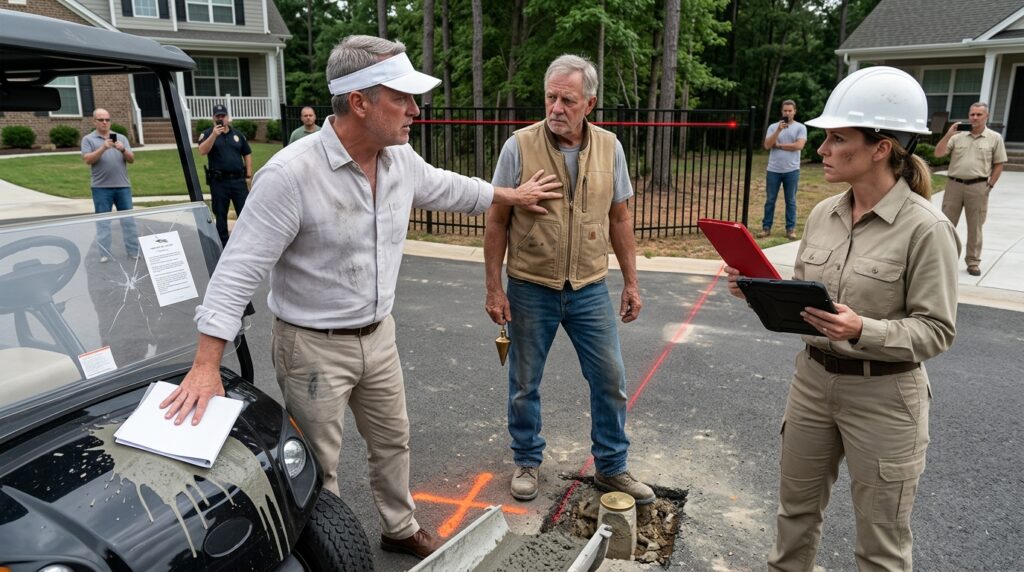
Harrison Drake took a sudden, aggressive step forward, his luxury golf cart forgotten behind him. His face was no longer composed into a neat marketing smile; the heat and the sudden intervention had pulled his mouth into a tight, white line. “Back that truck up!” he commanded the driver, his gold watch catching the fierce afternoon glare. “Vance, you don’t dictate commercial operations on an approved community drainage site. We’re pouring the load.”
“Not on this coordinate, you’re not,” a cold, sharp voice cut through the mechanical thunder.
An orange county-issued SUV swung into the cul-de-sac, its emergency flashers cutting bright yellow bars through the dust. Before the tires had even stopped crunching against the gravel, Senior Building Inspector Elena Rostova slid out of the driver’s seat. She wore a stained white hardhat over dark, swept-back hair, a heavy leather tool belt cinched over her uniform khakis, and carried a rugged, drop-tested field tablet. Behind her vehicle came a white panel van, its doors already swinging open to reveal a licensed state surveyor pulling a heavy, yellow laser-transit tripod from the back rack.
“Mr. Drake,” Rostova said, her boots hitting the blacktop with a solid, authoritative thud. She didn’t look at his linen shirt or his private guards; her eyes went straight to the cement mixer’s lowered chute. “This site is under an immediate investigative hold based on a priority utility discrepancy report filed at ten-forty-five this morning. Tell your driver to put that drum in neutral or I’m calling the county sheriff to pull his commercial registration before the pour sets.”
Drake’s arm swung out, thrusting the white leather folder toward her face. “Inspector, your office cleared this topographical remediation three months ago. The board signed the physical infrastructure waiver. We have twelve million dollars in private capital riding on the completion of this viewing deck before the regional tournament.”
Rostova didn’t take the folder. She tapped her field tablet, her thumb sweeping through a series of official digital plat layers. “The board signed a private agreement regarding neighborhood retention basins, Mr. Drake. The board does not possess the civic authority to grant an exclusion zone over a primary geodetic benchmark. Move your guards back.”
Marcus stepped over his gravel line, his boots sinking into the wet, gray overflow of concrete that had begun to pool on the edge of the asphalt. The heat radiating off the blacktop was suffocating, thick with the smell of wet lime and aggregate. He stood beside the state surveyor, who had already dropped the heavy brass plumb bob from the center of the tripod, aligning the crosshairs of the laser transit with the undisturbed concrete benchmark across the road.
“Vance is running a personal vendetta because he doesn’t want a fence near his trees,” Drake said, his voice lowering into a low, rumbling threat as he stepped directly into the surveyor’s line of sight. “We checked the GIS maps. The line is fluid along this ridge due to historic creek erosion.”
“The earth isn’t fluid, Harrison,” Marcus said, his voice flat, his fingers coated in a fine dust of gray lime as he knelt into the mud. He reached for his old three-pound steel engineering scale, using the blunt edge to scrape through the wet asphalt sealer where the neon orange crosshairs had blistered. “You didn’t check the maps to build. You checked the maps to find out when I’d be gone.”
The state surveyor adjusted his micrometer with a sharp, metallic click. “Transit is level, Inspector. Projecting the 1954 township baseline right now.”
A bright, thin beam of ruby-red laser light cut through the rising heat waves, striking the black fence line. It didn’t align with Drake’s steel posts. It ran exactly twelve feet to the west, cutting straight through the center of the newly poured spectator pavilion and the concrete foundations of the pickleball court.
“That’s impossible,” Drake said, his voice cracking slightly as the construction foreman slowly stepped back from the concrete truck, pulling off his hardhat to wipe a sheet of sweat from his forehead. The two private security guards had stopped moving altogether, their arms locked behind their backs, their eyes fixed on the bright red dot burning against the fence mesh.
“The laser doesn’t lie, Mr. Drake,” Inspector Rostova stated, her pencil scratching against her pad. “But that’s just the residential line. We’re here for the municipal anchor.”
Marcus didn’t wait for them to finish the calculation. He rammed the steel rule deep into the gray mortar soup beneath the mixer chute, his knuckles scraping against a hard, unyielding edge buried four inches beneath the fresh asphalt. It wasn’t the gravel base coat. It was smooth, chiseled granite. He wiped the sludge away with his bare palm, exposing a heavy, weathered brass cap embedded in the ancient stone, stamped with the deep, unmistakable seal of the 1954 municipal township survey.
Drake’s whole posture went rigid. The decoy secret of his HOA infrastructure waiver had collapsed into the wet dirt. He stood in the center of his expensive playground, his fake authority stripped away by a red light and a buried stone, while the neighbors on their front porches leaned over their railings, their smartphones raised to catch the exact second the developer lost the hill.
CHAPTER 5: THE COLLAPSE
The heavy iron cylinder of the state surveyor’s core drill bit ground to a teeth-rattling halt against the granite face of the 1954 township monument. A thick, milky plume of limestone dust plumed upward into the sweltering July heat, coating the wet gray slurry of the cement truck’s aborted pour like ash. Harrison Drake didn’t move. He stood completely rigid on the edge of the blacktop, hisVisor slightly askew, watching a tiny drop of sweat track through the fine gray powder that had settled across the expensive crest embroidered on his linen shirt.
“Shut down the secondary compressor,” Senior Inspector Elena Rostova ordered, her voice cutting through the high-pitched hum of the diesel rigs with the clinical precision of a bone saw. She unclipped a heavy, red-inked enforcement pad from her leather belt and pressed it flat against the hood of Drake’s black golf cart. The plastic frame cracked slightly under the force of the downward stroke. “Mr. Drake, this property line is no longer a matter of residential mediation or neighborhood association interpretation. You have willfully obstructed a municipal geodetic anchor point. That is a state-level administrative violation.”
Drake’s hands twitched at his sides, his fingers grasping at the empty air where his leather folders had been. “Inspector, my legal team has a standing motion—”
“Your legal team can argue the structural liabilities from the curb,” Rostova interrupted without looking up from her pad. She ripped the top sheet off with a sharp, violent shredding sound that made the nearby construction foreman flinch. She slapped the bright orange placard directly onto the center of the golf cart’s windshield, right over the copy of the fake infrastructure waiver. “This is a formal, non-negotiable stop-work mandate and a structure remediation directive. Every piece of steel and unpermitted aggregate extending twelve feet west of this baseline is designated a public hazard. If your crews do not begin structural extrication within forty-eight hours, the county will execute the contract at your personal expense.”
Marcus stood perfectly still beside the yellow transit tripod, his palms raw and stained black from the tar sealer he had scraped away to expose the stone. He didn’t feel a sudden surge of triumphant warmth; his chest felt hollow, heavy with the cold, pragmatic weight of an assignment finally brought to its geometric conclusion. He reached into his canvas vest pocket and pulled out his cell phone, his thumb tapping the screen to release the holding pattern on the commercial nursery flatbed at the mouth of his drive.
“Alright, Miller,” Marcus said into the receiver, his eyes remaining locked on Drake’s face. “The easement is clear. Bring the rig down.”
The massive Peterbilt engine roared back to life with a deep, guttural belch of black exhaust that drifted over the freshly painted pickleball courts. Drake turned toward his two private security guards, his mouth opening as if to give a final command to hold the boundary line, but the two men had already unhooked their arms from behind their backs. They stepped off the asphalt, their heavy utility boots crunching into the dry ditch weeds as they walked back toward the main estate gates, completely ignoring the developer’s outstretched hand.
Across the road, the watching crowd of neighbors shifted. The silence that had held the cul-de-sac for an hour broke into a low, rolling murmur of overlapping conversations. Three separate cell phones remained hoisted along the front porch of the neighboring lot, their glass lenses tracking Drake as he slowly reached into his pocket to retrieve his ringing phone—his own investment partners already reading the digital code violations filing in real-time on the county portal.
Marcus walked back onto his own gravel, his boots leaving a faint trail of gray, dusty footprints across the stone line. The foreman of the concrete crew was already hoisting himself into the cab of the mixer, throwing the drum into reverse to pull the remaining load back into the valley before it hardened into a twelve-thousand-dollar block of solid waste.
“You think this patch of brush is worth the litigation, Vance?” Drake said, his voice dropping into a dry, hoarse whisper as the shadow of the nursery truck began to block out the sun between them. “You’re an old man living in a dead lot. Nobody is going to see these trees but you.”
Marcus stopped at the threshold where his gravel met his house. He looked down at the bright red laser line still burning a thin, perfect scar through the steel links of the fence Drake would have to tear down with his own hands.
“My wife would have seen them, Harrison,” Marcus said, his voice dropping into the quiet, unyielding rhythm of the timber lot. “And that’s all the math I need.”
He didn’t wait to watch the golf cart back away. He turned his back to the courts, his fingers tightening one last time around the cold brass bob in his vest pocket as the first ten-foot cedar sapling was swung clear of the trailer, its roots sinking deep into the shade of the land he had kept unbroken.