The Weight of the Soil: A Narrative of Sovereign Land and Broken Boundaries

CHAPTER 1: THE TORN LINE

The dust hit Marcus first—a dry, alkaline cloud that tasted faintly of iron and pulverized limestone. It hung thick over the western pasture, settling into the canvas folds of his old field jacket and coating the windshield of his parked truck. He did not step away from the vehicle immediately. Instead, he stood by the driver’s side door, his boots resting on the unyielding gravel of the approach road, watching the long arm of the hydraulic excavator swing over his fence line. The bucket dropped with a heavy thud, the steel teeth dragging through the sod, exposing a jagged wound of red clay and ruptured roots.

Three meters out from the excavation site, Victoria Vance stood with her feet planted firmly in the weeds, completely unaffected by the diesel exhaust rolling from the machine’s manifold. She looked exactly like the corporate descriptions Marcus had received in his Washington briefs: an authority-faker silhouette wrapped in a crisp, high-visibility mesh vest that looked pristine enough to have been unboxed ten minutes ago. Her oversized designer sunglasses caught the sharp afternoon glare, turning her gaze into two blank, silver mirrors. In her right hand, she clutched a heavy aluminum clipboard, her thumb rhythmically clicking a gold pen against the metal edge.

Marcus walked toward the boundary line, his movement unhurried. He carried a stained ceramic mug, the coffee inside long since gone cold. With every step, the texture of the ground changed under his soles—from the compacted gravel of his own road to the loose, unstable clods of displaced topsoil pushed aside by heavy rubber tracks. He didn’t look at the workers in their bright orange shirts; he kept his eyes on the stakes. They were driven every five paces, a line of aggressive plastic markers carving a path straight toward the old timber barn.

“You’re cutting the historical line,” Marcus said. His voice was flat, matching the gray desaturation of the dry summer grass. He didn’t raise it over the rumble of the idling engine.

Victoria didn’t flinch. She turned her head slightly, her sharp bob haircut shifting in a single, rigid motion. She lowered the sunglasses just far enough to reveal the cold calculation in her eyes, her lips instantly forming a sharp, dismissive line.

“This community voted for development, Mr. Sterling,” she said, her voice carrying the transactional weight of someone who spent her life weaponizing municipal sub-clauses. “Your little patch of dirt isn’t above the collective progress of this valley. The Valley Development Coalition approved the drainage corridor three weeks ago. The timeline doesn’t pause for outdated family sentimentality.”

Marcus looked down at the deep trench. A thick, severed oak root protruded from the clay side wall, its fibers weeping sap into the dirt. A minor discrepancy caught his eye—a faint glimmer of old iron wedged deeper into the exposed bank, far below the level of the new plastic stakes. It was the top of a buried iron surveyor’s pin, ancient and rusted, completely ignored by the grading crew.

“I suggest you check the county registry,” Marcus replied quietly, his posture remaining perfectly still against the split-rail fence. “Before you let that excavator dig another inch into this topsoil.”

Victoria let out a short, dry laugh, her gold pen pointing directly at his chest. “We are well past the registry, Marcus. By Monday, this trench will be lined with concrete, and the county will have its easement. If you have an issue with the coalition’s authority, you can file an appeal at the regional office next month. Until then, stay behind the markers.”

She turned back to the machinery, waving the aluminum clipboard to signal the operator. The engine roared, a cloud of black smoke erupting into the clean sky. The bucket rose again, its shadow falling directly across Marcus’s boots.


CHAPTER 2: THE PAPER LINE

“You can take that notice off my gate, Victoria, or you can watch the wind carry it down the highway.” Marcus didn’t lower his arm. His fingers remained wrapped around the handle of his cold coffee mug, his forearm resting against the splintered top rail of the cedar post. The white boundary envelope she had jammed beneath the iron latch fluttered like a trapped moth, its crisp, heavyweight bond paper catching the grit drifting from the ditch.

Victoria Vance adjusted the strap of her leather boots, stepping back onto the strip of packed earth the excavator had left behind. The heels sank slightly into the wet clay, but she kept her chin tilted up, her silver sunglasses reflecting the wide, desaturated stretch of Marcus’s upper pasture. “It’s an official summons of non-compliance, Marcus. The Valley Development Coalition doesn’t drop warnings in the dirt. You’ve got forty-eight hours to clear the secondary access road for the aggregate trucks, or the daily assessment fines start locking against the deed.”

“The coalition doesn’t hold a charter for the western section,” Marcus said, his voice carrying the dry, rhythmic cadence of a man accustomed to reading federal land grids. He reached out with two fingers, pinched the edge of the envelope, and slid it free from the latch. The paper was stiff, over-engineered. On the back, pressed into the thick stock, was the blue ink emblem of the municipal planning board. He didn’t look down at it, but his index finger traced the raised border of the seal. Something about the texture felt wrong—the ink was too thick, the ridge of the stamp slightly offset, like an old brass plate pressed too hard into modern paper. “This acreage sat under the 1904 homestead patent before your valley subdivision was even a blueprint for timber salvage. My grandfather didn’t sign a right-of-way then, and I haven’t signed one now.”

“Your grandfather didn’t have three hundred households downstream trying to keep their basements from flooding every time the northern ridge sheds water,” Victoria countered. She stepped closer, the gold tip of her pen clicking against the aluminum clipboard with a sharp, mechanical snap. “The board held a public forum at the civic center last winter. Seventy-three percent of the registered valley residents signed off on the infrastructure map. We aren’t asking for your permission anymore, Mr. Sterling. The easement is classified as a public safety necessity. The machinery stays until the culverts are set.”

Marcus turned the envelope over in his hand. The blue seal was still wet enough to leave a faint, dark smudge across his thumb. The date stamped within the circle read October 14, 2024, but the legislative prefix code beneath it belonged to the old municipal charter—the one dissolved by the county court back in the winter of twenty-two. It was a tiny discrepancy, an institutional scar that would have gone unnoticed by anyone who hadn’t spent twenty years auditing regional land surveys for the Bureau of Land Management. The coalition wasn’t executing a public utility line. They were using an obsolete regulatory ghost to force a physical path through his fence.

“A safety necessity,” Marcus murmured, his eyes tracking past her shoulder toward the three-man grading crew. The workers were leaning against the tracks of the idling excavator, their shovels planted in the raw clay, watching the boundary line with the dull, passive interest of day laborers caught between two different bosses. “If this was a standard valley runoff channel, your engineers would have followed the creek bed through the section line half a mile south. The grade is lower there. The flow is natural.”

“The section line is restricted,” Victoria said instantly. Her response was too fast, the rhythm of her speech clipping the end of his sentence. She pulled her clipboard against her chest, her fingers shifting across the legal papers beneath the clip. “The environmental assessment flags the southern creek as a protected wetland habitat. This ridge is the only viable path that doesn’t trigger a federal review. We have the permits, Marcus. We have the engineering stamps. What you have is an empty barn and a patch of weeds you haven’t farmed in ten years.”

“The southern creek isn’t a wetland,” Marcus said softly, his thumb pressing again into the irregular ink of the forged seal. He knew every square yard of the local topography; he had drafted the federal geological survey for the entire basin during his second year as regional coordinator. The southern section was dry scrub oak and fractured limestone—completely unregulated. The only reason to avoid it was if someone needed a high, dry access road that could bear the weight of commercial construction rigs without alerting the state transport inspectors.

Victoria stepped back onto the gravel lane, her sneakers crunching aggressively against the stones. “The grading crew works from dawn until four, Mr. Sterling. If that tractor or any of your grandfather’s old machinery is within twenty feet of the trench line when the first shift starts tomorrow morning, the county deputy will be out here with a removal order. I suggest you spend your evening looking for a lawyer who understands municipal eminent domain, because this line is already drawn.”

She didn’t wait for his answer. She turned and walked toward her black SUV parked by the secondary gate, her white vest cutting a bright, artificial path through the gray dust of the road.

Marcus stood by the gate post until the rumble of her vehicle faded into the low, constant hum of the valley highway. He looked down at his thumb, at the small blue smudge of ink that shouldn’t have been there. The paper was a decoy, a carefully constructed layer of administrative weight designed to make a private overreach look like the unyielding will of the state. He slid the envelope into his jacket pocket, his hand brushing against the weathered leather gloves he hadn’t used yet. The valley thought he was an absentee owner returning to bury his past under the old trees, but as he walked back toward the dark interior of the house, his mind was already mapping the layout of the county records office three towns over.

CHAPTER 3: THE FORGED ARCHIVE

“The ledger from the winter session isn’t on the open shelf, Mr. Sterling. If it’s not in the lower cabinet, the county clerk hasn’t logged it back into the master index since the realignment.” The clerk, a thin man named Miller with ink-stained calluses and a faded denim vest, didn’t look up from his microfiche machine. The basement of the county records office smelled heavily of iron filings, damp paper, and the vinegar tang of aging acetate reels.

Marcus Sterling leaned his forearms against the scarred oak counter, the weight of his old canvas jacket grounding him against the steady hum of the building’s ventilation system. He didn’t check his watch. “The coalition filings for the northern infrastructure sector require a signed manifest from the regional municipal board. Check the charter cross-reference for the dissolved twenty-two boundaries.”

Miller paused, his fingers resting on the mechanical dial of the reader. He turned his head slowly, his eyes narrowing through his thick spectacles at Marcus’s steady, unyielding posture. “The twenty-two board was fully dissolved by judicial order, son. Nobody digs under those names anymore. It’s a dead index.”

“Someone dug it up three weeks ago,” Marcus said, his voice dropping into the quiet, flat cadence he used when auditing disputed mineral claims for the Bureau of Land Management. He reached into his pocket and slid Victoria’s over-engineered white envelope across the counter. The blue ink smudge on the corner had dried into a stiff, dark purple crust against the high-weight bond stock. “Look at the legislative prefix on the back stamp. The circle uses the old brass plate from the municipal planning division, but the date says last October.”

The clerk pulled the envelope toward himself with one crooked finger, rotating it under the low-wattage desk lamp. The yellow light caught the edges of the pressed paper, revealing the irregular, heavy indentation where the stamp had bitten too deeply into the grain. Miller’s breath caught—a tiny, dry wheeze that cut through the mechanical click of the microfiche. He slid a drawer open, pulled out a heavy metal magnifying loupe with a scratched iron rim, and held it over the blue ink.

“This isn’t a modern county alignment stamp,” Miller muttered, his thumb tracing the slightly offset rim of the seal just as Marcus had done at the pasture fence. “The lettering is the old serif block from the nineteen-eighty municipal overhaul. The county office melted those plates down when the new digital charters took over in twenty-three. Where did you get this?”

“It was pinned to my secondary gate post by Victoria Vance,” Marcus said. He leaned in closer, his sensory focus locking onto the dry, brittle smell of the old ledger boxes stacked behind the counter. “She claims seventy-three percent of the valley signed off on the infrastructure map. She says the drainage trench is a public safety necessity voted through by the active coalition board.”

Miller let out a short, bitter grunt, sliding the loupe back into his desk drawer. He stood up, his joints popping under the faded denim, and walked toward the heavy steel cage at the back of the vault where the restricted real estate transfers were locked. His keys clinked aggressively against the iron bars—a sharp, industrial rhythm that echoed down the concrete aisle. When he returned, he carried a thick, canvas-bound binder with rusted iron rivets along the spine.

“There’s a public utility easement logged for the southern route,” Miller said, dropping the heavy volume onto the oak counter with a thud that kicked up a thin cloud of gray dust. He flipped the pages back, his rough fingers stopping at a section marked with a faded red tab. “Look here. The valley coalition did vote on a drainage channel. They approved an excavation through the scrub oak creek half a mile south of your line. It’s an unregulated limestone bed. The project was fully funded and signed by the county surveyor eight months ago.”

Marcus adjusted his stance, his eyes scanning the technical text of the approved map. The official coordinates were clean, tracking perfectly through the natural drainage slope of the basin. But taped to the margin of the official record was a new, stark white addendum page—a sheet that matched the over-engineered weight of Victoria’s notice perfectly. The paragraph description claimed the southern route had been abandoned due to an unforeseen wetland classification, diverting the entire infrastructure corridor directly onto the Sterling homestead pasture.

Marcus reached out, his thumb running down the margin of the addendum sheet. At the bottom were three signatures under the heading of the Valley Development Coalition. The names were local board members, but the ink was identical to the blue, heavy-rimmed stamp on the envelope—the same depth, the same fresh, slightly thick texture that indicated a hand-turned brass stamp rather than a legal digital print. Beneath the names, a tiny detail caught Marcus’s professional eye: the corporate developer’s seal for Apex Valley Holdings was embossed into the corner of the paper, barely visible except for the faint distortion of the fibers.

“The southern creek isn’t a wetland,” Marcus said softly, his mind instantly running the cause-and-effect calculation. “Apex Valley owns the commercial lot directly adjacent to the limestone bed. If the drainage line went through the southern route, the developer would have to cede two hundred yards of highway frontage to the county for the retention basin.”

“Which means they couldn’t build their luxury subdivision gates,” Miller concluded, his voice dropping to a guarded whisper as he closed the canvas volume. “Victoria didn’t divert this water to save the valley from a flood, Sterling. She shifted the line onto your private pasture to clear the developer’s commercial zone. If that track excavator finishes the trench on your land, Apex gets the drainage infrastructure for free, and your grandfather’s homestead becomes the repository for the entire valley’s runoff.”

Marcus stood perfectly still, his hand resting on the rusted iron rivets of the ledger. The decoy secret was fully exposed in the basement vault: Victoria was hiding a corporate land grab behind the legal mask of a public safety vote. But as he looked at the identical blue ink signatures, a deeper, colder realization settled into his chest. A civilian coalition director couldn’t alter a county land ledger without internal assistance from someone who held the keys to the steel cage. The decoy covered the path, but the true corruption went deeper into the county structure itself.

“Leave the book on the counter, Miller,” Marcus said, his voice tightening with a quiet, dangerous resolve as he turned toward the exit. “Don’t log it back into the index just yet. I have a secondary gate to clear.”

CHAPTER 4: THE ACCESS BARRIER

The high-tensile steel of the gate post groaned against the frame of Marcus’s truck as he shifted into reverse. The tires spun briefly in the loose roadbed gravel, kicking up a spray of gray stones that rattled against the undercarriage. When he cut the ignition, the valley air didn’t fill with the natural hush of twilight. Instead, the low, mechanical grinding of a heavy flatbed engine idled just forty yards north, its cooling fan cutting through the dark like a blunt saw.

Marcus stepped out into the dry, swirling dust, his work boots instantly finding the edge of the access gate. It wasn’t just a notice pinned to the timber this time. Two massive, pre-cast concrete barrier segments—the standard three-ton interlocking blocks used by state highway crews—sat dead center across the secondary approach lane, completely bridging the gap between the corner cedar posts. Wrapped twice around the throat of the iron hinges was a thick, oxidized chain, secured by a heavy brass padlock.

Victoria Vance stood just beyond the concrete obstacle, her silhouette back-lit by the auxiliary floodlights of a waiting coalition utility truck. The harsh, white glare caught the crisp edges of her high-visibility vest, turning the dust particles around her into a shimmering web. She wasn’t holding her gold pen now; she had a laminated municipal enforcement order clipped to a new, larger clipboard, her fingers locked rigidly over the top margin.

“You’re outside your boundaries, Marcus,” she called out, the tone sharp, clinical, entirely stripped of the casual condescension she had carried the previous afternoon. “The coalition’s field supervisor filed an emergency access restriction with the county coordinator two hours ago. The secondary gate is officially closed to private agricultural traffic to ensure site stabilization during the drainage shift.”

Marcus didn’t touch the chain. He leaned against the concrete block, his fingers tracing the rough, abrasive aggregate texture of the industrial stone. Pinned beneath the padlock was a small, lead-sealed inventory tag. He leaned closer, his eyes catching the stamped identification number: BLM-REG-04. It was a federal surplus marker from the land management office two counties over—not a piece of municipal property, and certainly not something a local development coalition had the authority to requisition. The trap wasn’t just physical; it was an explicit administrative locking mechanism designed to isolate his home before he could return to the county seat with the ledger evidence.

“This gate services the northern well-house,” Marcus said, his voice level, flat, matching the hard iron chill of the chain beneath his hand. “If the cattle lose access to the lower trough because the pump line is blocked by three tons of unapproved highway stone, your coalition’s liability moves from a civil property dispute to a felony agricultural interference charge.”

“The water line was factored into the environmental adjustment,” Victoria said, stepping closer until her white designer sneakers touched the base of the concrete barrier. She didn’t look down at the lead federal tag. Her eyes were fixed entirely on Marcus’s jacket pocket, where the edge of the county vault envelope peeked through the fabric. “The county supervisor confirmed the temporary easement at four-fifteen. We aren’t violating your land; we’re stabilizing the public corridor. If your livestock are inconvenienced by the safety perimeter, you have the option to relocate them to the southern fields.”

“The southern fields are dry limestone,” Marcus replied, his index finger lightly pressing the lead seal of the inventory tag, noting the fresh, unweathered crimp marks on the wire. “Which you already knew when you signed the Apex addendum sheet.”

Victoria’s gold pen tapped once against the clipboard, the sound micro-tense in the graying light. “The coalition handles local development infrastructure, Mr. Sterling. Whatever corporate names you think you found in the basement archives don’t change the physical reality at this boundary line. The machinery stays. The barriers stay. By noon tomorrow, the regional investors will be on-site to verify the site clearance. I suggest you spend your night packing your records, because the county enforcement detail will be handling the final perimeter check.”

She turned sharply, her canvas vest rustling as she stepped into the passenger side of the utility truck. The heavy commercial vehicle shifted into gear, its dual wheels churning through the pasture grass as it backed toward the main road, leaving Marcus alone in the glare of the stationary floodlights.

Marcus stood by the locked iron rail, his thumb sliding over the cold brass of the padlock. The decoy secret had escalated into a total physical blockade, verified by a county supervisor’s signature that shouldn’t have been legally possible without a regional land coordinator’s sign-off. The system had failed exactly where it was supposed to protect him. He reached into his truck bed, his hands finding the heavy, oil-chilled steel handle of a rusted bolt cutter, his jaw setting as he calculated the precise timing of the investor arrival. The lines were drawn, the false authority had locked the gate, but as the high-pitched hum of the automated floodlights vibrated through the pasture fence, Marcus knew he wasn’t looking at a neighborhood dispute anymore—he was looking at an organized regional fraud that had just trapped itself inside his jurisdiction.

CHAPTER 5: THE SHOWDOWN AT THE CORNER PIN

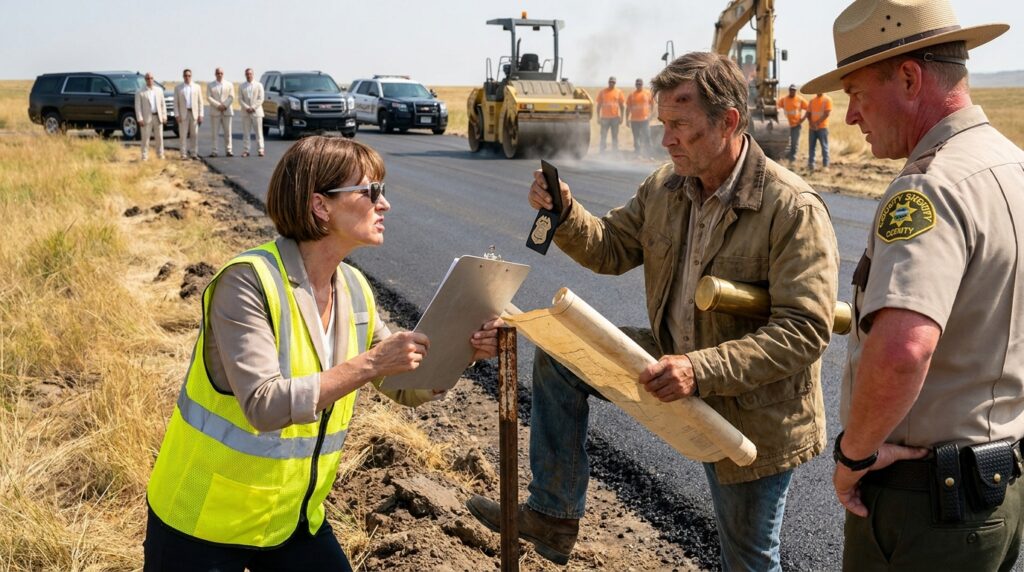
The heat coming off the western pasture was no longer just the humid weight of a summer afternoon; it was the suffocating, oily radiation of three hundred yards of fresh, unrefined black asphalt. The steaming tar rolled over the grass, its chemical stench mixing with the heavy exhaust of an idling road roller. Marcus Sterling stood directly over the ancient, rusted boundary pin he had cleared from the clay bank, his boots planted right where the black roadbed met his family’s native soil. Under his left arm, he clamped a heavy, weathered brass document cylinder, its metal surface pitted with gray corrosion and marked by the faint, stamped geometry of the federal land grid.

Victoria Vance stood ten feet away on the newly flattened surface, her white designer sneakers already stained with sticky black rings of tar. A fleet of black luxury SUVs lined the access lane behind her, their tinted windows reflecting the harsh glare of the midday sun. Surrounding her were five men in tailored linen suits—the regional investment syndicate from Apex Valley Holdings—fanning themselves with glossy development brochures that detailed a private airfield gated access network. Victoria gripped her aluminum clipboard with both hands, her gold pen pointing rigidly at Marcus’s chest as she stepped toward the unpaved gap.

“You are delaying a corporate project that has been fully certified by the county coordinator, Mr. Sterling,” Victoria barked, her voice amplified by the hard, flat echo of the machinery idling behind her. “The sheriff’s department has already logged your gate destruction from last night. Move off the line, or Deputy Wayne will execute the structural non-compliance removal right here in front of the board.”

Deputy Wayne shifted his heavy utility belt, stepping forward from the shadow of his cruiser. His face was slick with sweat under his wide-brimmed hat, his eyes darting between the thick canvas binder Victoria had provided and Marcus’s unyielding, calm posture. “Marcus, I’ve got a signed municipal easement addendum right here. The board says the southern creek is federal wetland and this channel is a public safety necessity. We can’t hold up the worksite while you contest the boundaries.”

Marcus didn’t move an inch. He slowly unthreaded the cap of the brass cylinder, the cold, metallic grind of the threads drawing the eyes of the linen-suited investors. He pulled out the heavy, linen-backed federal land patent map, letting the unrolled parchment catch the sharp midday light. “The southern creek is dry limestone, Deputy. This addendum isn’t a safety necessity. It’s a corporate easement bypass.”

Victoria’s jaw tightened, a sharp, abrupt gesture indicating the crew leader behind the roller. “The paperwork is filed and stamped, Marcus. Your grandfather’s homestead doesn’t hold an exemption from the county planning code. Operator, clear the path.”

“The county code doesn’t apply to a nineteenth-century sovereign land grant,” Marcus said, his voice dropping into the steady, flat authority that had silenced congressional subcommittees. He reached into his jacket pocket and pulled out his senior Bureau of Land Management identification badge, holding the heavy, polished gold emblem directly between Deputy Wayne and the idling machinery. “My name is Marcus Sterling. I am the regional land management coordinator for the federal department that oversees these exact coordinate grids. This isn’t a county road, Victoria. This is an absolute federal patent parcel, and your coalition addendum is an illegal trespass on a restricted government land trust.”

A heavy, absolute silence fell over the pasture, deeper and more mechanical than the rumble of the engines. The excavator operator’s hands froze on the control levers; he slid his headset down around his neck, looking toward the deputy. The investors stopped fanning themselves, their eyes locking onto the federal seal gleaming in Marcus’s hand.

Victoria tried to step over the line, her clipboard shaking against her vest. “This is a municipal development project! A single federal coordinator can’t override a seventy-three percent community vote! Our attorneys will have this property locked in litigation before you can file a brief!”

“The vote was for the southern route,” Marcus said, his finger tracking the fine, engraved lines of the master patent map. “The addendum signatures for the northern shift were forged in the records vault two weeks ago to hide the fact that Apex Valley Holdings was building a private access runway across a protected boundary line without a state environmental assessment. Deputy, check the legislative prefix on her stamped order against the regional registry manual.”

Deputy Wayne took the map from Marcus, his eyes widening as he compared the ancient, stamped coordinate anchors with the modern, irregular ink marks on Victoria’s copies. The deputy’s expression shifted from professional hesitation to absolute administrative certainty. He turned back toward the machinery, his hand resting firmly on the handle of his belt. “Operator, shut down the rollers. Everyone off the asphalt.”

Victoria lunged forward, her voice rising into a frantic, disjointed screech as the investors began to murmur angrily behind her. “You can’t do this! The project is operational! The contracts are signed!”

“The contracts are null and void,” Marcus said, his eyes locking onto hers with a cold, unyielding finality. “And your crew is currently trespassing on federal jurisdiction.”

CHAPTER 6: THE SOVEREIGN LINE RESTORED

“Keep moving those tracks backward, all the way past the culvert line,” Deputy Wayne directed, his voice dropping into a low baritone that cut clean through the cooling valley air. The heavy metal tracks of the excavator clanked in reverse, a slow, mechanical retreat that scraped a fresh path through the cooling tar.

Marcus Sterling didn’t move from the iron boundary pin. He stayed right at the edge of his property, his canvas jacket buttoned against the first light chill of the late afternoon. He watched the white designer sneakers belonging to Victoria Vance sink deep into the thick, unpaved red mud of the drainage ditch as the sheriff’s deputy escorted her toward the rear seat of the county cruiser. The aluminum clipboard she had carried like an administrative weapon sat abandoned on the hood of Marcus’s truck, its legal sheets fluttering in the rising wind, completely stripped of their false authority.

The five investors from the Apex Valley syndicate had already retreated to their vehicles, their expensive luxury SUVs reversing down the narrow access road in a frantic, uncoordinated exit. The glossy brochures detailing the private airfield had been left behind, scattered across the raw gravel like fallen leaves. The valley wasn’t entering a new era of corporate prestige; it was witnessing a complete regulatory collapse.

“This is an unconstitutional overreach,” Victoria yelled from the open door of the patrol car, her sharp bob haircut disheveled, her silver sunglasses hanging loosely from one ear. She glared at Marcus through the glass, her fingers clawing at the window frame. “The coalition board will have a federal injunction on your desk by Monday morning, Sterling! You can’t dismantle a public utility project with an outdated homestead patent!”

Marcus looked at her through the clear air, his expression remaining perfectly still, matching the gray resilience of the cedar posts. “The patent isn’t outdated, Victoria. It’s sovereign. And your coalition board doesn’t exist anymore. The county clerk logged the fraudulent addendum into the federal database twenty minutes ago. The state environmental protection division is already freezing Apex Valley’s commercial corporate assets for deliberate wetland bypass violations.”

The door of the cruiser slammed shut with a heavy, industrial latch sound that echoed across the pasture. The blue lights of the vehicle flickered against the darkening timber as the deputy pulled away, leaving the lane completely quiet for the first time in a week.

Marcus walked over to the abandoned concrete barriers blocking his secondary gate. The three hired grading crew workers were already hooking up the heavy chains to their flatbed, their movements silent, deliberate, and cooperative. They didn’t ask for his identification badge again; they had seen the federal seals on the original land map. The leader of the crew, a large man with grease-stained leather gloves, tipped the brim of his cap toward Marcus as he secured the final link.

“We’re taking the highway stone back to the district yard, Mr. Sterling,” the operator said, his voice carrying the rough, transactional pragmatism of a man who worked for whoever held the legal permit. “The coalition’s work order has been marked as invalid on our screens. Sorry about the fence line.”

“Just leave the cedar rails by the barn,” Marcus replied quietly. He didn’t check the progress of their trucks. He turned his back to the road, his boots stepping off the fresh asphalt and back onto the native blue-stem grass of his grandfather’s pasture.

The sun was dropping below the western ridge now, casting long, desaturated shadows across the valley floor. The chemical smell of the hot tar was fading, replaced by the deep, wet scent of fresh topsoil and the clean wind moving through the cornstalks. Marcus walked down to the edge of the deep trench where the excavator had stopped its work. The severed oak root was still visible in the clay bank, but the water in the ditch wasn’t rising; it was draining naturally toward the southern limestone basin, following the true topography of the land.

He crouched down, his fingers finding the rough, rusted head of the old iron boundary pin buried in the silt. It had remained unchanged through forty years of commercial expansion, a permanent anchor hidden beneath the surface of the valley. Victoria had tried to draw a line with asphalt and forged ink, but the true line belonged to the soil itself, paid for by generations of labor that couldn’t be voted away by an entitled neighborhood coalition.

Marcus stood up, dust brushing from his canvas sleeves as he looked out over the open fields. The heavy machinery was gone, the fence was going back up, and for the first time in a month, you could actually hear the wind in the trees. He turned back toward the old farmhouse, the quiet of the homestead settling around him like an earned victory.

Similar Posts

Leave a Reply

Your email address will not be published. Required fields are marked *