The Inventory Friction at Register Four and the Heavy Weight of a Final Ledger
CHAPTER 1: THE ACCRUED WEIGHT
The heavy wheels of the commercial cart rattled against the unsealed concrete of the third aisle, a low vibration that traveled up the steel frame and settled behind Arthur’s knuckles. The air smelled distinctly of cold refrigeration coolant and floor wax—the industrial perfume of a suburban market at mid-day. Around him, the noise of Saturday morning shopping was flat, muffled by the sheer volume of high-stacked pallets and the distant hum of the main compressors. Arthur didn’t look up at the glare of the high overhead lights. His gaze was anchored three inches above his own reflection on the chrome handle, his left thumb hooked through a tarnished brass key ring that had grown cold against his skin.
He picked a bunch of rosemary from the wooden crate, his fingers catching the rough, oily texture of the stems. Every movement had the dry, metric precision of a man who spent his mornings measuring flour by the gram and wood shavings by the millimeter. The leaves went into a plain canvas sack that sat beside three blocks of local cheddar. The weight was right. He knew the margin of his clock down to the single digit; the community kitchen doors would unlock at exactly four, and the iron ranges required two full hours of pre-heating before the iron would hold the steady, uniform heat Martha had always demanded for the charity roast.
“They’re holding the box at the cage, Artie,” the boy behind the specialty counter muttered, his voice dry from the draft of the nearby intake vent. He didn’t look up from his ledger. He simply reached out a hand, his skin gray under the fluorescent tube, and waited for the slip.
Arthur handed over the paper. The blue ink was faded, stamped forty-eight hours prior by the parish administrator. He watched the boy slide the key into the heavy iron lock of the mesh cage at the rear wall. When the gate swung back, it gave a dry, ungreased shriek that made a woman two lanes over stop her cart. Inside the cage sat the hammered copper set—a three-ply heavy metal container with raw brass rivets, the cardboard box thick and bound with fiber tape that smelled of old starch and dust. It was an old-stock model, heavier than the modern aluminum-core sets that flooded the front displays, built for heavy labor over open flame.
The terminal key clicks were short, sharp impacts. Arthur pulled his wallet from the internal pocket of his canvas jacket—the fabric stiff with the grease of three seasons of school workshops—and laid five twenty-dollar bills flat on the zinc counter. The paper money was dry, ironed flat by hand the night before.
“Serial number ends in nine-zero,” the clerk said, stamping the paper receipt twice with a heavy ink pad that left a purple smudge across the invoice margin. “It’s out of the system now. It’s off our ledger.”
Arthur lifted the box. The weight settled immediately into the lower discs of his spine—a solid, unyielding presence that felt real in a way the brightly colored boxes on the grocery shelves never did. He laid it flat in the bottom of his metal basket, covering the rough cardboard with the edge of his canvas sack. The metal lines of the basket groaned slightly under the load, then went silent as he turned the corner toward the main corridor.
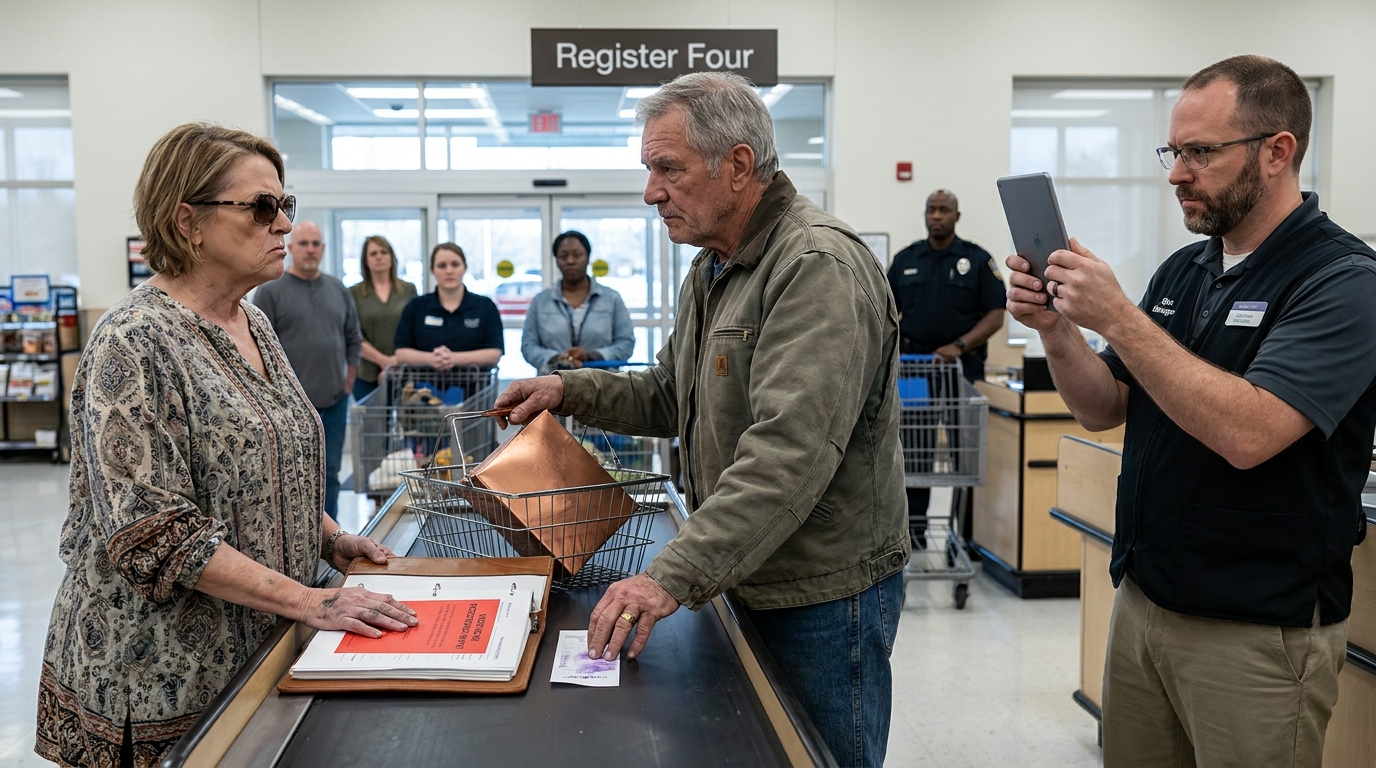
At the entrance of Lane Four, the line had ground to a complete halt. A massive cart, piled high with imported mineral water and white-boxed catering trays, sat diagonally across the narrow lane, its front wheels jammed hard against the rubber conveyor frame. Beatrice Crawford stood beside the obstruction, her frame rigid inside a loud, oversized tunic that seemed to absorb the gray light from the glass doors. Her designer sunglasses were pushed into her hair, leaving two dark marks on the bridge of her nose, and her right hand clutched a leather-bound logbook like a defensive weapon.
“That cart stays behind the line, Pendleton,” she said, her voice dropping onto the conveyor with the dull, metallic thud of a closing gate. She didn’t look at his face; her eyes were locked onto the brown cardboard corner visible beneath his canvas sack. “The registry for the valley foundation was cleared by the board this morning. That unit belongs on the club vehicle.”
Arthur stopped his cart six inches from her rear tire. He didn’t drop his hands from the handle. He felt the cold brass ring bite into his thumb as he tightened his grip, the sharp edge of the metal grounding the heat that had started to rise in his throat. The line behind him grew quiet, the sudden silence expanding outward until the checkout clerk at the register froze, a bottle of olive oil held inches above the red laser window.
“The unit is logged,” Arthur said. His voice was flat, carrying the dry rasp of dry erase dust and old pine. “It’s paid.”
Beatrice stepped forward, her sandals clicking hard against the concrete, her shadow falling directly across the rosemary leaves in his basket. She reached out, her fingers hooked like iron talons as they caught the edge of his canvas sack. “We’ll let the manager check the floor logs before you move another inch.”
Behind her, through the large glass front of the market, a silver sedan pulled into the loading zone, its hazard lights pulsing against the gray asphalt like a low, rhythmic warning.
CHAPTER 2: THE PAPER CONDUIT
“The cage stays locked until the morning transfer sheet clears, Artie,” the clerk muttered, his thumb tracing the jagged edge of a zinc counter strip that had peeled away from the particle board beneath. He didn’t look at Arthur’s face. He looked at the heavy fiber tape binding the corners of the copper saucier box, his eyes narrow beneath a low-hanging fluorescent tube that flickered with a faint, metallic click every seven seconds. The air in this rear corridor was colder than the floor, heavy with the smell of damp cardboard and the faint, acidic sting of old hydraulic fluid from the freight elevator down the hall.
Arthur didn’t pull his hands from the cart handle. The brass key ring wound around his thumb felt like a cold nail pressing into the skin, a steady reminder of the three miles remaining between this loading bay and the community kitchen ranges. “The invoice has the parish stamp,” Arthur said, his voice dropping into the narrow space between them like a heavy iron weight. “The terminal registered the transaction at 10:14. It’s out of your inventory.”
The clerk pulled a yellowed ledger toward himself, the spine cracking with the sound of dry pine breaking under a boot. He flipped through three pages of carbon receipts, his fingers stained a dark, permanent violet from the legacy ink pads used in the wholesale bay. He stopped at a line marked with a double purple star—the unique identifier for historical regional allocations. “The system says it’s out, yeah. But the physical manifest inside that box isn’t a floor slip. It’s got a cross-reference tag to the old district maintenance warehouse. The one they boarded up back in ’22.”
Arthur shifted his weight, his work boots grinding a small grain of dried salt into the concrete. He reached down, his fingers catching the rough texture of the fiber tape on the box. Through the cardboard, he could feel the solid, cool mass of the copper—not the thin, spun metal of modern retail stock, but the dense, unyielding metal of a tool built to survive thirty winters of constant scrape. “The district account was liquidated during the merger,” Arthur said quietly. “The assets were cleared for public purchase under the third clause of the county code. I signed the ledger myself.”
“Maybe you did,” the clerk said, his hand finally moving to the iron handle of the mesh gate. The metal shrieked as he pulled it back six inches, the latch catching on a rusted lip of steel. “But someone else was down here an hour ago looking for this exact serial number. Had a ledger with the country club seal on the cover. A brand new leather binder that smelled like a new car interior. She knew the item number down to the last decimal.”
The image of Beatrice Crawford’s rigid frame, her oversized designer sunglasses catching the gray fluorescent light at the entrance of Lane Four, returned to Arthur with the cold force of an open freezer door. He remembered the claw-like grip she had kept on his canvas sack, the tight, furious line of her jaw when he refused to cede the square yard of concrete his cart occupied. She hadn’t been looking for a generic registry item; she had been tracking this specific tracking code.
“She didn’t have the blue slip,” Arthur stated. It wasn’t a question.
“No,” the clerk admitted, his fingers tapping a fast, rhythmic beat against the ledger’s cardboard cover. “She had a corporate authorization draft. Signed by the valley foundation treasurer, dated for next Tuesday. She wanted me to log it as a ‘pre-clearance withdrawal’ and move it to the side dock before the weekend count. I told her the system wouldn’t drop the lock without a live cash confirmation or a certified county voucher. Five minutes later, she was up at Register Four trying to cut the line before you could reach the front glass.”
Arthur reached into the pocket of his canvas jacket, his fingers brushing past three spare washers and a piece of dry chalk until they found the printed paper receipt. He pulled it out, smoothing the margins against the zinc surface of the counter. The purple smudge from the ink pad was still damp enough to leave a faint trace on his skin. When he held it under the flickering tube, he noticed the discrepancy—the terminal had printed a secondary sequence of seven digits beneath the standard transaction code. A secondary asset tracking number that wasn’t supposed to exist on a public retail document.
“Look at the bottom line, Artie,” the clerk whispered, his hand stopping its tapping. He leaned over the counter, the iron smell of his sweat mixing with the cold draft from the floor vents. “That’s a lien-hold flag. The store didn’t buy this from the distributor. It was seized during the district audit. The foundation didn’t put it on their registry because they bought it—they put it on there because they claimed it was already their property under an old development easement.”
A low rumble from the floorboards signaled the movement of the heavy freight elevator down the corridor. Arthur looked toward the turn in the hallway, where the high-gloss floor gave way to raw, unpainted plaster. The logic of Beatrice’s anger was shifting, its clean, entitled edges blurring into something heavier, something tied to the dry, financial rot that had been quietly eating through the town’s historic core since the mills went dark.
“The easement was dissolved when the county took the road,” Arthur said, his voice tightening as he tucked the receipt back into his jacket. He lifted the box from the zinc surface, the cardboard scraping against the metal with a sharp, dry rasp. He set it back into his metal basket, settling the canvas sack over the top until the brown corners were completely hidden under the weight of the cheese blocks and rosemary. “The parish owns the kitchen now. The pot stays in the cart.”
The clerk looked at the closed ledger, then back at the iron mesh gate. He didn’t lock it again. He just let the key ring drop onto the wood with a small, flat ping. “You’d better get to the front before the evening shift manager rotates the gate logs, Artie. If Crawford’s binder has the foundation seal on it, she isn’t going to stop at the register lane. She’s already waiting by the manager’s office near the glass doors.”
Arthur turned the cart, the heavy casters screaming as they took the friction of the turn on the unsealed floor, his eyes fixed on the long, dim corridor that led back to the light of the front registers.
CHAPTER 3: THE CORRIDOR FRICTION
The transition from the cold rear corridor to the high-glare ceiling matrix of checkout Lane Four brought a sharp spike of dry air that tasted of static electricity and cheap receipt paper. Arthur pushed the cart forward, the squeal of the left caster cutting clean through the dense murmurs of the Saturday queue. The massive cart belonging to Beatrice Crawford remained wedged across the rubber lane barrier like a rusted vehicle chassis left in a creek bed. She hadn’t shifted her boots by a fraction of an inch. Her leather-bound planner was still pinned beneath her forearm, its brass corners glinting under the store lights, while her other hand remained clamped onto the wire lip of Arthur’s basket.
“You’re not clearing this register, Arthur,” Beatrice said. Her voice lacked the high, shrill pitch of a typical floor dispute; it carried the cold, transactional weight of a bank clerk denying a late withdrawal. Her sunglasses had dropped back down across her nose, hiding her eyes, but the tight, graying cords of her neck showed the true strain of her posture. “The warehouse clearance for the valley foundation was logged into the regional database before the weekend count. This unit belongs on the country club vehicle, and I have the asset ledger right here.”
Arthur kept his hand locked onto the chrome bar, letting his thumb press harder against the brass key ring until the metallic chill of it ground into the bone. He didn’t check the line behind him, though he could hear the distinct sound of two heavy grocery baskets dropping onto the floor and the rustle of cell phone cases being cleared from pockets. The clerk at the register lane stood completely immobile, his fingers hovering over the manual void key as if any sudden movement would trigger a terminal shutdown.
“The register accepted the payment,” Arthur said, keeping his voice beneath the rhythm of the overhead cooling fans. “The manifest inside this box is already signed off by the parish administrator. The district warehouse account has been closed for four seasons.”
“The district account was transferred, not closed,” Beatrice countered, her fingers tightening on the wire grid until the skin over her knuckles turned the color of dry tallow. She leaned in closer, the scent of expensive lavender soap cutting through the heavy smell of floor wax. “The valley foundation retained the easement rights under the old charter. If you think the parish can just liquidate structural assets to fund a free kitchen at the community center, you haven’t read the small print on your own tax vouchers.”
She yanked backward on the wire basket, the sharp metallic jolt traveling up Arthur’s arms and rattling the heavy blocks of cheddar against the cardboard box below. The sudden movement pulled the corner of his canvas sack away, fully exposing the thick, double-banded fiber tape and the stamped serial number ending in nine-zero.
Arthur didn’t pull back. He allowed the momentum of her pull to carry his cart forward two inches, the heavy steel frame striking the rubber bumper of her own vehicle with a solid, unyielding crunch that echoed off the front glass doors. From the corner of his eye, he saw the store security guard—a thin man named Miller with an old leather holster that smelled of dry rot—begin a slow, heavy-footed march from the service desk.
“Take your hand off the basket, Beatrice,” Arthur said quietly.
“Not until the evening manager pulls the duplicate tracking invoice,” she said, her voice dropping into a razor-thin whisper as she tapped the cover of her planner. “This isn’t an item, Pendleton. It’s a documented asset allocation. And if I have to call the sheriff’s department to lock down this register lane for an audit, I’ll ensure your kitchen doors stay chained shut through the winter.”
Arthur reached down, his fingers sliding between the cheese blocks until they touched the raw cardboard. The physical reality of the box—the rough starch of the binding tape and the dense, industrial cold of the three-ply copper beneath—felt entirely solid against the shifting, paper-thin logic of her arguments. He pulled the purple-smudged printout from his jacket pocket, unfolding the dry sheet with a slow, deliberate scrape of paper that sounded like a boot tracking across dry earth.
“The receipt has a secondary tracking sequence,” Arthur said, holding the paper flat against the dividing bar so the register clerk could see the ink impression. “The clerk in the rear bay stamped it twice. It’s not an allocation anymore. It’s a cash-cleared purchase under the third code.”
Beatrice didn’t look at the paper. Instead, her hand moved toward the inner pocket of her leather binder, her fingers searching for a document she seemed to expect would override the purple ink. But as her hand caught on the zipper, her thumb slipped, her leather binder dropping slightly to reveal a modern pink slip tucked behind her corporate sheets—an official bank overdraft notification from the county trust, stamped forty-eight hours prior with a bright red notice of immediate receivership.
Arthur’s gray eyes locked onto the red ink before she could shove the folder shut. The decoy secret of the dissolved development easement was clear—she was using the old district charter to justify the seizure—but the physical reality of the red receivership stamp revealed a far rougher truth. The valley foundation wasn’t collecting registry items for an auction. They were scrambling to secure un-audited physical property before the morning bank freeze locked their holdings completely.
The security guard stopped at the mouth of the lane, his boots squeaking on the polished concrete as he looked between the flat invoice in Arthur’s hand and the rigid, defensive line of Beatrice’s shoulders. “We’ve got a backup forming all the way to the pharmacy counter,” Miller said, his hand resting awkwardly on his belt. “Let’s move this talk into the vestibule.”
“We stay right here, Miller,” Beatrice commanded, her jaw locking as she stepped directly between Arthur’s cart and the register gate. “This cart doesn’t move an inch until the manager checks the duplicate ledger.”
CHAPTER 4: THE AUDIT LOCKDOWN
The heavy black boots of floor manager Marcus Vance stopped precisely at the juncture where the rubber conveyor belt met the stainless steel dividing rail. He did not look at the crowd backing into the seasonal endcaps, nor did he look at the cell phone lenses catching the harsh fluorescent glare from the pharmacy line. His eyes were entirely clinical, fixed on the corner of the brown cardboard box wedged beneath Arthur’s canvas sack. The air between them hummed with the electric dry heat of twenty digital registers operating at maximum capacity, carrying the smell of crushed paper bags, warm circuit boards, and the dry grease of old shopping cart axles.
“Miller, clear the corridor behind Lane Five,” Marcus said, his voice dropping into the tense pocket of air like a wrench hitting a workshop floor. He did not raise his tone, but the transactional rhythm of his command made the guard shift his weight away from Arthur’s cart. “We’re blocking the egress lane. Mr. Pendleton, keep your hands on the chrome bar. Mrs. Crawford, take your planner off the conveyor.”
Beatrice did not retreat. Instead, she adjusted the heavy strap of her binder, her knuckles whitening as she jammed the leather cover down onto the metal divider. The motion was defensive, quick, but it wasn’t fast enough to conceal the bright red receivership notice tucked into the clear plastic sleeve of her portfolio. “The ledger is clear, Marcus,” she said, her teeth clicking slightly behind her sunglasses. “The corporate authorization draft was logged by the foundation treasurer. This unit was flagged for pre-clearance withdrawal under the old valley development easement. If this man has a printout from the rear bay, it’s an invalid duplication.”
Arthur felt the cold brass of Martha’s key ring press deep into the muscle of his left thumb. The time on the big digital terminal clock above the exit doors read 11:42. The iron ranges at the community center required two full hours of pre-heating before the heavy metal plates could hold the precise, uniform thermal load needed for the charity roast. Every minute spent idling at this register was a minute stolen from the promise he had made in the dry dust of the winter cemetery.
“The invoice is cash-cleared,” Arthur said, his voice carrying the rough, unyielding grain of a rasp cutting through pine. He reached down with his right hand, smoothing the smudged purple invoice against the dividing rail. “The terminal registered the transaction at 10:14. The tracking code ends in nine-zero. The parish paid the warehouse directly.”
Marcus Vance pulled a gray digital tablet from the holster at his hip. The screen flickered with a low, green-tinted inventory log that reflected across his glasses in thin, horizontal lines. His thumb made three sharp, tapping sounds against the glass—the friction of dry skin on an unpolished screen. “The inventory log shows the nine-zero series was moved to the secondary asset cage forty-eight hours ago,” Marcus murmured, his eyes scanning the data columns. “It wasn’t flagged for the floor. It was designated as a county liquidation asset.”
“Exactly,” Beatrice said, her posture straightening as she took a half-step forward, her loud tunic rustling like dry corn husks. “It’s a corporate allocation under the charter. The store has no authority to clear it for public purchase.”
“Hold on, Mrs. Crawford,” Marcus interrupted, his thumb pausing on a specific line of the data matrix. He leaned closer to the tablet, the light from the screen illuminating the tight, critical set of his mouth. “The liquidation manifest wasn’t initiated by the county. It was generated by the regional bank trust as part of the asset collection sweep. The district easement was dissolved three months ago when the township defaulted on the road bond.”
He turned the tablet screen six inches to the left, letting the data line align with the purple smudge on Arthur’s paper receipt. The secondary tracking sequence—the seven digits Arthur had noticed under the flickering tube in the rear corridor—matched perfectly with the automatic lien-hold flag on the manager’s screen. The decoy logic Beatrice had used to claim the cookware under the old community charter was entirely gone; the physical reality of the record proved the item had already been seized by the state to cover the foundation’s unpaid liabilities.
Beatrice’s jaw tightened until the skin over her cheekbones looked like paper pulled tight over limestone. Her hand moved instinctively to cover the edge of her binder, but the movement was too late. The family standing directly behind Arthur’s cart had already shifted their basket, the father pointing his phone camera directly at the open portfolio sleeve where the red receivership stamp remained visible under the high-intensity register lights.
“The bank freeze took effect at midnight, Mrs. Crawford,” Marcus said, his tone dropping the standard customer-service veneer entirely, replacing it with the flat finality of a court officer reading an eviction notice. “This unit isn’t on your registry because it can’t be registered. The foundation doesn’t own the inventory in the valley warehouse anymore. The state cleared it for public cash auction to liquidate the district’s outstanding labor debts. That’s why the parish slip is legal.”
A heavy, static-filled murmur broke through the checkout line. The clerk at Lane Four finally lowered his arms, his fingers moving away from the void key as he looked at Beatrice with a cold, clear recognition. The crowd was no longer an uneasy audience; they were witnesses to a structural collapse, their whispers turning into a sharp, dry scratch of judgment that filled the narrow corridor between the shelves.
Beatrice didn’t drop her binder. She double-downed, her voice rising slightly as she slammed her hand against the conveyor. “The board will have a stay of execution on that freeze by Monday morning, Marcus. I am taking this box to the club vehicle now, and we will settle the variance with the parish attorneys after the weekend.”
She reached out, her fingers hooking onto the cardboard edge of the saucier box beneath Arthur’s canvas bag, her grip desperate, heavy, and frantic. Arthur did not move his boots, but his left hand tightened on the chrome bar until the wire frame of the basket groaned under the strain of the resistance beat.
CHAPTER 5: THE REMOVAL OF THE LEDGER
“Let go of the fiber tape, Mrs. Crawford,” Marcus Vance said, his voice dropping into the small space between their hands with the thin, metallic scrape of an old blade. He didn’t touch her arm. He didn’t reach across the dividing rail. He simply laid the flat edge of his gray digital tablet across her fingers, the hard plastic casing pressing down against her rings until the physical pressure forced her grip to slip from the rough cardboard box.
The air in Lane Four was completely static now. The rhythmic beeping of the neighboring scanners had dropped away as three separate operators turned their stools around to watch the center corridor. Arthur stood perfectly straight, his work boots immovable on the unsealed concrete, his left thumb still hooked into the tarnished brass ring. The metal felt warm now, heated by the steady, unhurried pulse of his own blood. He looked past Beatrice’s shoulder, his gaze fixing on the large digital terminal clock. It read 11:46. Fourteen minutes had been cut from his ledger, but the margins were still wide enough if the traffic on the lower county road held clear.
Beatrice drew her hand back slowly, her fingers curling into her palm as if she could hide the grey smudges left by the warehouse dust. She yanked her leather binder against her chest, her oversized tunic catching on the metal corner of the conveyor frame with a small, dry rip that sounded like old canvas tearing. “This isn’t an isolated procurement, Marcus,” she whispered, her lips pale against the dark plastic frames of her glasses. “The valley board will have the state injunction signed before the bank doors open on Monday. If you let this man walk out of the store with a documented structural asset, you’re exposing this franchise to a formal conversion claim.”
“The state filed the collection order forty-eight hours ago, Mrs. Crawford,” Marcus said, his finger making a single, definitive stroke across the glass screen. The horizontal green lines of the ledger system shifted, turning into a stark column of black zeroes. “The conversion claim is already void. The terminal has dropped the registration prefix completely. The nine-zero series is off our books, cleared under the parish tax voucher. The store doesn’t have a variance to settle because there is no longer a balance to track.”
He turned to the checkout clerk, his head moving in a short, precise nod. “Scan the rosemary bags. Log the cheddar blocks under the standard parish account. Void the lane code.”
The clerk’s fingers moved instantly, the keys clicking with the fast, dry impact of a typewriter. The red laser window flashed three times, throwing thin lines of crimson light across the faded canvas of Arthur’s jacket before the terminal gave a short, high-pitched chime that signaled the final balance execution.
Beatrice looked from the manager’s tablet to the small blue screen of the register terminal. The transition was absolute. Her authority, constructed from years of board logic, developmental easements, and prestige-coded registries, had been systematically reduced to a series of closed entries on a state liquidation sheet. She took a half-step backward, her sandals scraping against a ridge of dry floor grease, her frame suddenly appearing smaller under the unyielding glare of the ceiling bulbs.
Behind her, the witness layer shifted with a dry rustle of clothing and moving carts. The man who had been holding his phone camera lowered the device slightly, his expression changing from curious voyeurism to a flat, heavy indifference. The crowd didn’t shout; they simply moved around her, their wheels squeaking on the concrete as they bypasses the wedge of her cart to find open lanes. The social isolation was instantaneous, a quiet quarantine executed by regular neighborhood shoppers who knew the difference between real labor and a paper-thin performance.
“Miller,” Marcus said, his hand returning the tablet to his hip holster with a sharp click of the strap. “Clear Mrs. Crawford’s cart from the conveyor path. Move it to the customer service hold bay until the trust representative arrives to review the personal items.”
“You can’t touch the foundation records,” Beatrice said, but her voice had lost its metric rhythm. It was light, dry, drifting upward into the high steel rafters of the ceiling like dust from a dry field. She didn’t look back at the register as the guard reached for her handles. She turned sharply, her binder held like an iron shield against her ribs, and walked toward the heavy glass front doors. The hazard lights of the silver sedan outside continued to pulse against the grey asphalt, but the vehicle looked hollow now, an empty asset waiting for a bank driver to claim the keys.
Arthur didn’t watch her pass the threshold. He reached into his jacket, pulled out three clean dollar bills to cover the variance on the fresh greens, and laid them on the zinc counter next to the purple-smudged receipt. The paper money was dry, solid, real.
“You’re clear, Artie,” the register clerk said, sliding the heavy cardboard box into a plain brown paper sack that smelled of starch and clean timber. “The ledger is locked.”
Arthur lifted the sack, the weight settling firmly into his shoulders as he turned his cart toward the exit glass. The metal casters gave one last, low shriek against the concrete, then went silent as they hit the smooth rubber mat of the vestibule. Outside, the air was cold and clean, smelling of dry earth and coming rain. The clock was still running, but the promise was secure, its weight carried forward by a man who knew exactly what his work was worth.