The Iron Line: A Narrative of Single-Family Land Enforcement and Rusted Suburban Borders

CHAPTER 1: THE SCARRED EDGE

“You’re three inches over the utility margin, Vance,” the voice cut through the damp morning air before the latch on the driver’s side door could click shut.

Marcus Vance didn’t lift his head immediately. He kept his grip on the steering wheel of his work truck, letting the diesel engine rumble to a quiet halt. Through the desaturated tint of the side window, the suburban block looked like a row of identical teeth—clean, white, and sharp. The smell of cut fescue mixed with the heavy scent of unburned fuel. When he finally stepped down onto the asphalt, his boots hit the edge of the gray concrete curb with a solid, dull thud.

Brenda Vance stood precisely at the seam where his driveway met the public road. She was a stocky silhouette against the morning fog, wearing a bright pink short-sleeve top that looked garish against the desaturated gray of the early light. Her white cropped pants were immaculate, free of the mud that currently coated Marcus’s work boots. In her left hand, she held a thick plastic clipboard like a shield; her right index finger pointed directly at a fresh line of neon-green utility paint marking the turf.

“The board reviewed the layout at six this morning,” she said, her voice dry, carrying the high, nasal pitch of a person used to talking over municipal meetings. “You parked the trailer outside the allowable twelve-hour window for commercial offloading. The citation is already logged in the system.”

Marcus adjusted the brim of his faded dark baseball cap, his eyes tracking past her to the low retaining wall running along the side of his lot. The stone was scarred. Someone had taken a can of industrial aerosol paint to the masonry overnight, leaving a jagged, sloppy mark right over the boundary line. The paint was still tacky, catching the low angle of the morning sun. He didn’t check the masonry for structural damage; he looked at the ground, noticing where the turf had been freshly disturbed, the grass torn away in clumps near the spot where his metal surveyor stakes had been driven into the dirt the day before.

“The stakes are gone, Brenda,” Marcus said. His voice was flat, rhythmic, carrying the practiced restraint of a man who had spent a decade monitoring logistics lines under pressure.

“The wind carries things off out here,” Brenda replied, her lips tightening into a thin, pale line as she pushed her oversized dark sunglasses up into her short, rigid blonde hair. She didn’t look at the defaced stone wall. Her eyes were fixed on the phone clutched tightly in her other hand. “And if you place unapproved markers in the common easement zone again, the county will be the ones pulling them. We maintain visual uniformity on this street, Mr. Vance. It’s what keeps the values where they belong.”

Marcus took one step closer, his boots crunching against a small patch of gravel near the mailbox lane. He felt the familiar weight of the block’s silent observation—the subtle shift of white blinds in the kitchen window across the street, the slow rotation of a neighbor’s lawnmower halting fifty yards down the asphalt. The air smelled of iron and dry earth. He reached into his pocket, his fingers brushing the cool, metallic edge of the certified plot maps he carried. He didn’t pull them out. The conflict wasn’t about the paper; it was about the rusted pin buried six inches beneath the sod, a marker that had stayed quiet for forty years.

“The public street doesn’t belong to the board, Brenda,” he said softly.

Brenda’s posture stiffened, her heels catching the lip of the concrete as she took a half-step backward, her phone rising slightly as if to record the distance between them. Before she could answer, the distinct sound of a heavy utility door slamming shut echoed from the far end of the development, followed by the sharp, rhythmic click of iron tags on a heavy leather collar.


CHAPTER 2: THE DISCREPANCY LINE

“This is municipal business, Brenda. Stand down from the curb,” Marcus said, his voice dropping into the low, gravelly register he used when a supply line went sideways in the sandbox.

Brenda’s knuckles went white against the edge of her plastic clipboard. The bright pink fabric of her top twitched as she adjusted her posture, straining to look over Marcus’s shoulder toward the far end of the lane. A dark transport vehicle had pulled to a stop near the hydrant, its diesel engine ticking loudly as it cooled. Through the heat shimmer rising from the dry suburban asphalt, the silhouette of the K9 handler officer emerged, his tactical vest matte black against the glare, the large German Shepherd straining slightly against a thick, double-riveted leather lead.

“I am the code enforcement liaison for this entire sector, Marcus,” she spat back, though her voice lacked its earlier mechanical certainty. She took a sharp step forward, her white cropped pants catching a dusting of yellow lime residue from the edge of the lawn. “The township doesn’t authorize property inspections without three days’ written notice to the board chair. I know every easement variance from here to the highway.”

Marcus didn’t argue. He turned his back on her performance, walking slowly toward the low stone retaining wall where the fresh neon spray paint still smelled like cheap solvents. The friction of his work boots against the loose gravel felt heavy, deliberate. He knelt down in the dirt, ignoring the dry fescue that clung to his canvas trousers, and jammed his fingers into the loose soil where his first surveyor stake had been torn out. His fingernails scraped against something hard, flat, and corroded.

He dug out a handful of dry earth, revealing not the clean zinc plating of the stakes he had driven in yesterday, but a thick, rectangular iron plate bolted to a concrete footing four inches beneath the surface. It was heavily oxidized, its surface flaking off in deep orange scales that stained his palm like dried blood. Stamped into the center of the iron was a serial number prefixed by a corporate insignia that didn’t belong to the township or the county public safety division. It belonged to North-East Infrastructure Holdings—a private utility conglomerate that had supposedly failed to secure access to this development five years ago.

“You shouldn’t be digging there,” Brenda said, her voice suddenly right behind him, tight and thin. She had moved off the asphalt, her immaculate white flats sinking into the loose dirt near the mailbox line. The clipboard was pressed tight against her chest now, covering the floral emblem on her top. “That’s common ground. The association handles all sub-surface maintenance. You’re violating the landscape covenant.”

Marcus rubbed his thumb across the flaking iron plate, the grit grinding into his skin. He looked up the length of the boundary line, noticing for the first time that the row of fresh yellow utility flags driven into the neighboring lawns stopped precisely three feet before Brenda’s property line, skipping her lot entirely before resuming near the cul-de-sac. It was a clean operational gap—the kind of deliberate omission that required a signature at the county clerk’s desk.

Across the street, the click of the German Shepherd’s claws against the pavement grew louder, a steady, rhythmic march that drew the eyes of three different neighbors who had stopped washing their cars to watch. The backup officer had already unclipped a heavy leather folder from his utility belt, his steady stride matching the handler’s pace down the curb lane. The air felt thick, charged with the sudden weight of actual institutional presence.

“The covenant doesn’t cover private infrastructure lease holds, Brenda,” Marcus said, standing up and wiping his stained hands on his thighs. He looked down at her, his dark cap casting a sharp shadow over his eyes. “And the county doesn’t use green spray paint for utility margins. They use white.”

Brenda opened her mouth to speak, but her phone suddenly buzzed in her hand—a sharp, high vibrato that made her flinch. She looked down at the screen, her features tightening as she took three rapid steps back toward the safety of the concrete curb, her authority beginning to fray at the absolute edges.

CHAPTER 3: THE VAULT ARCHIVE

The damp smell of decaying paper and unvented concrete hung thick in the basement archive of the county land records office. Marcus leaned his weight against a rusted steel flat-file drawer, the metal groaning in protest as he forced it along its track. The light down here was sparse—just a single bare bulb casting long, geometric shadows across the concrete floor. His thumbs were still stained grey from the flaking iron oxide he had scraped out of his lawn, and every breath tasted faintly of limestone dust.

He didn’t need a computer; he needed the original leather-bound surveyor books from the mid-seventies, the ones that had been handled before developers started trading easements like baseball cards. His fingers traced the stiff, yellowed edges of the vellum maps until he found the primary plat map for Sector 4, Block B. The paper crinkled under the calloused pads of his hands, a dry, high-pitched scrape that was the only sound in the dead silence of the vault.

He flattened the sheet across a scarred oak drafting table. The ink was faded, brown at the borders, but the technical numbers were sharp. His eye immediately locked onto the coordinates for his own driveway easement. According to the original county layout from 1974, the boundary line was fixed by a series of subterranean brass pins driven twelve inches into the bedrock. But when he cross-referenced this map with the digital records the HOA board had uploaded three months ago, the numbers didn’t track. A three-foot corridor running the length of the curb lane had been entirely scrubbed from the public record.

A quiet click behind him broke the silence. The heavy iron door at the top of the concrete stairs had unlatched. Marcus didn’t clear the desk. He stood his ground, his arms flat against the map, his dark baseball cap angled low against the bare bulb.

A clerk in a faded county polo shirt stepped out of the shadow of the file stacks, holding a heavily notched brass key stamped with the county clerk’s seal. It wasn’t the regular counter staff. The man’s name tag read V. Miller—Special Assessments. His eyes scanned the table, noting the ancient records spread out under Marcus’s hands.

“You shouldn’t have access to the seventies logs without a written subpoena, Mr. Vance,” Miller said, his voice flat, dry, and professional. He didn’t sound angry; he sounded like a gatekeeper whose perimeter had been breached. He didn’t approach the table, keeping the heavy steel shelving unit between himself and Marcus. “Those books are flagged for historical review. The data inside them isn’t considered current under the modern township zoning ordinances.”

“The modern ordinance is built on a forgery, Miller,” Marcus said. His voice remained in that steady, unhurried register he had used when auditing missing fuel trucks in the service. He tapped the brown vellum map with a blunt finger. “Look at the seal on the 2021 revision. The board chair signed off on an infrastructure variance that legally requires a full county commission vote. It’s not an easement change. It’s a private lease assignment.”

Miller’s fingers tightened slightly around the brass key. He took a single step closer, the light catching a small, old scar across his knuckle. “The association has legal authority over the visual margins of the common property. What they do to protect neighborhood values is their jurisdiction.”

“Not when they sell the ground out from under the county,” Marcus replied. He turned the vellum map slightly so the clerk could see the bottom margin. There, hidden under an archaic utility footnote, was the physical signature of a young Brenda Vance—acting as the board’s corporate secretary twenty-five years ago—and a second signature from North-East Infrastructure Holdings. The board hadn’t been defending the neighborhood from a messy driveway trailer; they had been actively blocking any public excavation that would reveal the high-voltage transmission conduits illegally buried beneath the curb line. The green paint wasn’t a warning to Marcus; it was a layout marker for a corporate service crew scheduled to dig the following morning.

Miller looked at the map for four long seconds. His expression didn’t change, but his hand slowly dropped into his pocket, concealing the brass key. “The county safety division is already on your street, Mr. Vance. If I were you, I’d get back to that curb line before they start digging. Because once the tracking team logs the physical deviation, the board isn’t the only entity that’s going to face the fallout.”

Marcus didn’t waste time rolling up the ancient map. He memorized the coordinates, took a clean digital scan with his phone, and walked past the clerk without another word. The concrete steps felt steep, the air growing warmer as he climbed out of the basement vault and into the blinding daylight of the afternoon, the low, distant rumble of a diesel utility truck already vibrating through the soles of his boots.

CHAPTER 4: THE CURB LINE INVESTIGATION

The heat radiating from the suburban blacktop felt like an oven door left cracked. Marcus swung his truck onto the block, the tires grinding over loose grit before he killed the engine outside his lot. The quiet of the street had taken on a new, high-friction density. It wasn’t the lazy silence of a summer afternoon anymore; it was the rigid stillness of a perimeter being drawn.

Two dark county public safety cruisers sat idling near the corner hydrant, their exhaust fumes mixing with the scent of hot engine block and dry dust. Standing in the middle of the curb lane, the K9 handler officer adjusted the webbed harness of his German Shepherd. The dog was massive—black-and-tan, its alert ears pinned forward, its paws scratching a steady, testing cadence against the sun-bleached asphalt. A thick leather lead ran taut from the harness straight to the officer’s calloused palm. Beside him, the backup officer unclipped a rugged aluminum folder, his eyes scanning the manicured lawns like a field technician auditing a structural failure.

Marcus closed the truck door with a solid, metallic click that broke the quiet. He walked toward the edge of his porch, his faded cap pulled down low against the dry glare. He could see them now—the driveway bystanders. Old man Miller across the street had stopped his trimmer mid-line; two houses down, a group of residents stood motionless beside a parked SUV, their smartphones held level at their chests, capturing the slow, methodical advance of the county uniform team.

“Mr. Vance,” the backup officer said, his voice clipped and transactional as Marcus reached the edge of the grass. He didn’t offer a hand. He tapped the aluminum clipboard. “We received the report regarding malicious property damage on the designated utility easement. The tracking unit is here to document the boundary markers.”

“The original metal stakes were pulled before sunrise,” Marcus replied, his voice maintaining its flat, disciplined operational calm. He pointed with a blunt finger toward the low retaining wall, where the fresh neon spray paint sat like an ugly green scar on the stone. “The overnight crew didn’t just paint the wall. They dug into the easement footer four inches down.”

The K9 handler officer didn’t speak. He gave the lead a fractional slack, and the German Shepherd dropped its nose instantly to the dry dirt at the edge of the curb lane. The animal began a tight, sniffing sweep, its claws digging into the loose limestone gravel near the mailbox post. It moved with a practiced, rhythmic momentum, its nostrils huffing softly against the parched grass.

“The board filed a counter-injunction forty minutes ago,” the backup officer noted, his eyes tracking the dog’s movement. He turned a page on his clipboard, the stiff paper crinkling loudly in the heat. “They claim this entire corridor falls under an exclusive private landscape maintenance variance granted in 2021. According to their filed blueprints, any unapproved sub-surface marking by a resident constitutes a civil trespass.”

Marcus reached down and touched the edge of the limestone wall, his thumb rubbing the chalky residue left by the vandals. “Look closer at the revision stamp on their copy, officer. The county clerk’s archive shows the original 1974 iron pins are still active under the bedrock. The 2021 variance doesn’t exist in the historical ledger. It’s an unrecorded corporate lease hold.”

The backup officer paused, his pen hovering over the log sheet. Before he could challenge the assertion, the German Shepherd shifted its weight, its ears flattening as it let out a low, guttural huff. The dog didn’t lunge, but its body went rigid, its nose locked onto a patch of dense, overgrown privet hedge exactly three feet inside the line—right at the absolute corner where Brenda’s manicured property met the public right-of-way.

From the top of the street, the front door of the corner house flew open with a sharp bang. Brenda emerged into the blinding daylight, her bright pink short-sleeve top burning like a flare against the desaturated gray of the detached houses. Her white cropped pants caught the harsh glare as she marched down her concrete driveway, her phone clutched in one hand like a weapon and a thick stack of laminated HOA papers pressed hard against her ribs. Her face was already set in a tense, snarling performance of absolute jurisdiction.

“Officers! Hold that animal right there!” her voice shrieked across the asphalt, thin and hot. She didn’t stay on her sidewalk; she stepped straight into the road, her white flats crunching hard against the curb lane as she moved to intercept the line of march.

CHAPTER 5: THE STANDOFF AT THE CURB

“Don’t bring that dog closer, I’m standing right here!”

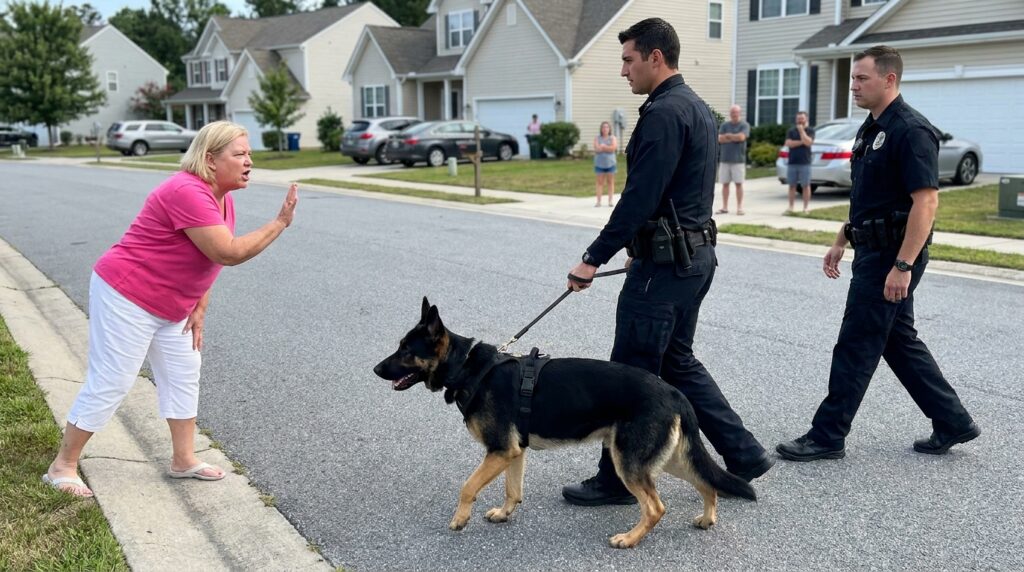
Brenda’s voice cut across the hot, heavy air of the suburban lane like a rusty blade sliding over sheet metal. She stepped off the concrete curb directly into the edge of the pass-by lane, her stocky frame locking into a confrontational stance. The bright pink short-sleeve top she wore caught the blinding glare of the afternoon sun, an aggressive splash of color against the dry, desaturated gray of the single-family homes behind her. In her right hand, she thrust a rigid stop-hand directly toward the advancing public safety team, her mouth twisted into a tense, aggressive snarl. The stack of laminated HOA documents under her arm crinkled as her chest heaved.

Marcus stayed at the shoulder of the road, his faded dark cap pulled down low, watching the operational lines intersect. He knew the math of the street. Emboldened by months of unchallenged policing, Brenda wasn’t just attempting to stop a dog; she was trying to defend a perimeter that was rapidly shrinking down to her own front yard.

The K9 handler officer did not stop. He didn’t slow his pace, shift his shoulders, or alter the steady, rhythmic fall of his heavy tactical boots against the sunlit asphalt. His face remained a mask of absolute institutional indifference, his eyes locked dead down the center of the lane, completely icing her out. The backup officer marched in perfect, silent alignment beside him, his expression equally blank, his arms resting naturally near his utility belt. Between them, the large black-and-tan German Shepherd kept its head low and focused, its pads scratching a steady cadence on the pavement as it moved forward under total control. The single black lead remained a taut, unbroken line from the handler’s hand to the heavy working harness.

“This is a private development under corporate covenant review!” Brenda shouted louder, her body trembling slightly as the distance between her extended palm and the dog’s snout shrank to less than three feet. Her white cropped pants caught the dust kicked up by the patrol stride. “You have no authorization to cross this curb line without a board escort! I am ordering you to turn back to the main road!”

The team swept straight past her.

The German Shepherd moved through the space she occupied without a single bark, lunge, or sideways glance, its flank brushing the dry grass right at the edge of her white flats. The handler officer passed so close his utility belt cleared her rigid arm by inches, the low, mechanical click of his gear the only response to her command. They treated her not as an authority figure, not even as an adversary, but as a completely irrelevant physical obstruction in the right-of-way.

The shift in the neighborhood gallery was instantaneous and absolute. Across the street, old man Miller’s trimmer died completely, the sudden mechanical silence dropping over the block like a heavy weight. The lawnmower farther down the road went idle. Along the driveways, the silent clusters of neighbors slowly lowered their smartphones, their faces freezing as they watched the self-appointed dictator of the block left standing isolated in the middle of the road, her stop-hand hanging uselessly in the hot air.

Marcus watched the flush of deep, humiliated frustration creep up Brenda’s neck, turning her skin the color of her bright top. Her mouth remained open, but the mechanical certainty had vanished from her eyes. As the distance between her and the officers opened, her raised hand slowly, awkwardly began to lower, her shoulders slumping as the performance of absolute jurisdiction shattered in front of the community she had spent decades intimidating.

The officers kept their forward momentum, their footsteps rhythmic and unbroken as they moved past her towards the corner of the lot. But as Marcus stepped out to follow the line of the march, his boot struck something metallic buried deep in the grass right at the curb’s concrete seam—a second, altered utility blueprint folder, half-scorched and stuffed into a rusted drainage pipe. Before he could reach down to pull the document from the silt, the German Shepherd gave a sudden, sharp huff and went completely rigid, its nose pinning itself directly to the base of Brenda’s private privet hedge.

CHAPTER 6: THE IRON BOUNDARY

The German Shepherd went completely rigid, its front paws digging hard into the mulch at the base of Brenda’s privet hedge. A low, vibrating whine caught in the animal’s throat—not an aggressive challenge, but the definitive operational alert of a working dog tracking a buried disturbance.

Marcus stepped forward, his boots sinking into the loose, damp loam. The thick, plastic folder he had pulled from the drainage tile crinkled under his arm, its edges caked with dried mud. He didn’t wait for the officers to authorize the clearance. Reaching down, his hands tore past the tangled woody stems of the hedge, the rough bark scraping across his knuckles as he hauled back a thick layer of decorative limestone rocks.

“Mr. Vance, stay clear of the tracking zone,” the handler officer said, though he didn’t adjust his grip on the lead. He held the German Shepherd steady, his boots planted firmly on the edge of the asphalt.

Marcus ignored the warning, his fingers sinking deeper into the dirt until they struck something cold, square, and unyielding. With a heavy, upward heave that sent dry earth flying across the pristine white of Brenda’s cropped pants, he dragged the object out into the harsh daylight. It wasn’t just a survey stake. It was the complete bundle of Marcus’s missing zinc-plated property markers, bound together with heavy-gauge copper wire and wrapped in a copy of the unrecorded corporate infrastructure lease he had unearthed in the basement vault.

“The markers didn’t blow away, Brenda,” Marcus said, his voice flat and level as he dropped the heavy metal bundle onto the sunlit asphalt. The iron weights hit the pavement with a loud, metallic clang that vibrated through the quiet street.

Brenda stood entirely motionless on the shoulder, her smartphone drooping toward the ground, her face completely drained of its rehearsed fury. The laminated HOA papers under her arm slipped, scattering across the gravel like dead leaves. She looked at the bundle, then at the silent gallery of neighbors watching from their driveways. Her lips twitched, but no sound came out; the performance of absolute neighborhood authority had collapsed entirely under the weight of physical recovery.

The backup officer stepped into the dirt, his heavy tactical boots crunching over the remaining limestone rocks. He reached into his belt, pulling out a solid steel probing rod. He drove the tip straight down into the exact hole the dog had indicated, searching for the structural baseline. Three inches down, the rod struck something with a dull, heavy tink that sounded completely different from the loose stone.

“We have a primary marker contact,” the backup officer noted, kneeling down and using a small hand trowel to clear the remaining soil.

Time seemed to slow as the earth was scraped away, every movement heavy and deliberate. Marcus watched the rust-colored crust of a massive, ancient iron pin emerge from the ground. It wasn’t the shallow zinc stake Marcus had driven yesterday, nor was it the modern corporate footer. It was the original 1974 primary county surveyor pin—a thick, flaking spike driven directly into the bedrock before the subdivision had ever been named.

The backup officer cleared the lime residue from the top of the pin, revealing a deeply stamped numeric grid coordinate. He cross-referenced the numbers with the certified historical vellum map on Marcus’s phone screen, his pen tracking the old infrastructure lines.

“The original grid pins are active,” the officer said, standing up and dusting the gritty soil from his trousers. His eyes locked onto Brenda, then turned slowly toward Marcus, his expression completely devoid of neighborhood sentiment. “According to the 1974 county baseline, the primary utility easement doesn’t stop at the curb lane. The true county right-of-way extends exactly twelve feet inward from the asphalt seam.”

A heavy, absolute silence settled over the lot. Marcus stood perfectly still, his hand resting on the brim of his cap as the structural logic of the revelation settled into his mind. The line didn’t just strip Brenda of her jurisdiction over the street margins; it cut directly through the middle of his own retaining wall and took three feet of his own paved driveway. The true iron line stripped both sides of the property they had been fighting to control, leaving the entire dispute completely irrelevant under the grander authority of the county grid.

“Everyone saw it,” Marcus said softly, his eyes tracking from the flaking iron pin back to the stunned, silent neighbors. “The board doesn’t own the ground. Neither do we.”

The backup officer began clipping a series of formal county citations into his folder—tampering with public safety evidence, criminal mischief, and maintaining an illegal infrastructure obstruction on a county right-of-way. He stepped toward Brenda, his voice carrying the cold, final weight of institutional enforcement.

Marcus turned away from the curb, his work boots dragging through the loose gravel as he walked back toward his truck. The sun was beginning to drop, casting long, desaturated shadows across the identical houses. The battle for the easement was over, settled not by corporate rules or neighborhood pressure, but by the quiet, unyielding weight of the iron buried deep beneath the grass.

Similar Posts

Leave a Reply

Your email address will not be published. Required fields are marked *