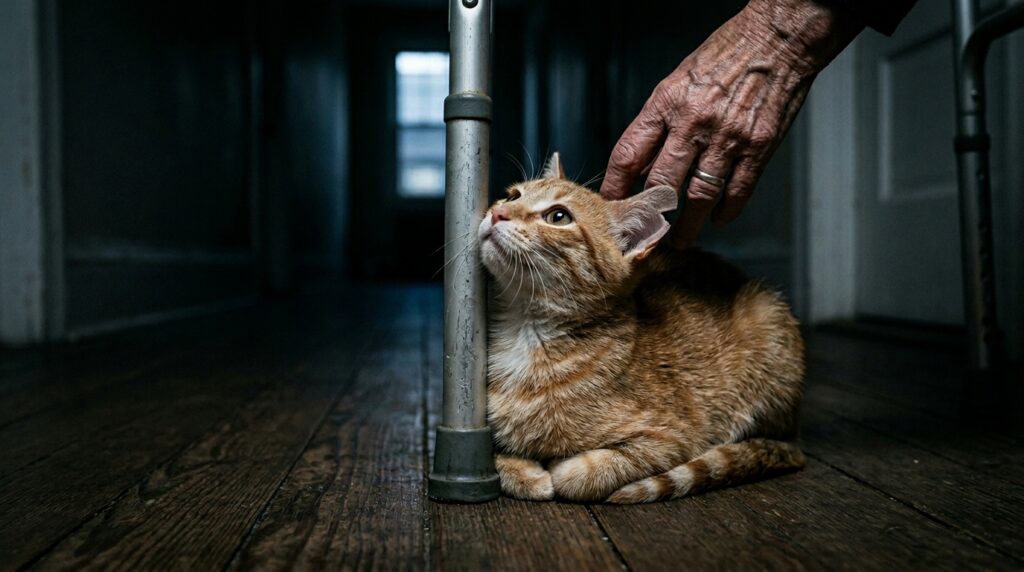
CHAPTER 1: The Shadow in the Hall
The silence in Marianne’s house had a weight to it, like a dusty quilt that had been folded for too long. It sat in the corners of the kitchen and settled over the empty chair where Arthur used to read the morning news. For three years, the only thing that broke that stillness was the rhythmic, metallic squeak-thump of her walker against the linoleum.
Then came the ginger-and-white shadow.
On his first afternoon, Lucky didn’t hide under the bed or tuck himself behind the sofa like the shelter volunteers said a “normal” cat might do. Instead, he sat precisely four feet away from Marianne’s walker, his amber eyes locked onto her ankles. When she took a step, he took a step. When the metal frame of her walker let out its signature squeak, Lucky’s tail gave a sympathetic, grounding twitch.
Marianne noticed it first in the kitchen. She was reaching for the chamomile tea, her fingers stiff with the morning’s dampness. As she turned, a small, warm weight brushed against her shin. It wasn’t the frantic, tripping-hazard leap of a kitten, but a steady, deliberate lean. Lucky wasn’t trying to get somewhere; he was simply making sure she was still there.
“Well, aren’t you a persistent little thing?” she whispered. Her own voice sounded loud in the kitchen, a stark contrast to the months of speaking only to the evening news or the grocery clerk.
Lucky didn’t meow. He didn’t demand a treat or claw at the cabinets for attention. He simply sat on her feet, the heat of his body soaking through her thin floral slippers. To the families who had returned him, this was a defect—a shadow that refused to leave. But to Marianne, it felt like a tether.
From Lucky’s perspective, the world was a fragile place where people tended to vanish when doors clicked shut. He watched the silver-haired woman with a focus that bordered on prayer. The scent of her—lavender and old paper—was the only solid thing in a world that had rejected him twice for the crime of wanting to stay close.
He didn’t understand the concept of a “bathroom” or a “bedroom.” He only understood the Gap. The Gap was the space between him and his person, and it was a space that needed to be closed at all costs. To him, every step she took was a promise he had to keep.
By the third day, the pattern was set. If Marianne went to the mailbox, Lucky was a silent sentinel by the front window, his nose pressed to the glass until the door creaked open again. If she sat in her recliner to watch the ballgame, he was on the footrest, his chin resting on the hem of her trousers. He wasn’t just a pet; he was a silent partner in the business of getting through the day.
One evening, Marianne forgot to bring her water glass to the bedside table. She stood up from her bed, her joints groaning in the dark of the midnight hour. She didn’t turn on the light, thinking she knew the path by heart. But as she gripped the handles of her walker, she felt a familiar vibration.
It wasn’t coming from the floor, but from the metal legs of her walker.
Lucky had followed her into the dark. He was pressing his side against the cold aluminum, purring so deeply that the metal itself seemed to hum. It was a rhythmic, grounding sound that cut through the loneliness that usually settled in after the sun went down.
Marianne stopped in the middle of the hall. She looked down at the pale patch of white and orange fur at her feet. For the first time in three years, the house didn’t feel like a museum of things she used to have. It felt like a home where something was happening right now.
“You’re not clingy, are you?” she murmured, reaching down to find the soft notch in his ear. “You’re just making sure I don’t drift away.”
Lucky looked up, his eyes catching the sliver of moonlight from the hallway window. He didn’t look away, and he didn’t blink. He just leaned harder into the metal walker, his purr intensifying until it filled the small space.
Marianne realized then that she wasn’t just a woman with a cat. She was a woman with a shadow that had a heartbeat. And for the first time since the funeral, the silence didn’t feel like a weight. It felt like a shared secret.
As she finally climbed back into bed, she felt the slight dip at the corner of the mattress. Lucky hadn’t waited for an invitation; he had simply claimed his spot near her feet, a warm, breathing anchor in the dark. She fell asleep listening to the soft, rhythmic puff of his breath, a sound that told her the morning would come, and she wouldn’t have to face it alone.
But the next morning, the quiet of the neighborhood was broken by a different kind of noise—the sound of voices on the other side of the screen, and the realization that not everyone saw their bond as a blessing.
Next up in Chapter 2: Marianne discovers that the rest of the world has a very different opinion on Lucky’s devotion, and the “too old” whispers begin to reach her front porch.