
CHAPTER 5: THE SCRATCH OF THE CARBON PAPER
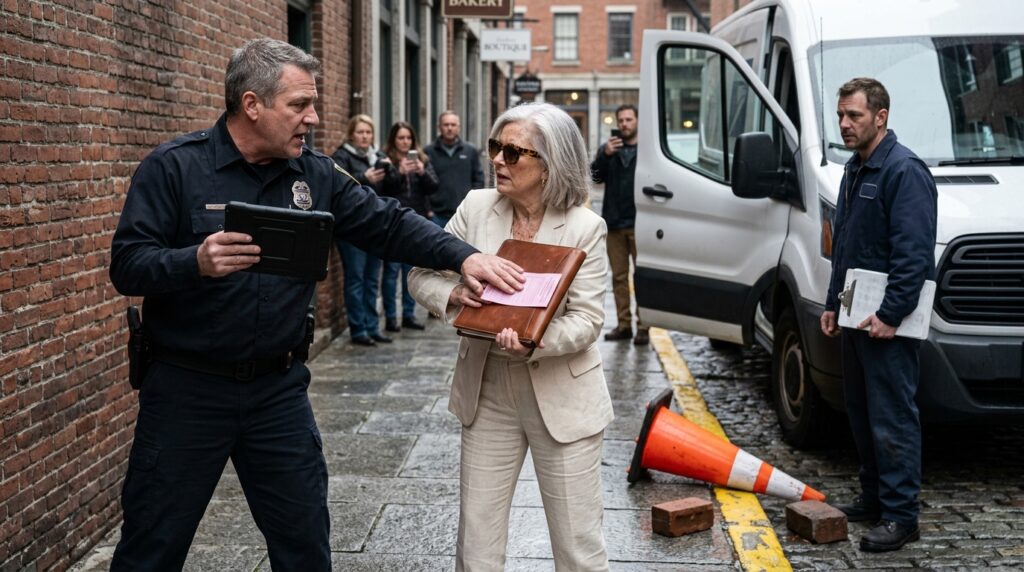
“The video matrix matches the live grid log,” Officer Briggs said. The words didn’t carry any anger; they fell into the heat of the alley like heavy bricks dropped onto dry dirt. He kept his thumb pinned to the edge of the rugged tablet, the unedited video loop running across the screen in crisp black-and-white pixels. On screen, the digital layout showed the unmistakable silhouette of Evelyn Thorne dragging a municipal-weight plastic cone across the easement line at exactly 7:43 AM, her gold watch links flashing under the alleyway’s high-pressure sodium lamp. “The obstruction marker was deployed by a private individual into a designated transit lane. That’s a code fourteen breach.”
Evelyn didn’t look down at the display. Her fingers shifted against the corners of her heavy leather ledger, her nails digging into the high-grade linen stock until the paper fibers flared gray. Her sunglasses caught the direct, blinding glare of the noon sun clearing the roofline of the clinic.
“The directive stands on the authority of the district council, Officer,” she said, her voice dropping into a hard, forced vibrato that was missing its previous administrative smoothness. She rattled the metal rings of the binder, thrusting the page with the misaligned seal toward the officer’s utility belt. “We adjusted these borders to protect the storefront values. The regional supervisor validated the signature on this registry index.”
Briggs didn’t glance at the paper. He reached down to his hip, pulling the rugged thermal terminal from its webbed holster with a dry, canvas rasp. The system hummed as it initialized, a small green indicator light pulsing against the desaturated grey casing.
“Your district council didn’t buy the ground under your boots, lady,” Briggs said, his voice level and cold as he pulled a digital land stylus from the side of the terminal. He brought up the city’s master geographic mapping framework, the public easement boundaries glowing bright green against the desaturated aerial background. “This coordinate line shows a clear twelve-foot arterial easement registered to the Department of Public Works since 1974. The historical district registry stops at the structural brick facade of your boutique storefront. The lane belongs to the city transport grid.”
Marcus stood perfectly still beside his open van door, his calloused thumb resting against the steel margin of his clipboard. He watched the crowd on the loading platforms. The baker, Geller, took a slow step backward, his boots grinding a trail through the white flour dust on the wood planks until his back cleared the platform line. He let his arms drop from the baking tray, his eyes fixed firmly on the ground near his own shop threshold. The two clothing store clerks had stopped their phones entirely, the screens going dark as they slipped the devices back into their aprons. The localized alliance Evelyn had cultivated over months of committee meetings was dissolving into silent isolation.
“Officer Briggs,” Evelyn said, her posture stiffening until her shoulders went completely square under her linen jacket. She took a single pace forward, her voice tightening into a desperate, transactional whisper. “This is an aesthetic zone. If we allow heavy regional distribution vehicles to tear up the lane during peak boutique hours, the foot traffic decreases by twelve percent across the quarter. I have a formal meeting with the municipal representative on Thursday. We can resolve the mapping discrepancies in chambers.”
“The city don’t negotiate code in chambers, Thorne,” Briggs said. His thumb clicked the print trigger on the handheld console.
The mechanical scratch of the thermal printer began, a high, continuous screech that cut through the low vibration of the van’s idling diesel engine. A long strip of gray, chemically treated paper spilled from the bottom of the casing, the font small and dense with statutory fines. Briggs ripped the paper clean against the metal serrations, the edge making a sharp, tearing pop. He didn’t drop it into her hand; he pinned it directly against the leather cover of her binder, right over the ink-printed seal.
“Four hundred dollars for the intentional block of a public courier easement,” Briggs stated, his voice ringing flat against the brick walls. “And if this plastic orange marker isn’t cleared from the path before my scooter engine cycles off, the department logs an administrative misdemeanor citation for falsifying municipal lane markings. That drops onto your retail license file within thirty minutes.”
Evelyn Thorne stayed frozen for three seconds, the paper citation fluttering slightly in the dry wind that funneled between the buildings. Her face had gone a mottled, dark red beneath the edge of her styled silver hair. She looked at Geller, but the baker had already turned his back, walking through his screen door until the iron latch clicked into the hasp. She looked at the boutique clerks, but they had vanished into the shadows of their showroom.
Her hand came down slowly, her expensive gold watch clinking against the plastic rim of the cone as she hoisted it by the center column. The brick she had used for weight dropped onto the granite pavers with a dull, heavy thud. She didn’t speak another word, her boots dragging across the stone dust as she hauled her properties back toward the rear threshold of her shop, her linen trousers trailing through the exhaust grease near the gutter.
The lane was clear. Marcus stepped toward the officer, taking his dashcam back with a firm, steady grip. He locked the camera into its magnetic windshield base, the blue light immediately resuming its quiet, unblinking cycle. Briggs gave him a brief, single nod, swung his leg over the saddle of the three-wheeled scooter, and kicked the starter. The small engine whined as the enforcement vehicle reversed out toward the mouth of the alley, clearing the bottleneck entirely.
Marcus walked to the rear of the van, popped the heavy double doors, and pulled the first aluminum logistics crate onto his hand truck. The air in Market Alley had returned to its normal, desaturated gray hum. He wheeled the load toward the clinic’s stainless-steel intake hatch, his boots striking the granite with the same methodical, unhurried rhythm that had brought him into the turn at dawn. The digital clock on the clinic wall read 7:48 AM. He pulled the manifest, stamped the barcode against the scanner, and watched the status indicator turn to green. The numbers had cleared.








