
CHAPTER 2: THE SOUND OF THE HASP
The manual window crank resisted Marcus’s grip, the internal gears grinding against years of accumulated brick dust trapped inside the door panel. He rotated the plastic lever three full times until the glass pane dropped six inches, allowing the sour smell of idling diesel and damp masonry to fill the cabin.
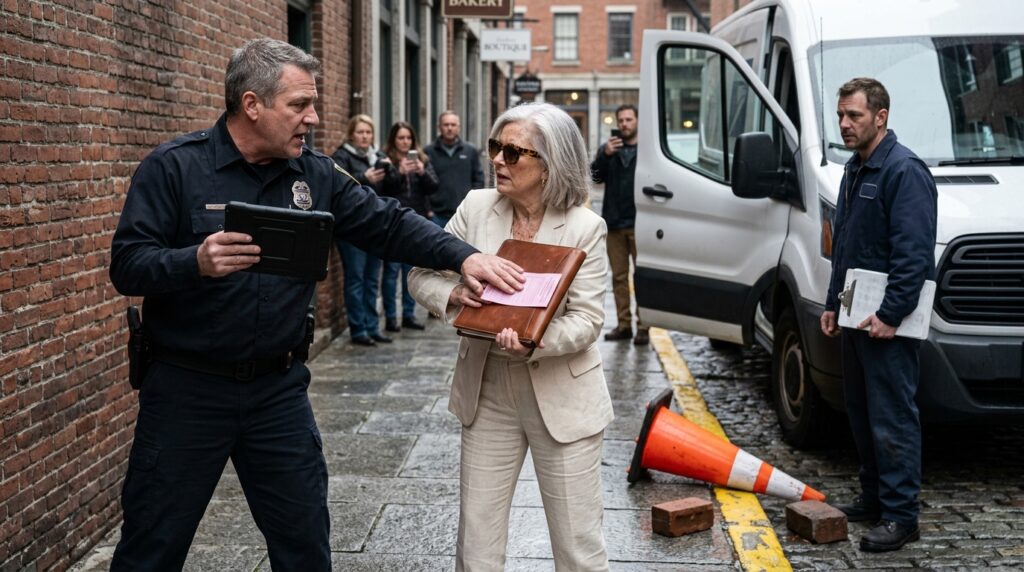
“You’re tracking grease across a preservation walkway, driver,” Evelyn Thorne said. Her voice lacked the high register of panic; it was flat, metered, and heavy with the bureaucratic assurance of someone who spent her Tuesday evenings drafting municipal grievances. She didn’t look down at the van’s bumper, which remained less than two feet from her shins. Instead, she struck the edge of her leather binder against the side-view mirror housing. The heavy gold links of her watch made a sharp, metallic clink against the hard plastic. “The historical designation for this alleyway was updated during the spring council session. Heavy commercial freight is restricted to the northern arterial docks. You have sixty seconds to reverse out to the main boulevard before I log the license prefix.”
Marcus didn’t shift his feet on the pedals. His right boot remained braced against the brake, the mechanical vibration of the transmission pulsing through his heel. He picked up his steel clipboard from the passenger seat, the metal cold and pitted against his fingertips.
“The city code painted on this curb says otherwise, ma’am,” Marcus said, his delivery level, stripped of any defensive inflection. “Yellow curb, zone four. Dedicated medical logistics priority. I have a three-minute delivery allowance for the clinic’s rear intake box, and my clock started when I cleared the archway.”
“Your clock is irrelevant to the district council,” she snapped.
With a swift, practiced motion of her wrist, Evelyn popped the brass hasp of her binder. The heavy leather covers flared open like a small shield, revealing a stack of cream-colored documents secured under a triple-ring mechanism. She flipped through two indexed dividers until she reached a page covered in dense, small-print terminology. She held the binder high, angling the paper toward the dropped window so Marcus could see the thick black lettering at the top: Market Alley Historical Conservation and Restricted Logistics Directive.
Marcus didn’t lean toward the window, but his gaze narrowed, tracking the lines of text with the precise, scanning habit of a man who spent eight hours a day verifying serial numbers on pharmaceutical packing slips. His eyes stopped on the lower third of the page. Beneath a paragraph detailing private property line extensions, a circular municipal emblem was stamped into the paper.
The seal was wrong.
The three-tower crest of the city’s department of transit was visible, but the outer ring of text was slightly misaligned, the font using a serif layout that the county clerk’s office had phased out during the technological audit three winters ago. More telling was the ink itself; it lacked the slight indentation of a heavy mechanical pressure stamp, appearing flat, slightly blurred at the edges, like an inkjet reproduction forced onto heavy linen stock. He didn’t say a word about it. He recorded the anomaly in his mind, filing it alongside the sound of the ticking watch on his wrist.
“This document has been ratified by the seven primary storefront stakeholders on this block,” Evelyn said, her fingers clamping down on the margin of the page, nearly obscuring the blurred seal. “We control the easement access from the hours of seven to eleven to preserve the architectural integrity of the foundations. Your firm was notified by certified mail in April.”
“My firm handles emergency regional logistics, Mrs. Thorne,” Marcus replied, his voice dropping into a quieter, transactional register that made her defensive posture look theatrical. “We don’t sign neighborhood covenants. If you don’t move the orange cone, I’m required by company protocol to log a physical delivery obstruction with the city enforcement desk. That call goes out on a recorded state line.”
Evelyn’s face didn’t soften; the lines around her mouth tightened until her lips were a thin, bloodless seam. She took a step back, her expensive boots scraping against the grit of the cobblestones with a dry, harsh friction. She didn’t touch the cone. Instead, she reached into her linen jacket and pulled out a slim, silver smartphone, her thumb hammering against the screen with rhythmic, vengeful force.
“I am the block captain for this section of the historic registry,” she said, holding the phone out like a weapon, the camera lens catching the blue reflection of Marcus’s dashcam. “We don’t take orders from regional couriers who don’t know the bylaws of the ground they’re parking on. I am calling the private enforcement detail we retain for this block. Let’s see how long your logistics clock runs when the flatbed hooks your front axle.”
Behind her, the door to the boutique bakery creaked open on dry, rusted hinges. A man in an unbuttoned white apron stepped onto the wooden loading deck, a heavy iron tray balanced on his hip, his eyes fixed on the idling van and the woman holding her binder like a ledger of judgment. The stage was setting itself, the local shadows beginning to lengthen across the brickwork as the neighborhood woke up to a conflict that had been building since the first drop of yellow paint hit the curb. Marcus remained inside his steel box, his fingers tapping a slow, unhurried cadence against the rim of his steering wheel, waiting for the system to grind its gears.








