
CHAPTER 3: THE ASSEMBLY OF SHADOWS
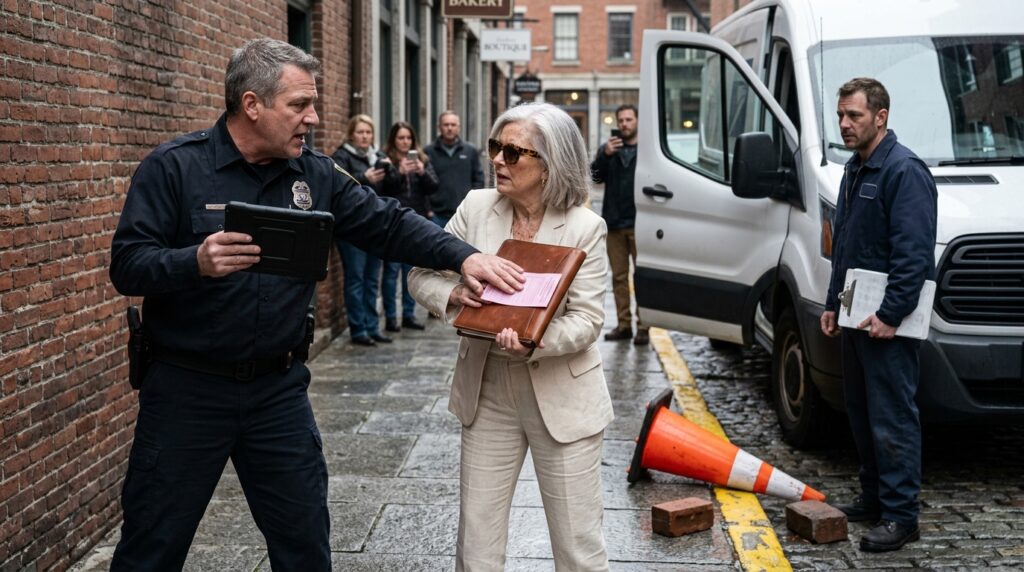
The back door of the boutique bakery didn’t just open; it hit the exterior brick wall with a low, hollow thud that sent a small shower of dried mortar flakes onto the cobblestones. The man in the white apron stepped completely out onto the wooden deck, his arms resting over the iron baking tray like a barricade. Across the alleyway, the brass latch of a clothing boutique swung free, and two sales clerks emerged into the humid morning air, their eyes instantly fixing on the gray profile of Marcus’s transit van.
Marcus kept his hands flat against the wheel. Through the side-view mirror, he watched the gap behind his rear bumper shrink as a boutique coffee supplier’s box truck pulled into the mouth of Market Alley, saw the driver hit his brakes, and recognized the immediate, absolute bottleneck. The alley had become a closed box.
“Evelyn’s right, you know,” the baker called out, his voice bouncing flatly off the narrow brick walls. He didn’t raise his tone to shout; the architectural compression of the alley carried the sound straight through Marcus’s open window window frame. “We put thirty grand into resetting these pavers last October. Your transport axles are chewing the lime right out from between the joints. Take it out to the avenue.”
Evelyn Thorne didn’t lower her smartphone. She held it high, her thumb braced against the volume casing to steady the lens as she walked a slow, deliberate semicircle around the front perimeter of the van. The heavy gold links of her watch clicked rhythmically against the spine of her leather binder with every shift of her balance.
“The driver has been advised of the district restriction, Mr. Geller,” Evelyn reported into the phone’s active microphone, her voice carrying the clear, calculated cadence of a deposition. “He is actively obstructing an emergency historical preservation perimeter. I have already logged the carrier identification number and the operator’s description with municipal dispatch.”
Inside the cabin, the heavy ticking of Marcus’s silver watch seemed to sync with the steady pulse of the diesel engine. He didn’t look at Evelyn’s lens. He turned his head slightly toward the passenger seat, his eyes tracking the specific sequence of names handwritten along the margin of the document she had displayed moments before. Geller was there, scrawled in faded blue ink next to a structural easement index code. Below it were three others—the boutique owners who shared the narrow corridor’s footprint. The layout wasn’t an official city planning annex; it was a localized grid, a privately maintained map disguised by the heavy linen stock of a municipal filing jacket.
“You’re running behind, Vance,” Geller said, stepping down from the wooden deck until his boots met the stone. He walked with a slight limp, his apron strings dragging through the dry stone dust near the yellow curb line. “The clinic intake box locks at 7:49 AM. If you’re sitting here when the timer trips, those medical coolers go straight back to the sorting hub on the county line. Nobody wins that game.”
“The city maintains the easement for the clinic, Mr. Geller,” Marcus said. His voice was a flat, unyielding line that cut through the low murmur of the growing group of onlookers. “If the courier logs a failure due to a physical blockade, the municipal fine drops onto the property tax block for the entire quadrant. Code section nine, paragraph four. It doesn’t split between the storefronts; it hits the registry wholesale.”
A silence settled over the loading platform. One of the clothing clerks lowered her phone by an inch, her gaze shifting from Evelyn’s back toward the yellow paint beneath the van’s front tire. The collective certainty of the alleyway was beginning to develop its first structural fracture. They knew the bylaws Evelyn had drafted, but they also knew the cold arithmetic of city tax liens.
Evelyn stopped her pacing. Her sunglasses slid half an inch down the bridge of her nose, her eyes fixing Marcus with a sharp, defensive glare through the glass pane. Her fingers tightened around the edge of her binder until the leather buckled under the pressure.
“The city doesn’t enforce code in a historical sanctuary without an independent site audit, driver,” she said, her tone dropping into a hard, defensive whisper that barely cleared the window ledge. “We have the signature of the regional supervisor on the active directive. Your logistics company answers to the state board, and the state board recognizes our protective boundary.”
She turned back to the crowd, her arm gesturing toward the mouth of the lane where the coffee delivery truck was already beginning to sound its reverse alarm, the deep beep-beep-beep echoing off the brickwork like a ticking clock. She was rallying them again, her words designed to thicken the wall of human pressure around the van, but Marcus remained locked in his seat, his eyes fixed on the blue LED of his dashcam as it captured the exact position of her hand against the fake seal of her ledger. The trap was still closing, but he wasn’t the one inside it.








