CHAPTER 5: THE EMBEDDED PIN
Mark’s fingers dug into the heavy cardstock of the blue folder, pulling the brass-clasp document flat against the hood of the truck.
“Deputy Vance,” Mark said, his voice dropping into a steady, unhurried cadence that cut through Brenda’s self-satisfied smirk. “You’re holding a four-hour-old administrative filing that claims an environmental hazard across a disputed easement. But you haven’t looked at the county auditor’s permanent plat map attached to this deed.”
Vance stepped closer, his eyes shifting from Brenda to the thick, wax-sealed pages Mark spread across the sun-warmed metal. “A deed map doesn’t override an active municipal drainage hold, son.”
“It does when the land grant shows there is no easement,” Mark replied. He tapped page four with a single, calloused index finger. “Look at the coordinates. Section 12, Lot 4B. The drainage right-of-way you’re referencing was abandoned by the county in 1994 when the main storm canal was buried two streets over. The easement line on her complaint doesn’t exist on county records. It’s a dead designation.”
Brenda’s hands twitched inside her yellow leather gloves. She took a step toward the truck, her voice rising in a sharp, strained rasp. “That’s an outdated plat! My civil surveyor verified the active flow path on Tuesday!”
“Your private surveyor mapped what you told him to map,” Mark said, turning his head slowly to face her. “You had him draft a fake topographic complaint because you knew if you filed a real property line dispute, the county clerk would require a physical monument check.”
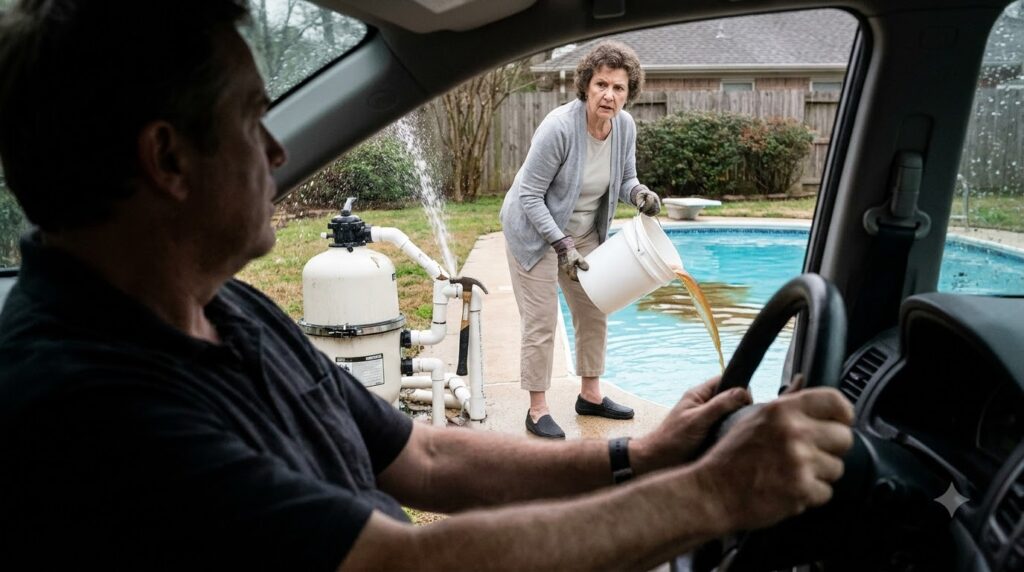
Mark didn’t wait for her to answer. He turned, walked four paces to the edge of the fence line where the fresh cedar post stood, and kicked aside three inches of dark, freshly spread mulch with the toe of his work boot. The rubber sole struck a hard, metallic object buried in the dirt.
A sharp, ringing clink sounded across the quiet yard.
Mark reached down, wiping away the wet earth to reveal a heavy, brass-capped steel rod driven flush into the bedrock. Etched into the yellowing brass face were four crisp numbers and the official seal of the state land surveyor.
“There’s the monument pin,” Mark said, looking up at Deputy Vance. “That pin has been in the ground since this subdivision was platted thirty years ago. The entire pool pump pad sits eight inches inside my brother’s legal boundary. The water she claims is flooding her retaining wall isn’t coming from this pool, Vance.”
David stepped up beside his brother, holding his phone out with the screen illuminated. “And here’s the elevation scan we ran before we poured the pad. The slope drops two degrees toward the street. Water physically cannot run uphill into her yard unless someone hauls it there in a five-gallon bucket.”
Deputy Vance looked down at the brass pin, then back at the shattered white PVC pipes spraying water onto the concrete. He reached out, took Mark’s certified land survey, and cross-referenced the brass pin’s serial number with the coordinates stamped on the deed.
The silence that followed was heavy, absolute, and suffocating.
Vance slowly closed his leather clipboard. The tension in his shoulders shifted, his posture straightening as he turned his full attention toward Brenda. His voice lost every trace of professional neutrality, hardening into the cold, flat tone of an officer executing a lawful command.
“Ma’am,” Vance said, his hand resting firmly on his duty belt. “Did you enter this lot with a hammer and a utility bucket knowing the boundary monument was located right here?”
“I… I was protecting my property!” Brenda stammered, her face turning a blotchy, mottled purple. She pulled her gray cardigan tight around her chest, taking two jerky steps back toward her own gate. “The water was coming over! I have a right to defend my home!”
“You crossed a marked legal boundary onto private property,” Vance said, stepping into her path and blocking her escape route. “You used a deadly weapon to destroy an active utility installation, and you committed intentional contamination of a private water structure.”
“It’s a civil matter!” she shrieked, her voice cracking as she held up her gloved hands. “You said it yourself! It’s a civil dispute!”
“Destroying three thousand dollars’ worth of private equipment with a claw hammer isn’t a civil dispute, ma’am,” Vance replied, pulling a pair of steel handcuffs from his utility pouch with a sharp, metallic click. “That’s felony criminal mischief and trespassing on private land.”
Brenda’s jaw dropped, her eyes darting frantically toward the fence line where three neighboring homeowners had gathered on their back porches, watching in stunned silence as the deputy stepped forward. The fake authority she had wielded like a weapon for three months shattered in an instant, leaving her standing in the damp grass, caught under the weight of her own trap.
“Turn around and put your hands behind your back,” Deputy Vance commanded.
Mark stood beside his brother, watching in cold, silent resolution as the yellow leather gloves were pinned behind her back and the steel cuffs clicked locked.