CHAPTER 3: THE PAPER TRAIL IN THE DUST
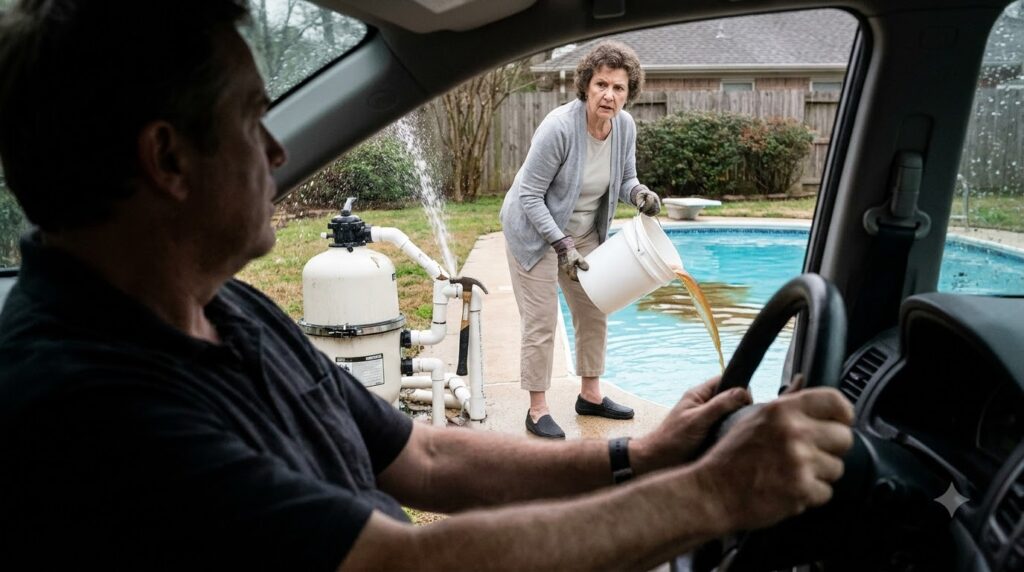
The hiss of the ruptured pipe filled the air between them, steady and cold, misting against the side panel of the work truck.
Mark didn’t wait for Brenda to answer. He stepped past her, his heavy work boots grinding small gravel chips into the wet patio slab. The yellow gloves she wore twitched, her fingers curling tight around the handle of the claw hammer, but she shrank back two inches as he bypassed her completely, heading toward the wooden fence line that separated his brother’s lot from her elevated yard.
“Where do you think you’re going?” Brenda shouted, her voice thin against the sound of spraying water. “I told you, that fence is a shared boundary! Touch those post footings and I’ll add property destruction to the police report!”
Mark ignored the noise of her voice. In a tactical exchange, speech was just atmospheric pressure; physical facts were the only anchors that held under scrutiny.
Near the base of the cedar post—right where the fresh concrete footing met the dirt grade—lay a discarded white paper sleeve, soaked through from the pipe spray and half-buried in crushed stone. Beside it sat a small, torn envelope stamped with blue ink. Mark bent at the knees, keeping his center of gravity low and his eyes on the ground, his hand reaching into the wet weeds to scoop up the envelope before the water dissolved the paper entirely.
He stood up, unrolling the wet sheet against his thigh.
Brenda lunged forward a half-step, her dark slip-on shoes sliding slightly on the slick patio before she caught herself. “Give that back! That’s private correspondence!”
“You dropped it when you set the bucket down,” Mark said flatly.
The paper was a civil site notice, but it wasn’t a standard municipal form. Across the top ran the letterhead of a private environmental testing lab based three counties over, dated four days prior. Stapled to the corner was a hand-drawn map of the property line, complete with topographic contour lines indicating elevation fall. A bold red marker line ran straight through Mark’s brother’s side driveway, cutting directly across the pool pump pad and terminating at Brenda’s property boundary.
Beneath the red line was a handwritten note in precise, angled script: ‘Verify active discharge point. If drainage crosses easement, file Section 4-A Immediate Nuisance Abatement before survey crew arrives Friday.’
Mark’s eyes narrowed. He looked up from the paper, tracing the physical contours of the yard. His brother’s lot sat in a natural depression, but the pool pad had been built up six inches on a poured concrete slab, engineered to drain backward toward the street gutter, nowhere near Brenda’s elevated property. The hand-drawn map claimed the exact opposite—falsifying the slope by three degrees to make it appear as though the pool backwash would naturally flood into her basement foundation.
This wasn’t a spontaneous outburst from an unhinged neighbor. It was a calculated, pre-planned paper trail designed to create the illusion of a chronic water nuisance.
“Section 4-A,” Mark said, his voice quiet, almost conversational as he turned the wet paper toward her. “That’s the municipal code for emergency land-use interventions. The one that allows a neighbor to petition for a mandatory drainage easement if they can prove unmitigated runoff.”
Brenda’s chest rose and fell rapidly under her light gray cardigan. She pulled her shoulders back, attempting to reclaim the rigid posture she’d held when she was swinging the hammer. “It doesn’t matter what note you found! The city inspector validated the hazard! He signed off on the preliminary review!”
“No, he didn’t,” Mark said. He held up the paper, pointing to the blue stamp at the bottom. “This isn’t a city seal. It’s an embossed stamp from a private civil surveyor. You didn’t call code enforcement because you knew they’d measure the elevation and tell you to clear your own gutters. You paid a private surveyor to write up a preliminary hazard assessment, and then you used his letterhead to fake a municipal stop-work order.”
Brenda’s jaw tightened until the skin over her cheekbones turned waxy and white. Her yellow-glover hand reached instinctively toward the side pocket of her cardigan where the laminated badge rested, but she stopped herself, realizing the gesture only confirmed his words.
“My yard is sinking!” she spat out, the calm, bureaucratic veneer finally cracking open to reveal the raw, desperate spite underneath. “Ever since your brother brought those heavy trucks in here and dug out that hole, my retaining wall has been shifting! He had no right to alter the water table! He didn’t ask permission from the block association, he didn’t consult the drainage board—he just bought a excavator and started tearing up the earth!”
“He bought a house on private land with a clear title,” Mark replied, taking one slow step toward her, forcing her to tilt her chin up to meet his eyes. “And every square foot of this pool installation was inspected and stamped by the county civil engineer three weeks ago. The permits are posted right inside the front window.”
“They’re fraudulent!” she screamed, her voice echoing off the wooden fences of the surrounding houses. “He paid off the inspector! Everyone on this street knows what kind of people you are—coming in here with your loud trucks and your weekend crews, acting like you own the block! I’ve lived here thirty-two years! I built this neighborhood!”
“You built a paper house, Brenda,” Mark said.
Behind them, down the long stretch of the suburban driveway, the gravel crunched under the tires of a heavy vehicle. A dark blue municipal pickup truck turned the corner, its yellow roof light flashing silently against the afternoon sun, followed closely by a white sedan bearing the logo of the county sheriff’s department.
Brenda’s eyes darted toward the driveway, her posture instantly collapsing as the flashing yellow lights reflected off the shattered white pipes and the brown-stained water of the pool.