CHAPTER 2: THE FORGED SHIELD
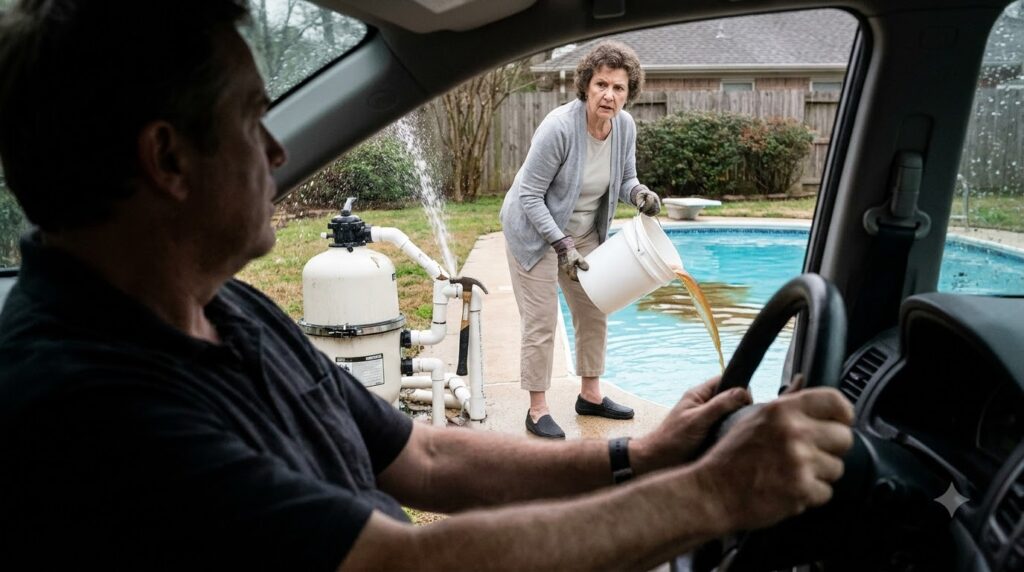
Brenda’s jaw worked silently for a single beat, her teeth clicking together before her mouth set into a thin, white line. The yellow leather of her gloves squeaked against the handle of the claw hammer as her grip tightened. She didn’t drop the tool. She didn’t look down at the dark, sludging cloud dispersing through the turquoise pool water.
Instead, she stepped toward the driver’s side of the work truck, her dark slip-on shoes leaving wet, muddy tracks across the clean concrete patio.
“You’re trespassing on a active municipal enforcement zone,” she snapped. Her voice had the shrill, practiced cadence of someone who had spent decades lecturing young clerks behind government desks. “I don’t care what you think you saw from inside that cab. This installation is an illegal, unpermitted environmental hazard, and I am executing a mandatory abatement.”
Mark didn’t reach for the door handle. He didn’t shift his weight. Through the four-inch gap in the glass, his eyes remained fixed on her face—tracing the tight fan of wrinkles around her eyes, the flush rising up her neck, and the slight, nervous twitch in her left cheek.
“Abatement,” Mark repeated. The word sat flat between them, weightless.
“Yes. Abatement.” Brenda reached into the deep side pocket of her light gray cardigan, her yellow-glover fingers fumbling for a second before pulling out a folded sheet of heavy yellow paper and a small, laminated badge that swung from a black lanyard. She shoved the yellow document up against the driver-side glass, her fingernails tapping against the pane. “Official stop-work order from the city department of environmental safety. Signed by the senior inspector. This pool setup is contaminating the sub-surface drainage basin that feeds directly onto my lower lot. I have the legal authority to neutralize any active hazard threatening the municipal water table.”
Mark leaned forward just enough to look at the yellow paper pressed against his window.
The header was bolded, crisp, bearing a heavy gold seal that looked convincing at a distance. But Mark spent his workdays reading commercial job permits, civil site plans, and county zoning clearances. His eyes immediately caught the discrepancy: the badge pinned under her thumb didn’t carry a state seal or a municipal officer ID number—it bore a generic shield emblem, the kind sold in bulk to private security contractors or self-appointed neighborhood watch coordinators. And the signature at the bottom of the yellow paper was stamped in fresh blue ink, but the property address listed wasn’t his brother’s house. It was the parcel number for the vacant easement strip bordering the drainage canal behind her property.
“That’s a nice piece of paper, Brenda,” Mark said softly.
“It’s a legally binding order!” she yelled, her voice pitching higher as she slapped the paper harder against the glass. The damp air carried the sour, metallic smell of her sweat mixed with the stagnant mud she’d dumped into the water. “Your brother ignored three formal notices dropped on his porch last week! He thought he could pour concrete and hook up high-volume pumps without approval? He’s ruining the grading for the entire block! I am well within my rights as the district block captain to take emergency measures before this water backs up into my foundation!”
“You smashed three feet of pressure-tested schedule-40 PVC,” Mark said, his voice dropping an octave, becoming entirely static. “You used a sixteen-ounce framing hammer on private property. And then you dumped five gallons of swamp muck into six thousand dollars’ worth of treated water.”
Brenda pulled the yellow paper back, folding it with quick, agitated snaps of her wrists before shoving it back into her pocket. Her eyes darted toward the side gate, checking the quiet gap between the houses. No neighbors had stepped out yet, though a window blind two houses down twitched slightly.
“I neutralized a hazard,” she insisted, taking a half-step back and squaring her shoulders. She raised the hammer slightly, pointing its steel head toward the spraying manifold. “And if your brother attempts to turn that pump back on, or if you step out of that vehicle to interfere with a civic officer, I will have the county sheriff down here within ten minutes to haul both of you off for building code violations!”
Mark reached up with his left hand, slowly unclipping his phone from the dashboard bracket.
The screen lit up, reflecting the ambient sunlight in a cold blue square against his face. He held the device flat, turning the screen outward toward the glass so Brenda could see the interface.
On the display, the high-definition video was already playing back in real-time. The frame showed the elevated view from the truck cab: clear, sharp, unblinking. It captured Brenda stepping over the property fence line holding the hammer. It captured the exact angle of her swing, the white plastic exploding under the blow, the water erupting, and the deliberate, two-handed tilt of the utility bucket as she dumped the dark sludge into the pool. The audio playback was quiet inside the cab, but the crisp thwack of the steel impact on the plastic pipe was unmistakable.
Brenda’s eyes widened. The color drained from her cheeks, leaving her face a blotchy, mottled gray. The rigid authority in her spine seemed to slacken by a fraction of an inch as she stared at the glowing screen.
“That’s an illegal, non-consensual recording,” she stammered, her voice losing its piercing edge, replaced by a sharp, defensive raspy tone. “You… you can’t use that. You’re filming into a private residence boundary!”
“You’re standing six feet inside my brother’s property line, Brenda,” Mark said. He unlatched the truck door.
The heavy steel door swung open with a slow, mechanical creak, forcing Brenda to take three quick, clumsy steps backward into the wet grass to avoid being clipped by the frame. Mark stepped down from the running board, his boots hitting the damp concrete with a heavy, deliberate thud. At six-foot-two, he towered over her, his shadow falling across her gray cardigan and the mud-stained utility bucket at her feet.
He didn’t raise his hands. He didn’t close the distance aggressively. He simply stood beside his truck, his phone held loosely at his side, his eyes scanning the shattered white pipes spraying water across the yard.
“My brother will be back from the supply store in six minutes,” Mark said, looking down at her. “And the officer I called five minutes ago is already turning onto the street.”
Brenda’s chest heaved as she clutched the yellow paper inside her pocket, her gloved fingers trembling against the fabric.