CHAPTER 3: THE DUST OF THIRTY YEARS
The county GIS map on Mark’s dual monitor setup didn’t lie, but it didn’t tell the whole truth either.
The blue property boundaries overlaid on high-resolution satellite imagery showed a clean, crisp rectangle defining Lot 42—his lot. The line ran precisely three feet west of his garage wall, placing the severed utility box, the gravel alleyway, and the cedar fence post solidly inside his deeded boundary. But when he pulled up the original 1996 plat records buried four tiers deep in the county recorder’s PDF archive, the line began to blur.
A blue-ink stamp from the original land developer, Oakridge Estates Development Corp., sat crooked at the bottom of the scanned plat sheet. Below the faint signature of the chief surveyor, someone had added a hand-written addendum in dark ballpoint pen: Subject to 6ft cross-lot drainage and maintenance corridor along west elevation of Structure 42.
Mark leaned close to the screen, his eyes tracking the pixelated ink. The handwriting wasn’t the surveyor’s precise block lettering. It was slanted, loose, and signed with initials that matched neither the county inspector nor the civil engineering firm listed on the header: G.H.
George Harrison. Evelyn’s late husband.
Mark set his coffee mug down on the desk, the ceramic ringing against the laminate. George Harrison had been a senior land planner for the township in the late nineties, a man whose name still appeared on half the variance approvals hanging in the municipal building downtown.
A sharp knock echoed from the front entryway—three brisk, authoritative raps against the solid core door.
Mark didn’t rush. He saved the PDF to his local desktop drive, locked his workstation, and walked down the hallway. Through the narrow glass sidelight, he saw a white Ford Ranger parked at his curb. The vehicle bore the blue emblem of the County Department of Building & Code Enforcement on its door.
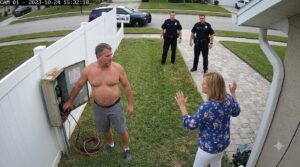
Standing on the concrete porch was Inspector Vance, wearing a sweat-stained khaki uniform shirt, a heavy leather tool belt, and a worn clipboard tucked under his arm. Three feet behind him, standing at the edge of the lawn with her hands clasped tightly in front of her gray top, was Evelyn.
Mark pulled the door open, letting the air-conditioned breeze escape into the sweltering afternoon heat.
“Mark?” Inspector Vance asked, squinting against the glare of the porch. “Vance, County Code Enforcement. We received an emergency priority call regarding an unpermitted structural hazard on the west garage wall.”
“There’s no structural hazard, Inspector,” Mark said evenly, stepping out onto the porch and closing the door behind him. He kept his posture straight, his shoulders relaxed in his blue-gray shirt. “It’s a standard low-voltage telecom drop.”
“He’s lying, Vance,” Evelyn called out from the grass, her voice slicing through the quiet neighborhood air. She took two steps up the walkway, her black sneakers digging into the edge of Mark’s sod. “The box is hanging off the wall, sparking into the dry brush! He ran unauthorized wiring through a shared utility corridor that was designated for neighborhood drainage thirty years ago!”
Inspector Vance sighed, rubbing the back of his neck where a ring of salt had dried against his collar. “Ma’am, let me handle the inspection. Mark, I need to see the wall.”
“Follow me,” Mark said.
They walked around the corner of the house, their boots crunching on the dry turf before stepping into the gravel alleyway. Evelyn followed five paces behind, her eyes darting between the garage roofline and the cedar fence as if measuring the air between them.
When Vance reached the damaged site, he stopped, his boots kicking against a stray fragment of grey plastic. He looked at the shattered casing, the severed orange fiber tray, and the bare vinyl siding where the mounting screws had been ripped from their anchors.
“This didn’t fail from wind load or age, Mark,” Vance said quietly, kneeling down to inspect the fracture points. “Looks like someone took a tool to it.”
“She used a claw hammer at 2:14 PM,” Mark said.
Evelyn stepped up to the wooden gate, resting her hand on the latch. “That’s a ridiculous accusation! I brought Inspector Vance out here because I have the legal documentation right here!” She pulled a folded, yellowed sheet of heavy bond paper from her purse and held it toward Vance. “This is a certified copy of the 1996 Developer’s Access Agreement. It explicitly grants Lot 43 full right-of-way over this six-foot corridor for drainage and infrastructure control. He has no right to mount equipment here at all!”
Inspector Vance took the paper, unfolding it against his clipboard. He adjusted his reading glasses, his thumb tracing the yellowed margin where a blue-ink stamp sat faded under decades of storage.
Mark watched the inspector’s face closely. He didn’t interrupt. He didn’t shout. He let the silence of the alleyway do the work.
“Well,” Vance said after a long half-minute, his voice sounding hesitant for the first time. “This document appears to carry an official township seal from ’96. It designates this strip as a shared drainage corridor under joint maintenance of Lots 42 and 43.” He looked up at Mark, a slight frown creasing his brow. “If this easement is active, Mark, any permanent surface-mounted hardware on this wall might actually require a joint variance from your neighbor before installation.”
Evelyn’s chin rose an inch. A faint, triumphant smile touched the corners of her mouth as she looked at Mark. “I told you, Mark. You don’t own this space the way you think you do.”
Mark didn’t flinch. He looked at the paper in Vance’s hand, noting the faded blue ink of the stamp, then turned his gaze back to the base of the fence post where the three brand-new chrome-headed nails pinned the hidden galvanized wire.
“Check the civil engineer registration number on that stamp, Inspector,” Mark said quietly, his voice dropping into a razor-thin edge. “Cross-reference it with the state board. You’ll find that registration belonged to George Harrison—and it was revoked six months before that paper was signed.”
Evelyn’s smile froze. Her hands tightened into fists at her sides, her black sneakers shifting uncomfortably in the loose gravel.