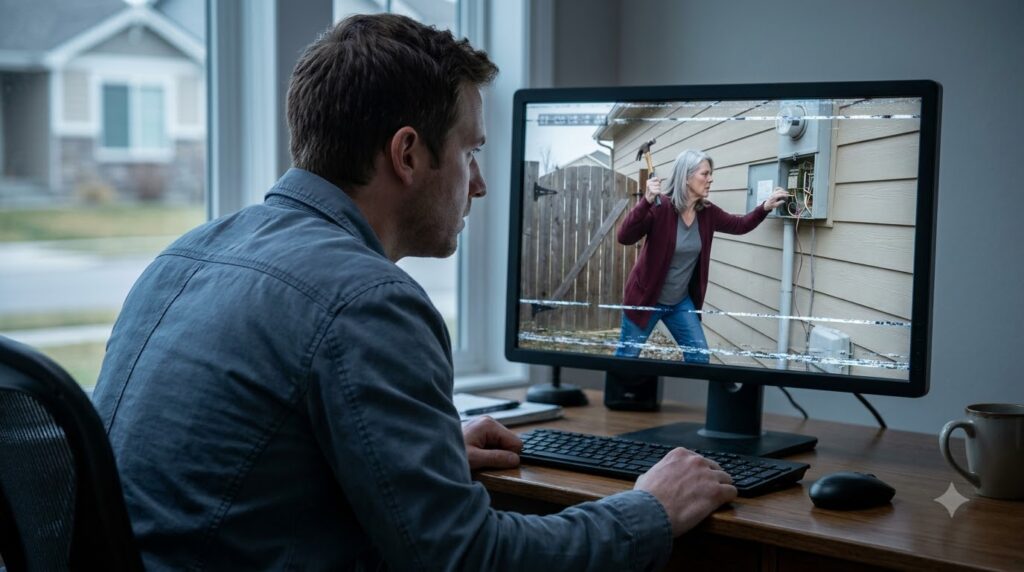
CHAPTER 2: THE GRAVEL PATH AND THE CHROME HEAD
The latch on the utility door didn’t yield easily. Sun-swollen cedar had wedged the frame tight against the jamb, requiring Mark to put his shoulder into the wood until the deadbolt scraped free with a dry, iron screech.
Outside, the heat hit like a wet wool blanket thrown over the face. The alleyway between the garage and the six-foot boundary fence smelled of scorched gravel, dying weeds, and the sharp, chemical tang of ozone coming off the shattered telecom housing.
Mark didn’t rush. He kept his boots planted in the loose grey stone, his casual blue-gray shirt already sticking to the small of his back. Every motion was deliberate. He leaned his hips against the vinyl siding, the heat of the wall soaking through his clothes, and looked down at the wreckage.
The grey plastic casing of the primary communications box hung by a single torn hinge, twisting in the dead air. Below it, fine white plastic dust coated the dry blades of crabgrass like winter frost. Two glass fiber strands—thin as horsehair and shimmering with a faint, fractured light—poked out from the sheared orange conduit.
He knelt, the sharp gravel pressing through his jeans into his kneecaps.
With two fingers, he picked up the largest fragment of the housing. The break was clean where the steel claw had struck, but right at the impact crater, the plastic bore the impression of a cross-hatched hammer face. It wasn’t an accident. It wasn’t a clumsy brush while trimming hedges. The blow had been delivered straight-on, driving perpendicular into the wall with enough foot-pounds of force to buckle the quarter-inch mounting plate behind it.
Mark flipped the plastic shard over in his palm. The back was coated in fine red dust—not dirt from his yard, but the clay-heavy soil from Evelyn’s side of the fence where she kept her prized potted hydrangeas.
As he reached down to sweep the remaining plastic shards into a small pile, his knuckles brushed the base of the nearest cedar fence post. The wood there was grey, weathered, and soft with dry rot near the soil line. But two inches above the dirt, driven flush into the decaying grain, sat three brand-new chrome-headed framing nails. They were clean, unweathered, and entirely out of place on a twenty-year-old fence line.
Mark touched the head of the top nail. The metal was cool despite the midday sun, hidden as it was beneath the overhang of a decorative vinyl cap Evelyn had installed three months ago.
He frowned, tracing the line of the post with his eyes. The fence didn’t run completely parallel to the garage. At the back corner of the lot, it angled inward by nearly four inches—a subtle creep he had always attributed to sagging posts and shifting earth. But the fresh chrome nails were anchor points, recently set, anchoring a thin galvanized wire that ran low to the ground, disappearing straight beneath the cedar pickets toward Evelyn’s foundation.
A heavy footstep crunched in the gravel at the far end of the alleyway.
Mark didn’t snap his head up. He stayed on one knee, let his hand drop casually over the chrome nailhead, and slowly turned his head.
Evelyn was standing just beyond the open wooden gate, her figure framed by the brilliant glare of her white-graveled driveway. She had taken off her cardigan, revealing a short-sleeved gray top that showed the ropy, sun-spotted muscle of her forearms. The tan crossbody purse was gone, but her hands were folded tightly over her stomach, her fingers twitching against her knuckles.
“You shouldn’t be messing with those lines, Mark,” she said. Her voice didn’t carry the high, frantic pitch of a trespasser caught in the act. It was flat, measured, and layered with the stale authority of a town clerk reading an overdue notice. “That’s county infrastructure. You touch the wrong wire and you’ll short the grid for the whole cul-de-sac.”
Mark stood up slowly, the gravel shifting beneath his soles. He kept his hands loose at his sides, his tablet tucked under his left arm.
“The grid is fine, Evelyn,” Mark said, his voice dropping into a low, flat register that matched the dry heat of the alley. “The fiber line, however, is dead.”
“Things deteriorate,” she said, her eyes darting past his shoulder to the shattered box hanging from his wall. She didn’t step through the gate. She stayed firmly on her side of the threshold, her black sneakers planted on her own concrete. “Sun damage. Cheap builder materials. I told you eighteen months ago when you had those utility boys out here—that wall wasn’t engineered for heavy loads. The whole setback is a shared corridor anyway.”
“It’s my deeded wall,” Mark replied quietly.
“On paper, maybe,” Evelyn said, a faint, cold smirk touching the corners of her thin lips before vanishing back into her neutral mask. “But papers from thirty years ago aren’t always the last word, Mark. Things get recorded wrong at the courthouse. Easements overlap. Sometimes people think they own the air three feet off their foundation when they’re actually sitting on someone else’s drain line.”
She reached into her pocket, pulled out a small set of brass keys, and let them clink against her palm.
“I’d be careful about calling any technicians out here,” she added, her eyes locking onto his with a hard, unyielding stare. “You start digging around that wall, you might find out your whole garage is sitting on a space it has no right to occupy.”
She turned on her heel and walked back toward her garage door, the soles of her sneakers squeaking faintly on the hot pavement.
Mark stood in the narrow shade of the eave, watching her disappear behind her screen door. He reached into his pocket, pulled out his phone, and took a close-up photograph of the three chrome framing nails driven into the rot of the post, noting how the galvanized wire pulled tight toward her lot.
He didn’t clean up the broken plastic on the ground. He left every fragment exactly where it had fallen, walked back inside his house, and pulled up his county tax portal to pull the original 1996 subdivision plat maps.