
CHAPTER 1: THE CRACK ON THE GARAGE WALL
The glass on the secondary monitor didn’t just flicker; it split.
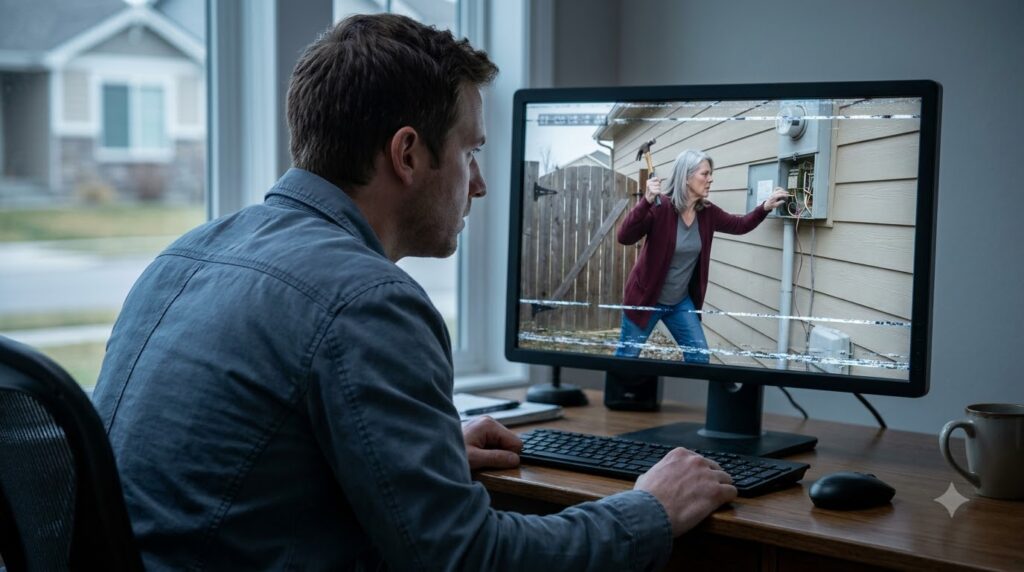
Mark didn’t move his hand from the mouse. His forearm stayed flat against the cold veneer of the desk, the blue-gray cotton of his sleeve catching the pale blue wash of four compressed camera tiles. In the lower-right quadrant, where the 28mm lens looked straight down the narrow gravel alleyway between his garage and the cedar fence, the light was yellow and dry.
Then the latch moved.
It wasn’t a sudden drop. The galvanized iron bar rose two inches, held for a beat in the still August heat, and clicked back against the wood. Evelyn came through sideways. She didn’t look like a woman trespassing; she looked like someone checking a lock on her own back porch. The burgundy cardigan was heavy for the hour, the hem dragging slightly against the blue denim at her knees. She kept her left hand clamped over the tan strap of her crossbody purse, her shoulders pulled tight toward her neck.
In her right hand, the steel claw hammer caught the afternoon sun—a dull, pitted gray head attached to a hickory handle worn dark by palm sweat.
Mark leaned forward. The chair spring groaned under his weight, a sharp metallic click in the quiet office. His eyes narrowed on the monitor frame. He didn’t call out. He didn’t reach for his phone. He watched the screen the way a man watches a crack spread across winter ice: calculating the depth before measuring the fall.
Evelyn stopped two inches short of the grey vinyl siding. Her profile was sharp against the shadow of the garage eave, her shoulder-length gray hair pulled back by the windless heat. She turned her torso just enough to block the sightline from the street, lifted the hammer four inches, and brought the flat face down directly onto the plastic housing of the communications box.
There was no sound on the digital stream, but the physics were immediate.
The grey plastic cover sheared down the center seam. The lower hinge snapped, sending a triangular shard bouncing into the gravel. Inside, the orange fiber splice tray buckled under the force, the thin glass threads shearing beneath the impact.
On Mark’s desk, the quadrant died.
Horizontal bands of green and magenta tore across the image, shivering like static on a dead channel, before the window went solid black. A white system prompt bloomed in the center of the dark square: SIGNAL LOST / NO CONNECTION.
Mark’s chest tightened, a slow, cold weight settling behind his ribs. His fingers twitched against the plastic body of the mouse, feeling the faint, rhythmic vibration of the desktop tower humming beneath the wood. He stared at the error prompt for three full seconds while the room-tone of the house—the low hum of the refrigerator in the kitchen, the distant rush of the HVAC compressor outside—filled the silence.
“Why did the camera feed just die?” he whispered to the dark glass.
He didn’t wait for the cloud server to report the timeout. He reached down, unlocked the small steel cabinet mounted to the floorboards beneath his desk, and checked the green LED flickering on the local battery backup. The hard drive was still spinning, its internal needle writing raw, uncompressed video directly to the iron platter.
He stood up, the blue-gray shirt stiff against his back, and turned toward the hallway that led to the side door.








