
The Iron Line on a Dusty Suburban Turf Where Silence Costs More Than Fiber

CHAPTER 1: THE CRACK ON THE GARAGE WALL

The glass on the secondary monitor didn’t just flicker; it split.

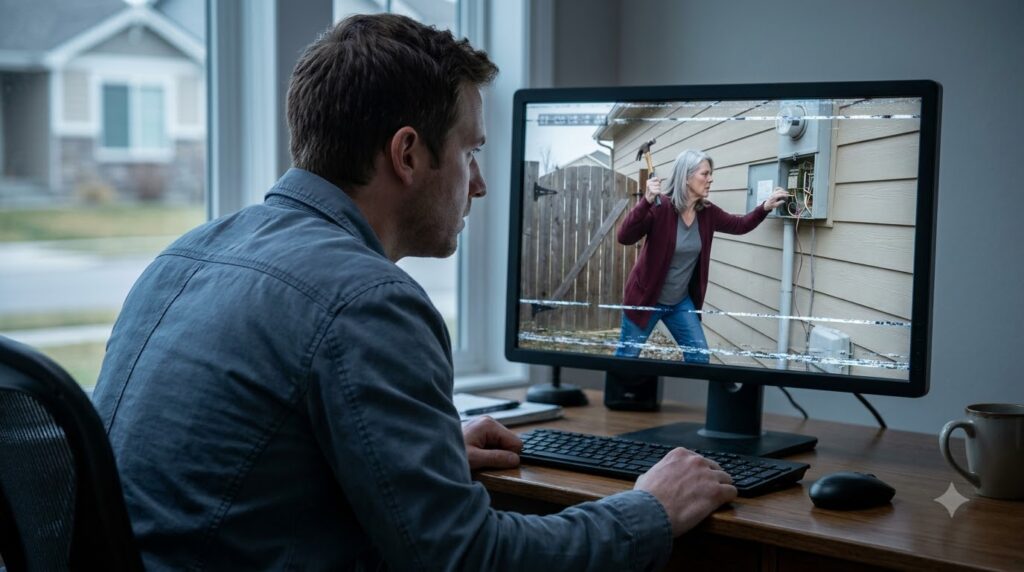
Mark didn’t move his hand from the mouse. His forearm stayed flat against the cold veneer of the desk, the blue-gray cotton of his sleeve catching the pale blue wash of four compressed camera tiles. In the lower-right quadrant, where the 28mm lens looked straight down the narrow gravel alleyway between his garage and the cedar fence, the light was yellow and dry.

Then the latch moved.

It wasn’t a sudden drop. The galvanized iron bar rose two inches, held for a beat in the still August heat, and clicked back against the wood. Evelyn came through sideways. She didn’t look like a woman trespassing; she looked like someone checking a lock on her own back porch. The burgundy cardigan was heavy for the hour, the hem dragging slightly against the blue denim at her knees. She kept her left hand clamped over the tan strap of her crossbody purse, her shoulders pulled tight toward her neck.

In her right hand, the steel claw hammer caught the afternoon sun—a dull, pitted gray head attached to a hickory handle worn dark by palm sweat.

Mark leaned forward. The chair spring groaned under his weight, a sharp metallic click in the quiet office. His eyes narrowed on the monitor frame. He didn’t call out. He didn’t reach for his phone. He watched the screen the way a man watches a crack spread across winter ice: calculating the depth before measuring the fall.

Evelyn stopped two inches short of the grey vinyl siding. Her profile was sharp against the shadow of the garage eave, her shoulder-length gray hair pulled back by the windless heat. She turned her torso just enough to block the sightline from the street, lifted the hammer four inches, and brought the flat face down directly onto the plastic housing of the communications box.

There was no sound on the digital stream, but the physics were immediate.

The grey plastic cover sheared down the center seam. The lower hinge snapped, sending a triangular shard bouncing into the gravel. Inside, the orange fiber splice tray buckled under the force, the thin glass threads shearing beneath the impact.

On Mark’s desk, the quadrant died.

Horizontal bands of green and magenta tore across the image, shivering like static on a dead channel, before the window went solid black. A white system prompt bloomed in the center of the dark square: SIGNAL LOST / NO CONNECTION.

Mark’s chest tightened, a slow, cold weight settling behind his ribs. His fingers twitched against the plastic body of the mouse, feeling the faint, rhythmic vibration of the desktop tower humming beneath the wood. He stared at the error prompt for three full seconds while the room-tone of the house—the low hum of the refrigerator in the kitchen, the distant rush of the HVAC compressor outside—filled the silence.

“Why did the camera feed just die?” he whispered to the dark glass.

He didn’t wait for the cloud server to report the timeout. He reached down, unlocked the small steel cabinet mounted to the floorboards beneath his desk, and checked the green LED flickering on the local battery backup. The hard drive was still spinning, its internal needle writing raw, uncompressed video directly to the iron platter.

He stood up, the blue-gray shirt stiff against his back, and turned toward the hallway that led to the side door.


CHAPTER 2: THE GRAVEL PATH AND THE CHROME HEAD

The latch on the utility door didn’t yield easily. Sun-swollen cedar had wedged the frame tight against the jamb, requiring Mark to put his shoulder into the wood until the deadbolt scraped free with a dry, iron screech.

Outside, the heat hit like a wet wool blanket thrown over the face. The alleyway between the garage and the six-foot boundary fence smelled of scorched gravel, dying weeds, and the sharp, chemical tang of ozone coming off the shattered telecom housing.

Mark didn’t rush. He kept his boots planted in the loose grey stone, his casual blue-gray shirt already sticking to the small of his back. Every motion was deliberate. He leaned his hips against the vinyl siding, the heat of the wall soaking through his clothes, and looked down at the wreckage.

The grey plastic casing of the primary communications box hung by a single torn hinge, twisting in the dead air. Below it, fine white plastic dust coated the dry blades of crabgrass like winter frost. Two glass fiber strands—thin as horsehair and shimmering with a faint, fractured light—poked out from the sheared orange conduit.

He knelt, the sharp gravel pressing through his jeans into his kneecaps.

With two fingers, he picked up the largest fragment of the housing. The break was clean where the steel claw had struck, but right at the impact crater, the plastic bore the impression of a cross-hatched hammer face. It wasn’t an accident. It wasn’t a clumsy brush while trimming hedges. The blow had been delivered straight-on, driving perpendicular into the wall with enough foot-pounds of force to buckle the quarter-inch mounting plate behind it.

Mark flipped the plastic shard over in his palm. The back was coated in fine red dust—not dirt from his yard, but the clay-heavy soil from Evelyn’s side of the fence where she kept her prized potted hydrangeas.

As he reached down to sweep the remaining plastic shards into a small pile, his knuckles brushed the base of the nearest cedar fence post. The wood there was grey, weathered, and soft with dry rot near the soil line. But two inches above the dirt, driven flush into the decaying grain, sat three brand-new chrome-headed framing nails. They were clean, unweathered, and entirely out of place on a twenty-year-old fence line.

Mark touched the head of the top nail. The metal was cool despite the midday sun, hidden as it was beneath the overhang of a decorative vinyl cap Evelyn had installed three months ago.

He frowned, tracing the line of the post with his eyes. The fence didn’t run completely parallel to the garage. At the back corner of the lot, it angled inward by nearly four inches—a subtle creep he had always attributed to sagging posts and shifting earth. But the fresh chrome nails were anchor points, recently set, anchoring a thin galvanized wire that ran low to the ground, disappearing straight beneath the cedar pickets toward Evelyn’s foundation.

A heavy footstep crunched in the gravel at the far end of the alleyway.

Mark didn’t snap his head up. He stayed on one knee, let his hand drop casually over the chrome nailhead, and slowly turned his head.

Evelyn was standing just beyond the open wooden gate, her figure framed by the brilliant glare of her white-graveled driveway. She had taken off her cardigan, revealing a short-sleeved gray top that showed the ropy, sun-spotted muscle of her forearms. The tan crossbody purse was gone, but her hands were folded tightly over her stomach, her fingers twitching against her knuckles.

“You shouldn’t be messing with those lines, Mark,” she said. Her voice didn’t carry the high, frantic pitch of a trespasser caught in the act. It was flat, measured, and layered with the stale authority of a town clerk reading an overdue notice. “That’s county infrastructure. You touch the wrong wire and you’ll short the grid for the whole cul-de-sac.”

Mark stood up slowly, the gravel shifting beneath his soles. He kept his hands loose at his sides, his tablet tucked under his left arm.

“The grid is fine, Evelyn,” Mark said, his voice dropping into a low, flat register that matched the dry heat of the alley. “The fiber line, however, is dead.”

“Things deteriorate,” she said, her eyes darting past his shoulder to the shattered box hanging from his wall. She didn’t step through the gate. She stayed firmly on her side of the threshold, her black sneakers planted on her own concrete. “Sun damage. Cheap builder materials. I told you eighteen months ago when you had those utility boys out here—that wall wasn’t engineered for heavy loads. The whole setback is a shared corridor anyway.”

“It’s my deeded wall,” Mark replied quietly.

“On paper, maybe,” Evelyn said, a faint, cold smirk touching the corners of her thin lips before vanishing back into her neutral mask. “But papers from thirty years ago aren’t always the last word, Mark. Things get recorded wrong at the courthouse. Easements overlap. Sometimes people think they own the air three feet off their foundation when they’re actually sitting on someone else’s drain line.”

She reached into her pocket, pulled out a small set of brass keys, and let them clink against her palm.

“I’d be careful about calling any technicians out here,” she added, her eyes locking onto his with a hard, unyielding stare. “You start digging around that wall, you might find out your whole garage is sitting on a space it has no right to occupy.”

She turned on her heel and walked back toward her garage door, the soles of her sneakers squeaking faintly on the hot pavement.

Mark stood in the narrow shade of the eave, watching her disappear behind her screen door. He reached into his pocket, pulled out his phone, and took a close-up photograph of the three chrome framing nails driven into the rot of the post, noting how the galvanized wire pulled tight toward her lot.

He didn’t clean up the broken plastic on the ground. He left every fragment exactly where it had fallen, walked back inside his house, and pulled up his county tax portal to pull the original 1996 subdivision plat maps.

CHAPTER 3: THE DUST OF THIRTY YEARS

The county GIS map on Mark’s dual monitor setup didn’t lie, but it didn’t tell the whole truth either.

The blue property boundaries overlaid on high-resolution satellite imagery showed a clean, crisp rectangle defining Lot 42—his lot. The line ran precisely three feet west of his garage wall, placing the severed utility box, the gravel alleyway, and the cedar fence post solidly inside his deeded boundary. But when he pulled up the original 1996 plat records buried four tiers deep in the county recorder’s PDF archive, the line began to blur.

A blue-ink stamp from the original land developer, Oakridge Estates Development Corp., sat crooked at the bottom of the scanned plat sheet. Below the faint signature of the chief surveyor, someone had added a hand-written addendum in dark ballpoint pen: Subject to 6ft cross-lot drainage and maintenance corridor along west elevation of Structure 42.

Mark leaned close to the screen, his eyes tracking the pixelated ink. The handwriting wasn’t the surveyor’s precise block lettering. It was slanted, loose, and signed with initials that matched neither the county inspector nor the civil engineering firm listed on the header: G.H.

George Harrison. Evelyn’s late husband.

Mark set his coffee mug down on the desk, the ceramic ringing against the laminate. George Harrison had been a senior land planner for the township in the late nineties, a man whose name still appeared on half the variance approvals hanging in the municipal building downtown.

A sharp knock echoed from the front entryway—three brisk, authoritative raps against the solid core door.

Mark didn’t rush. He saved the PDF to his local desktop drive, locked his workstation, and walked down the hallway. Through the narrow glass sidelight, he saw a white Ford Ranger parked at his curb. The vehicle bore the blue emblem of the County Department of Building & Code Enforcement on its door.

Standing on the concrete porch was Inspector Vance, wearing a sweat-stained khaki uniform shirt, a heavy leather tool belt, and a worn clipboard tucked under his arm. Three feet behind him, standing at the edge of the lawn with her hands clasped tightly in front of her gray top, was Evelyn.

Mark pulled the door open, letting the air-conditioned breeze escape into the sweltering afternoon heat.

“Mark?” Inspector Vance asked, squinting against the glare of the porch. “Vance, County Code Enforcement. We received an emergency priority call regarding an unpermitted structural hazard on the west garage wall.”

“There’s no structural hazard, Inspector,” Mark said evenly, stepping out onto the porch and closing the door behind him. He kept his posture straight, his shoulders relaxed in his blue-gray shirt. “It’s a standard low-voltage telecom drop.”

“He’s lying, Vance,” Evelyn called out from the grass, her voice slicing through the quiet neighborhood air. She took two steps up the walkway, her black sneakers digging into the edge of Mark’s sod. “The box is hanging off the wall, sparking into the dry brush! He ran unauthorized wiring through a shared utility corridor that was designated for neighborhood drainage thirty years ago!”

Inspector Vance sighed, rubbing the back of his neck where a ring of salt had dried against his collar. “Ma’am, let me handle the inspection. Mark, I need to see the wall.”

“Follow me,” Mark said.

They walked around the corner of the house, their boots crunching on the dry turf before stepping into the gravel alleyway. Evelyn followed five paces behind, her eyes darting between the garage roofline and the cedar fence as if measuring the air between them.

When Vance reached the damaged site, he stopped, his boots kicking against a stray fragment of grey plastic. He looked at the shattered casing, the severed orange fiber tray, and the bare vinyl siding where the mounting screws had been ripped from their anchors.

“This didn’t fail from wind load or age, Mark,” Vance said quietly, kneeling down to inspect the fracture points. “Looks like someone took a tool to it.”

“She used a claw hammer at 2:14 PM,” Mark said.

Evelyn stepped up to the wooden gate, resting her hand on the latch. “That’s a ridiculous accusation! I brought Inspector Vance out here because I have the legal documentation right here!” She pulled a folded, yellowed sheet of heavy bond paper from her purse and held it toward Vance. “This is a certified copy of the 1996 Developer’s Access Agreement. It explicitly grants Lot 43 full right-of-way over this six-foot corridor for drainage and infrastructure control. He has no right to mount equipment here at all!”

Inspector Vance took the paper, unfolding it against his clipboard. He adjusted his reading glasses, his thumb tracing the yellowed margin where a blue-ink stamp sat faded under decades of storage.

Mark watched the inspector’s face closely. He didn’t interrupt. He didn’t shout. He let the silence of the alleyway do the work.

“Well,” Vance said after a long half-minute, his voice sounding hesitant for the first time. “This document appears to carry an official township seal from ’96. It designates this strip as a shared drainage corridor under joint maintenance of Lots 42 and 43.” He looked up at Mark, a slight frown creasing his brow. “If this easement is active, Mark, any permanent surface-mounted hardware on this wall might actually require a joint variance from your neighbor before installation.”

Evelyn’s chin rose an inch. A faint, triumphant smile touched the corners of her mouth as she looked at Mark. “I told you, Mark. You don’t own this space the way you think you do.”

Mark didn’t flinch. He looked at the paper in Vance’s hand, noting the faded blue ink of the stamp, then turned his gaze back to the base of the fence post where the three brand-new chrome-headed nails pinned the hidden galvanized wire.

“Check the civil engineer registration number on that stamp, Inspector,” Mark said quietly, his voice dropping into a razor-thin edge. “Cross-reference it with the state board. You’ll find that registration belonged to George Harrison—and it was revoked six months before that paper was signed.”

Evelyn’s smile froze. Her hands tightened into fists at her sides, her black sneakers shifting uncomfortably in the loose gravel.

CHAPTER 4: THE AMBUSH AT THE CURB

Inspector Vance stopped with his thumb pinned to the edge of the yellowed paper.

The silence between the three of them didn’t stretch softly; it tightened like wire under tension. Evelyn didn’t step back, but her knuckles turned porcelain-white against the leather strap of her purse. A heavy gust of wind rattled the dry leaves of the maple tree at the curb, throwing dappled shadows across the heat-baked gravel path.

“Revoked?” Vance muttered, his eyes narrowing as he lifted the document closer to his face. He squinted at the faint blue ink of the stamp, his leather tool belt creaking as he shifted his weight. “George Harrison’s stamp was pulled?”

“March 1996,” Mark said. His voice was steady, cool, and completely devoid of drama. He kept his stance planted on the gravel, his hands loose at his sides. “Check the county administrative records for board order 96-04. George Harrison was stripped of his seal for back-dating site surveys in Oakridge Phase One. That paper isn’t a legal easement, Inspector. It’s an unrecorded draft written by a man who didn’t hold a license when he inked it.”

Evelyn’s breath hitched, a sharp, ragged sound. Her head snapped toward Mark, her eyes burning with an intense, icy rage.

“You don’t know a thing about George,” she spat, her voice trembling with an edge that was no longer municipal or civil. It was personal. “George built this neighborhood! He laid out every lot line on this block while you were still in grade school! You come in here with your cameras and your corporate job, thinking you can tear up thirty years of history because you bought a piece of paper at a bank auction!”

“I bought a deeded parcel, Evelyn,” Mark replied softly. “And your husband had no authority to grant you an easement on my garage wall.”

“That’s enough,” Vance interjected, his tone hardening as he folded the document along its yellowed creases and held it back out to Evelyn. “Ma’am, take this back. I’m code enforcement, not a land court judge, but if this document isn’t registered on the actual county deed book, it doesn’t give you standing to claim an unpermitted hazard on his wall. And frankly, looking at this housing, the damage isn’t structural degradation. It’s impact.”

Before Evelyn could snatch the paper from Vance’s hand, a low, rhythmic pulse of blue and red light reflected off the chrome bumper of Vance’s white Ranger.

A county sheriff’s squad car swung slowly into the mouth of the cul-de-sac. Its tires crunched against the dry gravel near the gutter before coming to a stop directly behind Vance’s truck. The driver’s door opened, and Deputy Miller stepped out into the oppressive heat. He was a broad-shouldered man in his late thirties, his dark uniform crisp despite the humidity, his radio humming with faint, garbled static.

He didn’t rush his approach. He adjusted his duty belt, his boots making a slow, deliberate cadence on the asphalt as he walked up Mark’s driveway. Across the street, two neighbors—old Mr. Henderson leaning on his rake and the young couple from Lot 40—stepped out onto their front porches, their eyes locked on the squad car.

“Afternoon,” Deputy Miller said, his gaze sweeping over Inspector Vance’s uniform, Mark’s calm posture, and Evelyn’s rigid, trembling frame. “We got a call about a verbal disturbance and property damage at this address. Who called it in?”

“I did,” Mark said, taking a half-step forward. He gestured toward the alleyway behind him. “At 2:14 PM, my exterior telecom box was smashed with a claw hammer, severing my main fiber line and camera feed.”

Evelyn immediately moved to cut between Mark and the officer, her hands gesturing wildly toward the house. “Deputy! Thank God you’re here. This man is trying to frame me! He’s running illegal electrical lines across a shared drainage corridor, and when his own rotten equipment collapsed, he started making wild, slanderous threats against a widow!”

Deputy Miller turned his head slowly toward Evelyn, his expression unreadable behind his dark aviator sunglasses. “Ma’am, I’m going to need you to take two steps back and let me talk to the homeowner.”

“He’s making it up!” Evelyn shouted, her voice carrying across the cul-de-sac, loud enough to make Mr. Henderson stop raking entirely. “He has no proof! He’s using fake tech talk to confuse the inspector! Ask him for proof! He doesn’t have any!”

Mark reached down to the tablet resting against his hip. He didn’t raise his voice to compete with her shouting. He simply unlocked the screen, tapped the local media player, and held the glass pane out toward Deputy Miller and Inspector Vance.

“I don’t need to argue about what happened, Deputy,” Mark said, his voice quiet against the heat. “My internet line was cut to stop the cloud upload. But the local hard drive sits on a battery backup in my desk.”

Evelyn froze. Her mouth stayed half-open, her chest rising and falling rapidly under her gray top.

On the bright, high-definition screen of the tablet, the wide-angle camera view of the side alley showed up in crystal-clear detail. The timestamp in the corner read 14:13:48.

They watched as the wooden gate swung open. They watched Evelyn walk through in her burgundy cardigan, her tan purse slung across her chest. They watched her pull the claw hammer from her side, step up to the garage wall, and bring the steel head down with a single, sharp strike into the plastic box before turning on her heel and slipping back into her yard.

Deputy Miller didn’t say a word. He looked at the video, then looked up at Evelyn.

In the silence that followed, the faint sound of a metallic clink drifted from the corner of the driveway. Mark glanced down. Where the gravel met the edge of his garage foundation, a small patch of dirt had been disturbed by Vance’s heavy boots. Sticking out from the crushed limestone was a heavy brass survey cap, tarnished green with age, stamped with a serial number that didn’t match Mark’s property deed—or Evelyn’s.

Mark’s eyes narrowed as he stared at the exposed brass pin. The survey cap was set six feet inside his property line, buried intentionally under two inches of loose rock.

Deputy Miller turned his body fully toward Evelyn, his hand resting casually near his belt. “Ma’am,” Miller said, his voice dropping into an official, unyielding tone. “I’m going to need you to step over to the hood of my cruiser right now.”

CHAPTER 5: THE PROOF AT THE PROPERTY LINE

Evelyn didn’t move toward the cruiser. She stiffened, her spine locking as if someone had driven an iron rod through her cardigan. Her eyes darted from Deputy Miller’s hand resting near his sidearm to the tablet glowing in Mark’s grip.

“I am sixty-two years old,” she whispered, the words rasping out of her throat like dry straw dragging across stone. “You are not going to order me around on my own driveway, Deputy.”

“It’s not your driveway, ma’am,” Deputy Miller said. His voice was devoid of malice, flat and immovable as a granite curb. He stepped forward, his heavy leather duty boots crunching on the loose gravel. “You crossed a closed gate onto private property and destroyed a utility installation with a hammer. It’s recorded in four-K resolution with a timestamp. Now step over to the hood of the car.”

Across the street, Mr. Henderson shifted his grip on his rake, resting both palms on the wooden handle. The young couple from Lot 40 stepped off their porch, coming down to the edge of their lawn to watch. The sun beat down mercilessly, boiling the tar in the street seams and filling the air with the smell of scorched rubber and hot vinyl.

“Look at the video again, Officer!” Evelyn insisted, her voice rising into an unsteady, brittle register as she pointed a shaking finger at Mark. “He set that up! He knew I was going to check the easement! He put that box there to trap me!”

Inspector Vance shook his head slowly, tucking his clipboard tightly under his arm. “Ma’am, no one forced you to carry a claw hammer into his alleyway. That’s a criminal act, plain and simple.”

Deputy Miller reached out, his hand making firm contact with Evelyn’s upper arm. She flinched, pulling back violently, but the deputy’s grip was locked. He guided her three paces to the front hood of the black-and-white Explorer. The metal hood was radiating intense heat, and she winced as he instructed her to place her palms flat against the black paint.

“You’re making a catastrophic mistake,” Evelyn snarled, her cheek pressed near the hot hood as Miller pulled her wrists behind her back. The sharp, double-click of the steel handcuffs echoed across the silent cul-de-sac. “My husband built this township! When the land court sees the original filings, you’ll be stripped of your badge!”

Mark stepped closer, his boots stopping right where the gravel met the driveway’s edge. He didn’t gloat. He didn’t smile. The heat of the afternoon sun burned against the nape of his neck, but inside, his thoughts were cold, precise, and calculating every move ahead.

“Deputy,” Mark said quietly, holding up the tablet. “I can transfer the raw video file directly to your department’s secure evidence portal right now. I also have the photographs of the damaged housing, the cut fiber strands, and the boot prints in the gravel.”

“Appreciate that, Mark,” Miller said, clicking the cuff ratchets once more to lock them in place. He looked at Evelyn, whose face was now pale and wet with sweat, her shoulder-length gray hair sticking to her forehead. “Mrs. Harrison, you are under arrest for criminal mischief and criminal trespass.”

“He stole six feet of my yard!” Evelyn screamed suddenly, turning her head toward the watching neighbors across the street. Her voice cracked, hysterical and raw. “Look at him! Look at what he’s doing to George’s memory! That fence is six feet inside my boundary! George put that brass pin in the ground thirty years ago! He marked it!”

Mark looked down at the exposed brass survey cap half-buried under the limestone near his garage corner. He crouched, his fingers brushing aside the loose stone until the tarnished collar of the brass pin was fully visible.

Stamped deeply into the bronze rim were the letters G.H.-96, but right beneath the surveyor’s mark was a fresh, deep groove where someone had recently used a cold chisel to alter the secondary number—turning a 3 into an 8.

Mark touched the fresh, unoxidized scratch in the metal. The realization hit him not as a surprise, but as the final, missing gear dropping into place.

Evelyn hadn’t smashed the box because she hated the visual sight of the vinyl housing. She had smashed it because the telecom technicians were scheduled to return the following morning with a deep-trenching machine to lay a permanent underground line along that exact path—a trench that would have unearthed the falsified survey pin her husband had buried thirty years ago to steal six feet of Mark’s lot.

“She wasn’t protecting an easement, Deputy,” Mark said, standing up and dusting the grey limestone powder from his knees. “She was trying to keep a backhoe out of the dirt before someone measured from the real pin.”

Deputy Miller looked down at the exposed brass head, then at Inspector Vance, who lowered his glasses in disbelief. Evelyn stopped screaming. She went completely limp against the hood of the cruiser, her eyes fixed blankly on the dry asphalt beneath her shoes.

“Get in the car, ma’am,” Miller said quietly, opening the rear door.

CHAPTER 6: THE STEEL LOCK AT THE BOUNDARY

The rear door of the patrol car closed with a heavy, hollow thud that cut off Evelyn’s muffled protests.

Deputy Miller walked around to the driver’s side, adjusting his cap against the blinding glare reflected off the windshield. He paused by the front bumper, looking at Mark, who remained standing where the gravel met the driveway asphalt.

“I’ll have the evidence technician log the video clip directly from the department link,” Miller said, his voice flat and unhurried as he rested one forearm on the roof of the Ford Explorer. “She’ll be processed at the county substation before the magistrate sets bond on the property destruction charge. You’ll get a formal notice for the restitution hearing in two weeks.”

Mark nodded once. “I’ll have the itemized invoice from the telecom utility ready for the clerk.”

“Do that,” Miller said. He glanced over at Inspector Vance, who was already scribbling notes across his clipboard near the white Ranger. “Inspector, you need anything else from the scene?”

“No,” Vance called back, his tone dry as bone. “I’m signing off on the code complaint as unfounded. The structure is compliant, the easement claim is invalid, and I’m filing a notice with the county recorder to flag that 1996 plat sheet for fraudulent alteration.”

Miller got into the cruiser, pulled away from the curb, and turned the corner at the top of the cul-de-sac. Across the street, Mr. Henderson slowly lowered his rake, gave Mark a brief, single-nod gesture of quiet solidarity, and walked back up his porch steps. The street settled back into the thick, suffocating silence of late afternoon.

An hour later, the hum of a diesel engine broke the quiet as a orange-and-black utility van backed into Mark’s driveway. Two technicians in hi-vis vests stepped out, carrying heavy tool cases and a long spool of black armored fiber conduit.

Mark met them at the wooden gate. He led them down the gravel alleyway to the garage wall where the shattered plastic casing still hung from its buckled hinge.

“Messy,” the lead technician, a burly man named Dave, muttered as he set his toolbox down on the gravel. He ran a gloved thumb over the sheared mounting plate. “Looks like someone took a sledge to the primary drop.”

“A claw hammer,” Mark corrected mildly, his posture straight, his hands tucked into the pockets of his jeans. “I want the replacement mounted directly to the concrete anchor studs behind the vinyl siding. And I want the heavy-duty enclosure.”

Dave grinned, pulling a heavy, powder-coated steel box from the back of the van. The box was forged from sixteen-gauge cold-rolled steel, fitted with a dual-locking tumbler mechanism and a heavy flange designed to resist mechanical impact.

“This one doesn’t break,” Dave said, lifting the steel cabinet against the wall. “You’d need a plasma torch or a grinder to get through this shell.”

For two hours, the alleyway rang with the rhythmic sound of masonry drills bit-screaming into concrete, the sharp pop of heavy expansion anchors expanding into the wall studs, and the smooth, ratcheting click of a torque wrench locking the steel housing to the house.

Mark stayed in the alleyway the entire time. He watched every bolt go in. He watched the technicians splice the fine glass fiber threads inside the armored splice tray, testing the light attenuation on their digital meters until the laser signal read clean and uninterrupted.

When the technicians finished and drove away, Mark stood alone in the cool shade of the eave.

The new box sat flush against the vinyl, dark grey, seamless, and immovable. Below it, the altered brass survey pin near the fence corner had been flagged with orange surveyor’s tape, waiting for the official county crew to re-establish the true deeded boundary line in the morning.

Mark walked back inside his home office. The air inside was cool, smelling faintly of clean air filters and warm electronics.

He sat down in his chair, leaning forward until his shadow fell across the desk. On the secondary screen, the four-tile grid was active again. The lower-right quadrant displayed a crystal-clear, high-definition 1080p view of the side alleyway: the gravel path, the wooden gate, the cedar fence, and the dark steel box bolted securely to his wall.

The feed was smooth, uninterrupted, and absolute.

Mark reached down to the desk console, clicked the save prompt on the local DVR configuration, and closed the system log. He didn’t look back at the quiet street outside. He turned his attention to his primary monitor, opened his work files, and let the quiet, steady rhythm of his own house fill the room.

Similar Posts

Leave a Reply

Your email address will not be published. Required fields are marked *






