CHAPTER 6: THE FINAL MEASURE AT THE BOUNDARY
“The physical grid doesn’t lie, Brenda. You can’t rewrite an easement with an adjustable fence.”
The county surveyor’s voice was completely flat, stripped of any neighborly politeness or bureaucratic hesitation. Miller stood directly on the line, his scuffed work boots straddling the open trench where the rusted iron collar sat exposed like an old tooth. He held a heavy brass plumb bob suspended by a braided nylon cord, its pointed steel tip hovering precisely three millimeters above the center notch of the benchmark.
Brenda stood entirely outside her green umbrella now. The shadow of her massive, white-trimmed detached garage fell across her face, but it couldn’t hide the grey, drawn tint of her skin. The linen suit she’d worn to the curb looked completely wrinkled, its hem stained with dark gray splashes of limestone dust from the surveyor’s boots. Her hands were dropped to her sides, the silver-rimmed phone tucked away into her pocket.
Beside her, the property manager from the HOA didn’t say a word. He was looking down at a fresh copy of the city-stAMPED municipal easement map unrolled across the hood of my lawnmower, his thumb pinning a brass surveyor’s rule against the grid lines.
“The original hubs from the 2006 phase were dropped completely blind,” Miller continued, his index finger tracing the solid black line where the concrete footing of Brenda’s garage met the soil. The paper made a dry, brittle crinkle under his callused thumb. “The developer built the perimeter retaining wall to match a misplaced fence line instead of pulling the true coordinate from the county baseline. If this iron pipe is the primary high-pressure utility hub, your garage isn’t just crossing onto her deeded turf.”
He paused, the heavy hum of the county truck’s diesel engine at the curb filling the silent gap.
“It’s sitting exactly twelve inches into the main county infrastructure channel,” Miller said softly. “The city has immediate, non-negotiable right-of-way for any excavation or structural clearance along this entire run. No board variance can override a stamped municipal utility line. If the township orders a line inspection, that whole eastern wall has to come down.”
The silence that followed was total. It was a dense, suburban silence that had nothing to do with birds or lawnmowers—it was the sound of twenty years of performative authority evaporating into a single sheet of paper.
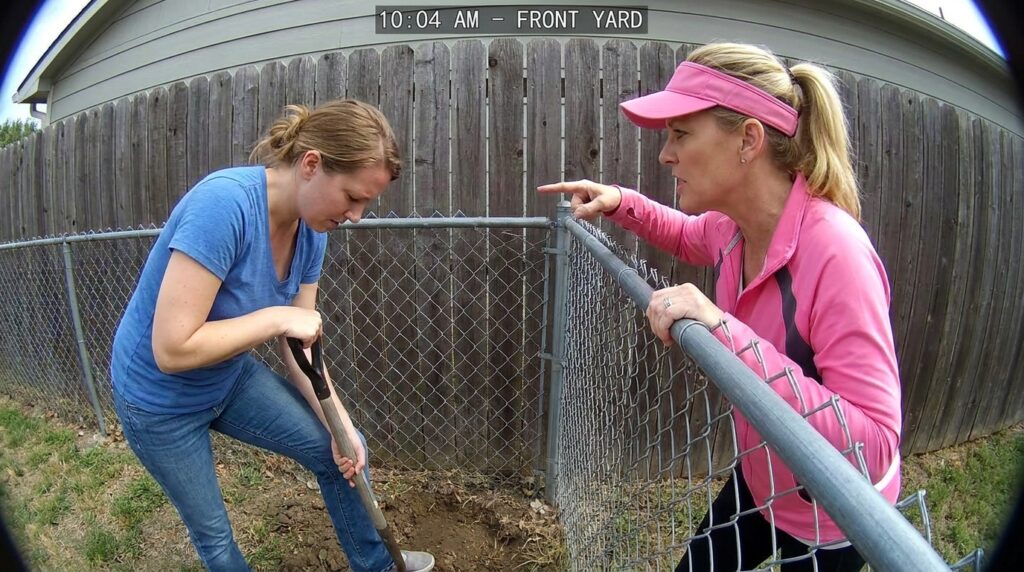
I stepped forward, my hands resting on the ash-wood handle of my spade, which remained planted deep in the limestone trench like an immovable marker. The dried clay on my fingers flaked off, dropping small gray crumbs into the dirt. I didn’t smile, and I didn’t raise my voice. In the gritty reality of the block, you don’t need a villain speech when the math has already closed the door.
“The fence stays on the true mark, Brenda,” I said, my voice steady, carrying the physical exhaustion of three nights of digging. I pointed down toward the exposed iron collar at the bottom of the cut. “And the trench goes down another six inches to clear the grade. I’m not changing my drainage project just because your contractor built a foot past your legal rights.”
Brenda looked from the surveyor’s transit to the unblinking black dome of the doorbell camera mounted on my porch eave. She knew what was on the drive—the night-vision footage of her planting the false yellow-capped survey stake at two in the morning, the desperate attempt to manufacture an HOA violation before the official trucks could arrive. The record was locked. Every movement she had made to protect her border had only served to draw the county’s attention directly to her own structural overreach.
The property manager finally rolled up his ruler, the brass clicking softly against the metal trim of his clipboard. He looked at Brenda, then turned his back toward the car. “The association is pulling the citation, ma’am. We’re non-parties to a county utility easement dispute. You’ll have to handle the variance with the city engineering office directly.”
Brenda took a slow, heavy step back toward her patio, her leather shoes crunching softly on the dry rye grass. Her shoulder line had completely dropped, the rigid posture she had maintained at the curb shattering into a limp, defeated retreat. She didn’t look at the fence, she didn’t look at the trench, and she didn’t look at the neighbors who were now standing openly on their porches down the block, watching her walk toward her side door.
I turned back to the trench, my boots finding the familiar ledge of the limestone shelf. I gripped the wood of the handle, lifted the spade, and drove the steel blade back into the earth with a clean, heavy clink that sounded like an absolute resolution.
“The fence doesn’t move just because you scream at it,” I muttered to the empty air between the houses, the grit under my nails pressing into the hickory as the afternoon sun finally cleared the ridge of the roof.