CHAPTER 3: THE SEIZURE AT THE CURB
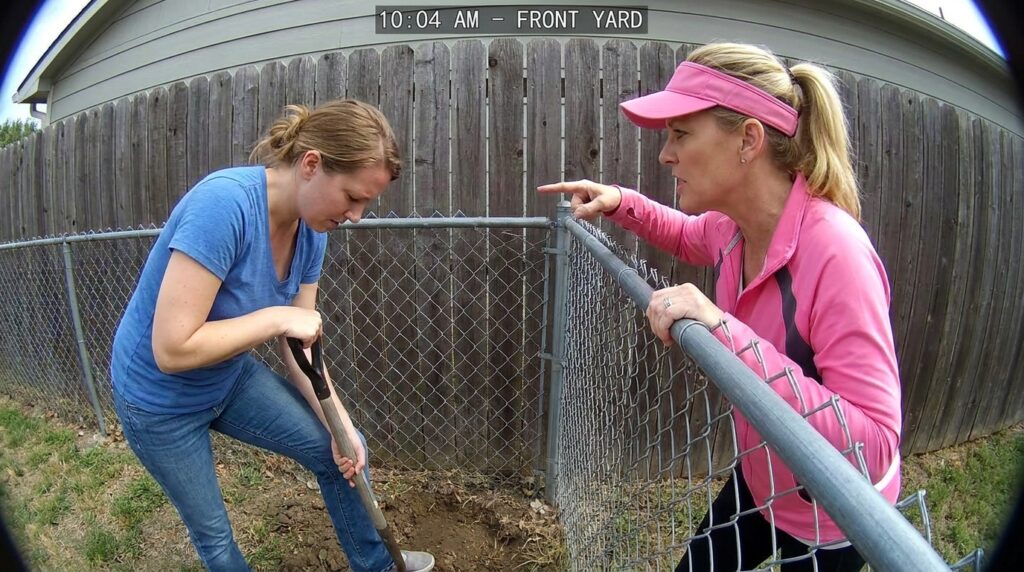
“You can drop the shovel now. It won’t save you from a formal lean.”
The words cut through the heavy morning heat before I even reached my driveway. Brenda was standing by the mailboxes, her bright pink athletic gear replaced by a crisp, tailored tan linen suit that looked completely unsuited for the ninety-degree humidity already radiating off the asphalt. She didn’t have her phone out this time. Instead, her hands were locked across her chest, pinning a bright white cardboard folder to her ribs. Beside her sat a white compact crossover with an orange magnetic strobe light resting silently on its roof—the property manager’s vehicle.
I didn’t slow my stride. The wooden handle of the spade was slick with sweat against my palms, and a crust of dried gray clay from last night’s excavation was caked around the steel collar. I stopped at the lip of my concrete apron, the sun beating down on the back of my neck with a dry, relentless itch.
“The trench is on my plat,” I said. I let the metal tip of the spade drop onto the concrete with a sharp, heavy clack that made the property manager shift his weight inside the idling car. “If the drainage isn’t cleared before Friday, the runoff will split the foundation block. Your bylaws don’t cover hydrostatic pressure, Brenda.”
“No, but they cover unapproved structural soil disruption within ten feet of a primary common line,” she countered. She stepped forward, her leather flats clicking on the sun-baked curb. The movement was practiced, her eyes tracking the precise line where my blacktop met her manicured turf. She pulled a folded sheet of yellow paper from the folder and held it out, her fingers stiff. “This is a formal cease-and-desist from the architectural committee. Effective at seven fifty-five this morning. Any further modification of that perimeter results in an immediate seven-hundred-dollar administrative fine per calendar day.”
I took the paper with my left hand, keeping my right wrapped tightly around the shovel’s ash-wood shaft. The document was warm from the sun, the ink fresh enough to smell of hot chemical toner. At the top, the bold lettering of the development’s management company was clear, but my thumb brushed the official validation stamp at the bottom corner. The purple ink was slightly smeared, the digital date code altered with a heavy black line through the original tracking number.
Brenda wasn’t waiting for me to read it. She took another half-step, her proximity close enough that I could smell the sharp, artificial lavender of her perfume mixed with the dry scent of her parched lawn. “The board doesn’t negotiate with new owners who treat the easement like a drainage ditch. The fence stays where it is, and that ditch gets backfilled before sunset, or the association handles it with an outside contractor at your direct expense.”
“The committee didn’t vote on this last night, Brenda,” I murmured, my eyes still fixed on the smeared ink of the validation stamp. The physical reality of the paper didn’t match the timeline of the board’s monthly meetings. “The office doesn’t open until nine on Wednesdays. Who signed off on the emergency variance?”
Her jaw tightened, the linen of her jacket wrinkling as her arms locked even harder against her chest. “The executive council has emergency oversight when a structural threat is identified by a resident of good standing. I don’t need a quorum to protect my foundation from someone with a hardware-store spade and an internet mapping tool.”
She reached down, her manicured hand moving toward the upper grip of my shovel as if to enforce the paper with a physical extraction. Her fingers closed around the dry, weathered wood just above my hand.
I didn’t pull back. I simply shifted my weight, driving the heel of my boot downward onto the spade’s metal shoulder, pinning the blade into the narrow gap between the concrete driveway and the edge of the lawn. The wood groaned slightly under the counter-pressure, but it didn’t budge. The absolute finality of the tool stayed locked between us, a vertical bar of iron and hickory that separated her linen suit from my dirt-smudged jeans.
Through the rolled-down window of the compact car, the property manager finally spoke, his voice thin and raspy over the hum of his air conditioning. “We just need the digging to pause until the county surveyor clarifies the baseline, ma’am. That’s all. No one’s touching the fence today.”
Brenda let go of the handle, her fingers leaving a pale, clean print on the dust-covered wood. Her eyes drifted down to the yellow paper in my hand, then back to the house behind me, where the dark dome of the security camera on the porch sat motionless under the eaves. Her performance of absolute authority had a crack in it now—a small, barely visible line that had nothing to do with the bylaws she kept quoting.
“Friday morning,” I said, my voice dropping into the quiet space between the idling car engine and the dry rustle of the honeysuckle. “The surveyor comes out with the original municipal stakes. If that iron pipe I found last night is the real baseline, your garage is eighteen inches over the mark, Brenda. Let’s see what the executive council says about structural threats then.”
She didn’t answer. She turned toward the white car, the linen of her skirt flashing starkly against the dark asphalt as she opened the passenger door, leaving the altered notice vibrating in my hand under the glare of the suburban sun.