CHAPTER 4: THE MEASUREMENT UNDER THE SUN
The optical lens of the surveyor’s transit caught the direct glare of the ten o’clock sun, throwing a blinding needle of white light across the yellowed rye grass. I stood by the corner post of the chain-link fence, my shoulder blades tight under my sweat-dampened shirt. The heat was a heavy, physical weight pressing down into the yard, drawing up the sharp, bitter smell of the turned earth from the un-backfilled trench.
At the center of the yard stood Miller, a county-certified surveyor with twenty years of field grit on his leather vest. He didn’t look at me, and he didn’t look at Brenda, who was stationed precisely on her concrete patio under the shade of a wide green umbrella. Miller’s boots crunched through the parched weeds as he walked a slow circle around the deep hole I’d cleared near the honeysuckle roots.
“Hold that prism rod steady on the line,” Miller muttered to his assistant, his hand reaching down to adjust the heavy brass leveling screws of the tripod. The metal was hot enough to hum under his fingers.
I watched the assistant place the tip of the red-and-white striped pole directly into the gray sand at the bottom of the trench, right on top of the heavily oxidized iron collar I had unearthed. The steel tape measure between Miller’s fingers made a sharp, rhythmic zip-zip-zip as he hauled it out from its leather case. The metal ribbon was old, its black numbers partially eaten away by rust and scratched from years of dragging across gravel and concrete. Near the three-foot mark, the steel was notched with a rough, jagged edge where the original tension loop had snapped and been crudely re-riveted.
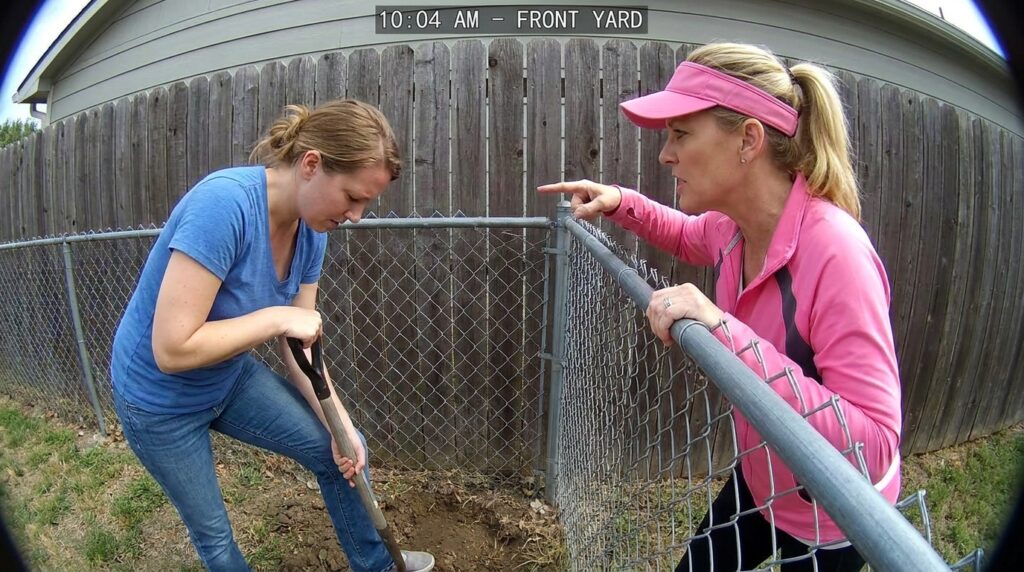
Brenda’s chair scraped against the concrete of her patio. She walked down the step, her sunglasses pushed tight against her brow, her bright pink visor a sharp punctuation mark against the dull gray siding of her garage. Her phone was locked between her hands, but she wasn’t filming. She was watching Miller’s hands on the brass transit with a cold, unblinking intensity.
“That pipe she dug up isn’t a residential pin, Mr. Miller,” Brenda said, her voice cutting through the heavy drone of a distant lawnmower. It was quieter than it had been on Wednesday, stripped of its administrative flourish and reduced to a tight, defensive strain. “The original developer’s survey from 2006 clearly places the boundary line three inches to the east of the wire. This entire neighborhood was recorded under that plat.”
Miller didn’t raise his head from the viewfinder. He clicked a dial on the side of the instrument, his thumb scarred and gray with graphite dust from his field notebook. “Developers lay pins to sell lots, ma’am. The county lays anchors to clear infrastructure. There’s a difference between a sales map and a benchmark.”
He stood up straight, his knuckles popping as he reached into his leather vest and pulled out a rolled bundle of translucent blue vellum—the original 1984 municipal municipal utility map, stamped with the heavy, purple ink seal of the county clerk’s office. He unrolled it against the warm hood of my lawnmower, using two rusted iron spikes to pin the corners against the wind.
“Come here,” Miller said, looking at me first, then nodding toward Brenda.
I stepped up to the mower, my boots leaving dark tracking prints of wet clay on the dry blacktop. Brenda hesitated, her linen-clad shoulders stiffening before she made her way to the opposite side of the engine shroud. Her gaze stayed fixed on the blue paper.
Miller’s stubby index finger traced a heavy, double-grooved line that cut straight across the residential blocks. “The young lady was right about the eighteen inches. The developer’s crew misaligned the corner hubs when they cleared the grade for the second phase of the subdivision. They dropped the chain-link right along the secondary line to save a retaining wall.” He pointed his finger directly at the bottom of the trench, where the assistant was holding the prism rod on the double-grooved pipe. “This iron collar here? This is the primary regional benchmark for the main high-pressure sewer easement. It hasn’t moved since the township laid the pipe forty-two years ago.”
A sudden, heavy silence fell over the yard, broken only by the dry hiss of the hot wind through the chain-link mesh.
Layer 1 was unlocked. The fence was wrong. The eighteen inches belonged to my deed. I felt a cold surge of vindication rise in my throat, but when I looked up across the blue vellum to see the collapse of Brenda’s posture, I didn’t see the panic of a defeated bully. I saw something else—a calculated, desperate lock of her eyes onto the western quadrant of the map where the lines didn’t stop at the fence.
Miller’s finger didn’t lift from the vellum. It drifted another two inches across the paper, crossing the newly discovered eighteen-inch border and moving directly under the heavy, solid black rectangle marked Structure 4B—Brenda’s detached garage.
“The misalignment doesn’t just shift the turf,” Miller said softly, his voice dropping into a flat, institutional cadence that carried no malice, only the cold finality of geometry. He looked up, his grey eyes settling under his weathered brow directly on Brenda. “If this benchmark is the absolute legal zero point for the utility easement, then your garage isn’t just over her lawn. It’s sitting twelve inches inside the county’s primary concrete utility conduit corridor.”
Brenda’s hand went completely still against her phone, her fingers turning the exact shade of chalk dust as her eyes locked onto the black ink lines that ran like iron rails right through the center of her home’s legacy.