
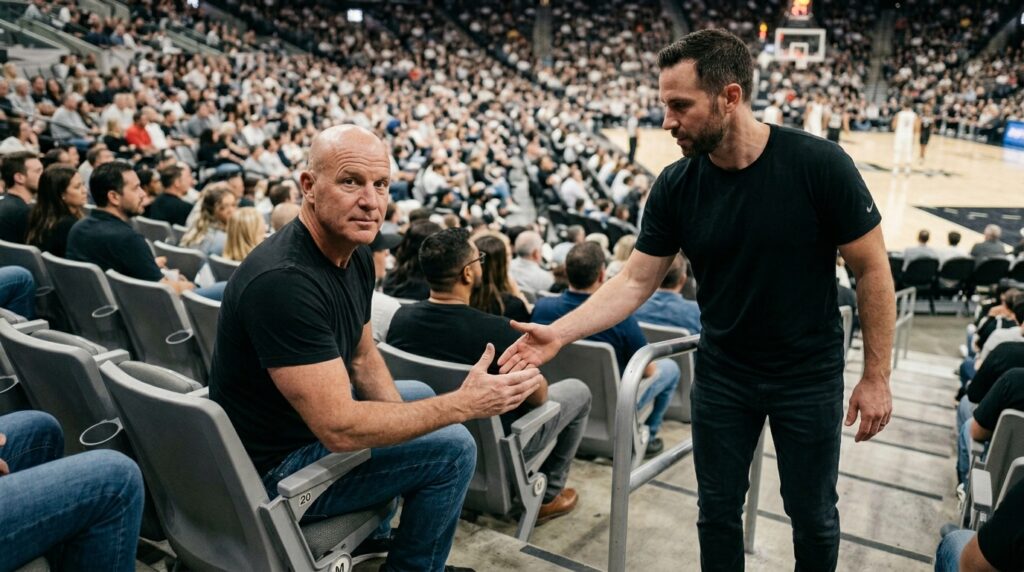
CHAPTER 8: THE RUSTED LOCKER
“The pressure on the lower lower ring is holding, but the side stairs are blocked.”
Marcus didn’t turn around when the stadium security door thudded behind him. He stood in the narrow alley of the home team locker room, his eyes fixed on locker forty-two—Noah’s locker. The room was cold, smelling of ancient floor wax, damp canvas wraps, and the distinct, sulfurous scent of municipal pipes. Above him, through six feet of solid steel-reinforced concrete, the arena crowd was already beginning to gather, a low, vibratory thudding that sounded like the baseline of a distant storm.
He had bypassed the main entrance. His left boot made a sliding, rubbery squeak against the green-painted concrete as he stepped up to the rusted metal door of the locker. The latch was broken, hanging by a single oxidized screw, a tiny, jagged tooth of silver steel keeping the door from swinging wide.
Marcus pulled the door open.
Inside, dangling from a plastic coat hanger, was Noah’s spare arena staff shirt, its white fabric slightly yellowed at the collar line, lint clinging to the shoulders like small gray burs. On the lower shelf, resting between a half-empty tub of athletic grip powder and an old leather weight belt, sat a blue aluminum clipboard.
Marcus reached out, his thumb dragging across the cold metal casing. His right hand was relatively steady now—the morning dose of Vance’s script had settled the nerves into a hard, rigid numbness—but his fingers felt clumsy as he lifted the top sheet of paper.
It wasn’t a schedule for the tournament bracket.
It was a series of printed clinical assessment sheets, dated exactly three weeks apart, stretching back across the winter. The top left corner bore the watermark of the state neurological center, but the patient name hadn’t been blacked out cleanly. The marker had faded, leaving the letters N. VANCE visible under the harsh glare of the utility bulb.
Marcus’s thumb traced the line graph on the second page. The curve wasn’t a plateau; it was a vertical drop, a jagged staircase where every step down represented a ten percent reduction in motor control velocity. At the bottom of the log, written in Dr. Vance’s small, angular handwriting, was a final note dated two days before the legacy dinner:
Patient demonstrating accelerated degradation of the lower motor columns. Anticipated loss of unassisted ambulation within forty-five to sixty days. Standard medication therapy showing zero efficacy. Recommend transition to manual mobility aids before the close of the current quarter.
Marcus let the clipboard drop against the metal shelf with a loud, hollow clack.
Forty-five days. Noah wasn’t looking over the edge of a cliff five years down the line; he was already in freefall. The whole performance at the banquet hall—the starch-stiff tablecloths, the brass key handoff, the proud generational script—wasn’t a transition plan. It was a barricade built out of pure desperation, a temporary wall erected to hide a collapse that was happening in real time.
“You shouldn’t be down here, Marcus.”
Noah stood at the entrance of the locker aisle. He was holding an old canvas chalk bag in his left hand, the drawstring loose, white powder dusting his dark trousers like frost. He looked smaller inside the narrow corridor, his shoulders leaning heavily into the green concrete wall to take the pressure off his left leg. His skin was pale, matching the sickly tone of the fluorescent tubes, a thin sheen of sweat catching the light at his temples.
Marcus gripped the rusted edge of the locker door, his ring finger pressing into the iron until the gold band bit into his knuckle. “You told me you had time, son.”
“I told you what you needed to hear to get on that stage,” Noah said, his voice dropping into a flat, dry rattle that didn’t have the strength to echo. He stepped into the aisle, his left boot making the same sliding, leaden sound Marcus’s had made an hour earlier. He didn’t look at the clipboard. “The foundation needed a name to secure the winter lease. If the town thought the new director was going to be using a chair before the tournament finished, the sponsors would have pulled out by noon.”
“This isn’t about the lease,” Marcus said, his step forward deliberate, heavy, his frame towering over the younger man in the narrow space. “You’re burning through your columns, Noah. You can’t even clear the portal without leaning into the bricks.”
“Then I’ll lean into the bricks,” Noah snapped, his right arm jumping violently inside his jacket pocket, the fabric tearing at the seam where his thumb had been pinning it. He pulled the hand out, revealing a plastic medical bracelet with a serrated clasp tucked into the palm of his hand, its surface stamped with an emergency admission code. He dropped it into the chalk bag, his features hardening into a fierce, ugly mask of pride. “The arena is full, Marcus. There are six thousand kids out there who think this foundation is still a pillar. I’m not going to be the one who tells them the concrete is hollow.”
Above them, the storm broke.
The low roar of the crowd suddenly spiked into a high, piercing scream as the stadium speakers kicked on for the opening introductions. The vibration was so intense that a layer of white dust filtered down from the concrete seams in the ceiling, settling over the yellowed collar of Noah’s shirt and Marcus’s bald head. The floorboards beneath them seemed to shift, a subtle, undulating wave of energy that traveled up through their boots.
Noah’s left knee gave out instantly.
He didn’t make a sound—no grunt, no exclamation of surprise. His frame simply dropped, his shoulder scraping down the green concrete wall as he went down, his fingers catching the latch of locker forty-two. The metal groaned as the remaining screw ripped free from the iron, the door swinging wide with a sharp, industrial shriek.
Marcus didn’t calculate the risk. The predator lens evaporated, replaced by the muscle memory of an anchor who had spent his life waiting at the rim.
He dropped his weight into his right hip, his own bad knee locking with an audible click as he reached out his broad arms. He caught Noah before the younger man’s head could strike the concrete floor, his hands wrapping around the sweat-stained fabric of the varsity sweatshirt, hauling him back against his chest.
The impact rattled Marcus’s teeth. He felt the rapid, electrical twitching of Noah’s muscles through the fabric—a furious, chaotic vibration that felt like a dying machine running at top speed.
“I’ve got you,” Marcus growled, his jaw clamped so tight his teeth ground together. “Don’t move. Just keep your heels flat.”
They sat together in the dust of the locker row, the broken locker door swinging lazily between them like a pendulum. Above them, the screaming of the stadium grew louder, a wall of sound that seemed to lock them inside the subterranean dark, two broken pieces of a single legacy trying to find an angle that would hold.








