
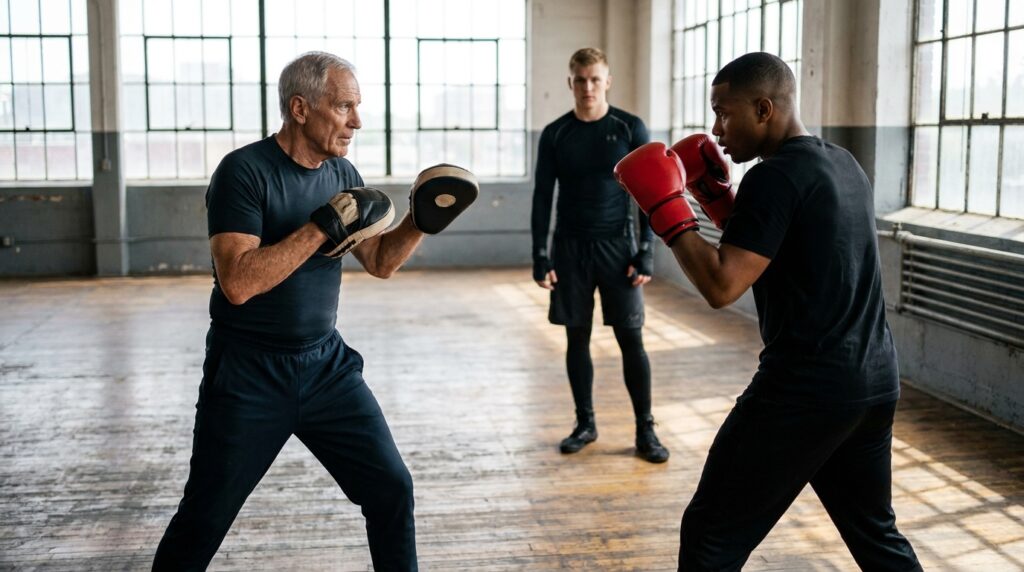
CHAPTER 4: THE FRAYED WRAP
“Again,” Thomas said.
The word was heavier now, catching slightly on his breath before it cleared his lips. The overhead bank of fluorescent tubes—the three that didn’t flicker—cast a dull, yellowed glare over the canvas. It was past eleven. Outside, the rain had turned the street asphalt into a dark mirror, the occasional rush of tires publicizing a world that didn’t care about thirty-two days or regional draws.
Julian didn’t punch. He stood in the center of the ring, his hands dropping to his waist, his skin slick with a cold, greasy sheen of sweat that didn’t dry in the damp air. His knuckles were wrapped in raw gauze, no tape, the edges already turning gray from the dust of the old ropes. “The left knee won’t hold the pivot, Thomas. It’s slipping on the seam.”
“The canvas isn’t slipping, Julian. Your hip is late,” Thomas said, his hands deep in his cardigan pockets. His right palm was clamped tightly around a small, square piece of iron—the key to the small wooden medicine chest by the water basin. For three decades, that chest had held nothing but smelling salts and liniment. Tonight, it held a small white bottle with a prescription label made out to a name Thomas didn’t use anymore, stamped by a clinic three miles outside the city line. He had left the key in his pocket so Leo wouldn’t see it when the boy cleaned the desk.
From the apron, Leo watched. He wasn’t sitting on his crate anymore; he was standing by the turnbuckle, his hand resting on the top rope. His fingers felt the split in the hemp where the protective plastic sleeve had worn away years ago. “The delivery van from the industrial supply company stopped downstairs at nine,” Leo said quietly. His voice had the flat, uninflected rhythm of a boy who had spent too many hours watching old men wait for things to break. “They had a work order for the utility meters. They said the account was flagged for administrative review.”
Thomas didn’t look at him. “The meters belong to the building, Leo. Not the floor. Hit the bag, Julian.”
Julian took a long, dragging breath, his feet making a damp shlack sound against the canvas weave as he reset his stance. He threw a single, short hook into the air—not the explosive swing he used to clear the preliminary cards, but the tight, internal arc Thomas had beaten into his shoulders through the winter. It was accurate, precise, but when his trailing heel came around to lock the weight, a sharp, dull click echoed from the wood beneath his boot.
Julian didn’t fall, but his balance tilted two inches to the flank. He caught himself against the middle rope, the hemp groaning under his weight.
“The joist gave,” Julian said. He didn’t look at Thomas; he looked down at the spot where the canvas had dipped into a shallow, permanent hollow near the center line. “It’s not the knee. The pine under the ring is rotting out from the washroom pipe.”
“Then you fight on the margins,” Thomas said. He stepped closer to the edge of the ring, his face staying in the long shadow cast by the unlit fixture over the corner post. “The center belongs to the man who can afford to stand there. You spend your time on the ropes. You use the bounce of the steel cables to turn his shoulder.”
“There isn’t any bounce left in these cables, Thomas,” Julian said, his voice dropping into the transactional coldness that always came before a fighter walked out of a room for the last time. He reached up, caught the knot of his gauze wraps with his teeth, and pulled the cloth loose with a single, violent jerk. The gray cotton uncoiled along his forearm like a dead snake. “Marcus called again. From the hotel near the arena. He said the commission isn’t going to recognize the entry slips from the gray box. He said the registrar’s office returned the money to your account on Tuesday afternoon.”
The small iron key in Thomas’s pocket felt suddenly twice as heavy, pressing cold against his hip bone. He didn’t move his hand from the cardigan pocket. “The slips have the blue seal.”
“The blue seal was retired in January, Thomas,” Julian said, his face looking old, the dark lines under his eyes matching the shadows in the rafters. “They use the digital bar-codes now. The clerk at the window only took your cash because she didn’t want to explain the regulation to an old man who used to have his name on the wall.”
Leo stepped over the top rope, his thin frame sliding into the ring with a silence that seemed almost uncanny compared to Julian’s heavy movements. He didn’t look at the registration slips or the old ledger that still lay open on the desk in the distance. He looked at the floorboards near the corner post where the wood had turned a dark, spongy purple from the dampness.
“The name on the contract isn’t the syndicate,” Leo said, his hand reaching into his pocket to draw out a small, crumpled piece of carbon paper he had pulled from the wastebasket behind the desk before the afternoon session. “The corporate name on the city injunction is Ames Properties LLC. It’s Marcus. He’s the one who bought the code liens from the bank.”
Thomas let his hand drop out of his pocket. The iron key clicked against a loose coin, a small, lonely sound that didn’t make it past the ring ropes. He looked at the carbon paper in Leo’s hand, the purple ink smeared where the boy’s thumb had held it against the light.
“He always had a quick hand with the ledger,” Thomas said, his voice completely level, completely free of anger. It was the voice he used when a fighter had taken three clean jabs to the mouth and still wanted to argue about the score. “He knew exactly how much the canvas cost per square yard.”
“He doesn’t want to sell it to the fitness club,” Julian said, his eyes finally rising to meet Thomas’s face through the yellow light. “He told me he’s turning the whole second floor into a historical archive. A museum for the state association. He offered me a position as the chief technician for the youth program. He said you could keep the chair behind the desk as long as you wanted. But the ring… the ring has to come down to make room for the display cases.”
Thomas walked to the corner post, his thick, distorted fingers tracing the rough iron where the railroad steel had been welded to the floor bracket forty years before. The weld was ugly, thick with gray slag, but it had held through four different floods and three changes of the city code.
“The youth program doesn’t need a technician, Julian,” Thomas said softly, his thumb finding a small, cold crack in the base of the iron weld. “They need a floor that doesn’t move when they step on the median.”
He didn’t look back at them. He reached up and pulled the light chord over the corner post. The three yellow fluorescent tubes went dark with a short, metallic pop, leaving only the weak gray light from the rain-soaked street to illuminate the three men standing on the rotting timber.
“Go home, Julian,” Thomas said into the grayness. “Your hands are dirty.”








