
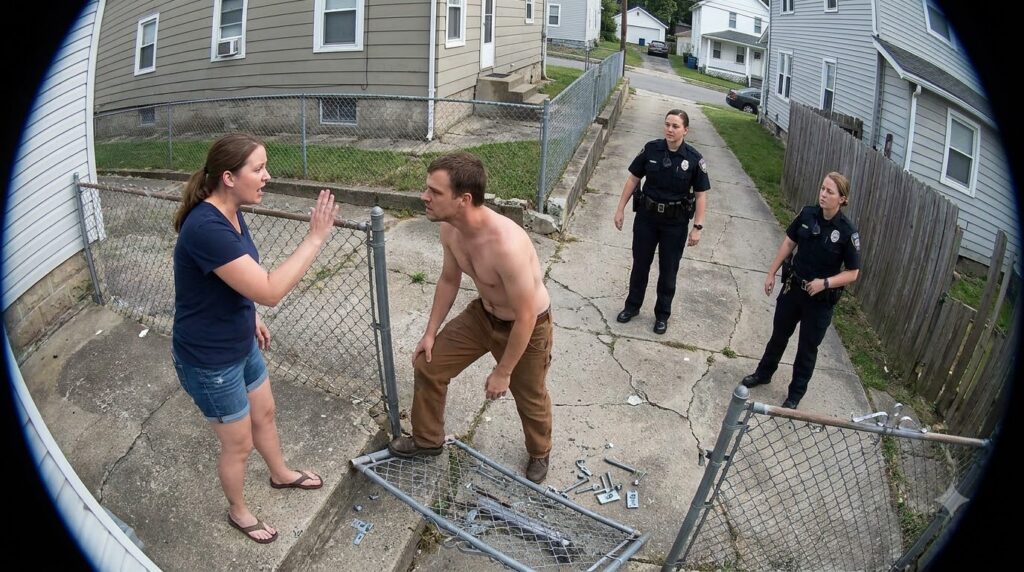
Chapter 6: The Meeting
The county scheduled a meeting with both property owners.
Mara arrived with Susan.
Crowe arrived with an attorney and a thick folder.
Travis Cole was not there.
Crowe appeared calmer than he had sounded on the phone.
He spoke about investment, construction delays, contractors, and the cost of resolving misunderstandings.
He never called Mara unreasonable.
He didn’t have to.
His attorney did it for him.
The argument centered on the old easement.
Crowe’s attorney suggested that the historic use of the property supported broader access than the written document appeared to provide.
Susan produced the original survey.
Then the updated survey.
Then photographs of the damaged fence.
Finally, she submitted the security footage showing workers measuring the boundary before the confrontation.
The room became quiet.
Crowe watched the screen without expression.
The footage showed the men standing beside Mara’s fence.
One of them placed a marker.
The other measured from it.
Then came the crucial moment.
The worker pulled the fence post away from its original position.
Not accidentally.
Deliberately.
Mara had suspected it.
Now everyone could see it.
The county official asked Crowe whether he had authorized the work.
Crowe’s attorney objected to the question.
The official repeated it.
Crowe finally admitted that he had authorized preliminary work to determine whether construction access was possible.
He claimed he had not authorized damage.
That distinction might have protected him legally.
It did not protect his credibility.
The county’s records showed that the easement was limited.
The surveyor confirmed the boundary.
The footage showed activity on Mara’s side.
The damaged fence showed the physical consequence.
Then came the reversal.
The county official revealed that Crowe’s renovation plans had already been submitted.
They depended on access through the disputed strip.
Crowe had presented the access as available.
But he had not obtained Mara’s permission.
In other words, the entire construction plan had been built around an assumption that had never been legally established.
The meeting ended with an order requiring Crowe to stop all activity affecting Mara’s property.
The county also required a corrected site plan.
Crowe could still renovate his property.
But he would have to do it without treating Mara’s land as his own.
Outside the building, Mara expected to feel victorious.
Instead, she felt exhausted.
She had spent weeks proving something she had known from the beginning.
The strip beside her house was hers.
The fence was hers.
Her right to say no was hers.
Susan placed a hand on her shoulder.
“You did the hard part,” she said.
Mara looked back at the county building.
“No,” she replied quietly.
“The hard part was making them listen.”








