
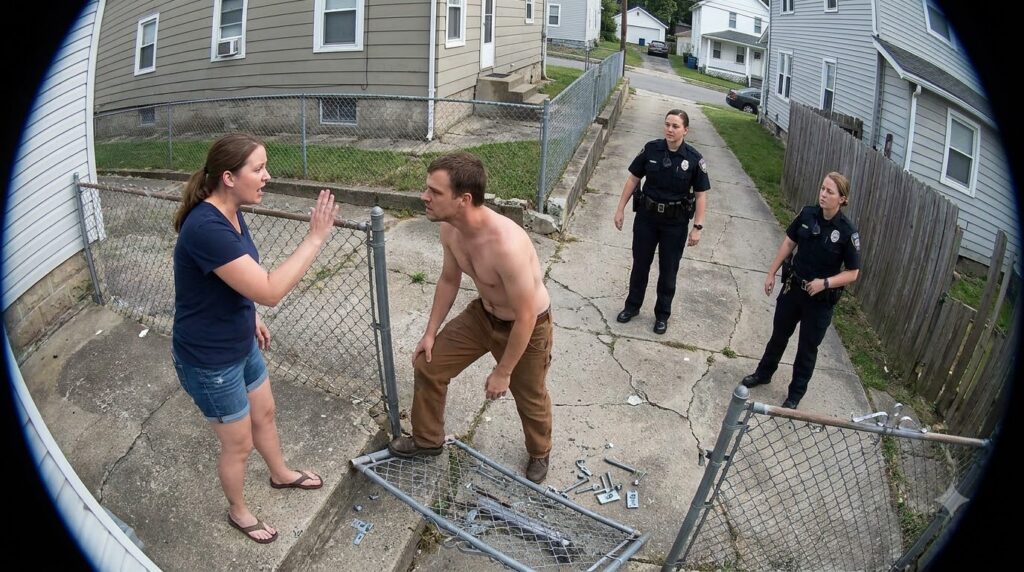
Chapter 4: What the Cameras Had Seen
Mara had installed a small security camera near the side entrance after a package disappeared from her porch the previous winter.
She had almost forgotten about it.
Now she pulled up the recordings.
The camera showed the side yard from a high angle.
At first there was nothing unusual.
Then, three nights before the confrontation, a white pickup appeared.
Two men stepped out.
One carried a measuring device.
The other walked directly to Mara’s fence.
They didn’t knock.
They didn’t enter her property.
But they spent nearly twenty minutes studying the boundary.
Mara watched the recording twice.
Then she saved a copy.
The following morning, Officer Price returned her call.
Mara told her about the footage.
The officer listened carefully and asked whether Mara had retained the original recording.
She had.
That mattered.
The man arrested during the confrontation had not been charged with anything serious. The incident had ended without injury, and the immediate dispute appeared to be civil.
But the new footage changed the context.
Officer Price suggested Mara speak with the county survey department and document every contact with the neighboring property.
Mara did exactly that.
She also called the investor who owned the abandoned house.
His name was Daniel Crowe.
He sounded polite.
Almost too polite.
He said there had been “some confusion” involving an old access agreement.
Mara asked him why his workers had been measuring her fence.
There was a pause.
Then he said they were trying to determine the best route for construction equipment.
Mara reminded him that the property records showed the strip belonged to her.
Another pause.
Crowe said he would have his attorney contact her.
The next afternoon, a letter arrived.
It claimed that Mara’s fence interfered with an access right associated with Crowe’s property.
It requested that she remove part of the fence within ten days.
Mara read the letter slowly.
She wasn’t a lawyer.
But she knew something about her own property.
And she knew when someone was trying to make a demand sound official.
She took the letter to an attorney recommended by Walter.
Her attorney, Susan Miller, was a practical woman in her sixties who had spent decades handling real-estate disputes.
Susan studied the survey.
Then the easement.
Then Mara’s photographs.
Finally, she watched the security footage.
Her expression changed.
“This isn’t just a disagreement about a driveway,” Susan said.
Mara waited.
“Someone may have been trying to create evidence for a boundary that doesn’t exist.”
That possibility was more frightening than the confrontation itself.
If someone could make enough people believe the wrong line was the right one, Mara’s actual ownership could become difficult and expensive to defend.
Susan advised her not to move the fence.
Not to sign anything.
Not to confront Crowe’s workers.
And not to assume that because the law was on her side, the problem would disappear.
The next morning, Mara discovered fresh orange survey paint.
This time, it had been sprayed directly onto her driveway.
Someone had crossed onto her property again.








