CHAPTER 4: THE CLOSERANGE CHESS MATCH
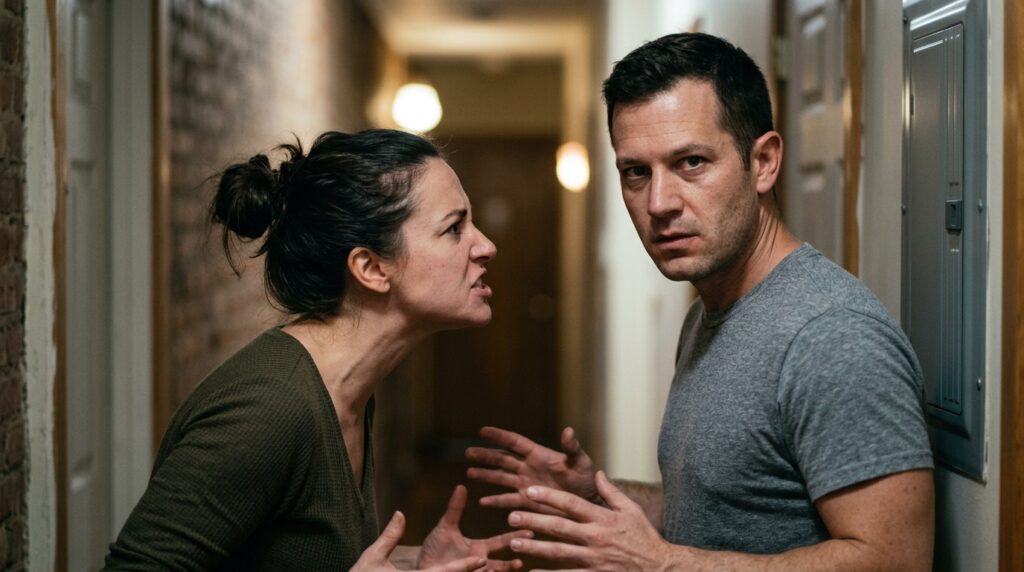
The space between them was less than an arm’s length. Inside the compressed lane of the clubhouse corridor, the hum of the climate control seemed to drop an octave, swallowed by the dense commercial carpeting and the heavy stone masonry of the partition counter. Sarah leaned in sharply, her torso angling forward with a rigid, calculated velocity that pushed her deep into his personal space. Her shoulders were braced, her dark top taut against her collarbones. Her chin was slightly raised, her jaw fixed like a latch driven into a slot.
She locked direct eye contact, her pupils dark and unyielding beneath the harsh fluorescent lights.
“You can’t just walk in here and act like you understand everything,” she delivered. The challenge was quiet, clipped, and razor-sharp, aimed straight at the space between them to prevent her words from carrying out into the wider lobby where the neighbors stood.
David stiffened. Every muscle in his frame locked into an upright resistance, absorbing the psychological weight of her posture without giving an inch of ground. The gray t-shirt across his chest didn’t move. He lifted his right hand half an inch between them, his fingers curled loosely around the folder of county surveys, a restrained, frustratingly calm gesture that acted as a silent physical dam against her forward lean.
“I’m not pretending, Sarah,” David said. His voice was low, flat, and clinical, utilizing the enclosed depth of the lane to anchor his position. “I’m trying to help but you keep shutting me out.”
“Then listen instead of assuming things,” she countered instantly. Her command was a cold snap, her eyes wide and dry, refusing to blink. Her posture tightened further, her elbows pinning the thick black ledger against her ribs like armor plating. She used the physical boundaries of the narrow corridor to simulate an unshakeable institutional power, entirely focused on driving him back past the swing-gate before the locked door behind her could open any further.
David didn’t break focus. His mind tracked the spatial geometry of the space—the raw physics of her stance, the subtle forward weight she was using to mask the vulnerability of the desk blotter behind her. She was performing authority because she didn’t possess the legal title to enforce it. The strategic pursuit required absolute stillness. He noticed the slight white pressure marks on her knuckles where her fingers gripped the leather binding of the book; she wasn’t calm, she was overextended.
“The board’s registry log doesn’t list an infrastructure workshop for eight-fifteen,” David said, his voice dropping into a rhythmic, transactional cadence that chipped away at her defense. “It lists a property asset reconciliation. And the initials on the signature block aren’t local board members, Sarah. They belong to a general partner at Apex Utility Holdings.”
A short, muffled rustle of paper came from the semi-open office behind her chair. The man in the flannel shirt had stepped closer to the door frame, the heavy roll of construction blueprints gripped under his arm like a blunt instrument. Through the two-inch gap, the giant valley development map was clearly visible, its red wax lines cutting across the drainage boundaries with surgical precision.
Sarah’s gaze flicked toward the shadow behind her, her unblinking eyes showing the first micro-second of real panic. Her fingers slipped slightly against the leather cover of the book, revealing a wider glimpse of the fresh violet ink impression on the gray blotter—the ARC-E-Z3 designation, the state planning commission’s specific classification for a distressed, un-vetted utility easement prone to rapid municipal foreclosure.
“The registry is an internal corporate file,” she whispered, her voice tightening into an impenetrable barrier. Her lean grew more aggressive, her shoulder line cutting off his view of the wall map. “You don’t have the status to query it. You have five seconds to clear this lane before I log a non-resident disruption code into the sheriff’s dispatch portal.”
“Log it,” David said. He took a single, deliberate breath, his grip tightening on the brass surveyor’s tack loose in his left pocket, its cold point a physical reminder of the six-foot iron rods anchoring his actual plot lines outside. “The sheriff uses county mapping grids, not association ledgers. When the deputy arrives, we can compare the coordinate lines on this digital survey with the pencil markings you’re hiding under your palm.”
Behind them, the low murmur of voices in the lobby suddenly went dead. The two neighbors by the mailboxes had stopped scrolling on their phones, their screens dropping toward their pockets as they turned their heads to watch the intense, silent compression of the corridor. The atmosphere in the room had shifted from a generic administrative dispute into a localized, cold-range siege, the spatial dominance of the clubhouse beginning to fracture under the weight of the legal documents gripped in David’s hand.
Sarah’s mouth remained shut, her jaw locked tight as she held her ground, her rigid frame absorbing the pressure of his refusal without stepping back an inch, while the shadow inside the executive suite grew completely stationary.