CHAPTER 3: THE GATHERING CORRIDOR
The deep voice through the oak door frame didn’t stop. It carried a dry, unhurried cadence, the sound of a man reading structural specifications from an open binder. David did not break eye contact with Sarah. His hand remained flat on the blue-line county map, his thumb lightly pressing the linen edge against the cold limestone counter. He could feel the fine ridge of the paper’s margin—a sharp, straight line cut by an industrial blade.
Sarah’s fingers remained rigid over the ledger page, covering the penciled coordinate numbers. Her shoulder alignment had shifted; her right elbow was pinned tighter to her ribs, an involuntary bracing mechanism designed to shield the desk blotter beneath her arm.
“The office lane is closed to non-administrative personnel after eight,” she repeated. Her voice had lost its smooth, transactional rhythm, dropping into a clipped cadence that clipped the vowels short. “I’ve given you the filing timeline, David. If you stand here, you’re interfering with daily standard operations.”
“The standard operations include public logs,” David said. He didn’t raise his voice. He kept his tone leveled at the exact volume of her whisper, a calculated frequency that forced her to lean an inch closer to hear him over the hum of the central air ventilation. “The association registry is open for member inspection under state corporate statute four-twelve. I don’t need the director’s clearance to look at the sign-in sheet for the executive session.”
Behind him, the heavy glass double doors of the clubhouse main entrance hummed, the magnetic latch clicking back into place. Two residents from the third tier of the subdivision walked in—older men wearing identical nylon windbreakers, their soft-soled shoes leaving damp, faint prints on the commercial matting. They stopped four feet back from the stone partition, their conversation dying mid-sentence as they registered the absolute lack of motion between David and the helper. The silence in the lobby grew thick, localized, and sharp.
Sarah didn’t look at the newcomers. Her gaze was a fixed laser line on David’s throat. “The registry is digital this quarter. The hard copy is restricted.”
“Then why is the binder out?” David asked.
His eyes flicked down to the corner of the black leather book where her palm wasn’t fully covering the edge. Beneath her thumb, a fresh ink impression had bled into the gray desk blotter—a circular violet stamp that hadn’t fully dried. It wasn’t the standard hexagonal emblem of the Architectural Review Committee. It had a clean, triangular core with three distinct alphanumeric sub-codes running along the lower radius: ARC-E-Z3.
David recognized the notation style. It wasn’t an internal HOA marker; it was the specific zoning taxonomy used by the regional infrastructure planning board when tracking private properties for municipal condemnation or utility right-of-way re-assignments.
The door to the executive suite swung back another two inches. The gap was narrow, but it allowed a clear view of the interior office wall—a stark expanse of white drywall where a giant, gridded map of the entire valley development had been pinned with heavy steel tacks. Red wax lines had been drawn directly across three specific parcels along the western fence line. One of those parcels had a small, handwritten notation beside the septic junction: LOT 44—DAVIDSON.
“Sarah,” the voice called from inside the office. The tone was sharp, flat, and entirely devoid of local accent. “Bring the corporate log. The surveyor needs the secondary signature on the drainage easement release before the board goes into the closed session.”
Sarah’s posture fractured. Her hand left the cream-colored page, snapping the black ledger shut with an intentional, heavy crack that drew a sharp look from the two men waiting by the mailboxes. She pulled the book off the stone counter, tucking it beneath her arm with a rapid, defensive twist of her torso.
“You need to step back into the main seating area, David,” she said, her voice turning into a thin, impenetrable shield. She stepped out from behind the limestone counter, her sneakers squeaking on the vinyl flooring behind the security gate. She adjusted her casual top, her shoulders squaring as she blocked the entrance to the inner corridor with her entire frame. “The board is in a private workshop. No exceptions.”
David didn’t step back. He took half a step to the left, positioning his body at a forty-five-degree angle to the security latch on the swing-gate. From this stance, his field of vision bypassed her shoulder, tracking the movement inside the light-filled office. A man in a high-quality, tailored flannel shirt was rolling up a set of construction blueprints, his movements methodical and fast. Beside his briefcase on the oak table sat a heavy, industrial-grade ink pad, its lid open, revealing a deep violet reservoir.
The puzzle was assembling itself with cold, calculated precision. The fines on his driveway weren’t designed to force compliance; they were designed to create a documented record of unresolved property disputes. Under the community’s revised covenants, any lot with an outstanding title dispute for more than fourteen consecutive days was automatically barred from voting on corporate structural alterations—including the sale of peripheral common acreage.
“I’m staying until the director logs the map,” David said clearly. He adjusted his grip on the folder of county surveys under his arm, the crisp paper rustling against his ribs. He looked past her, directly at the open seam of the office door. “And I want to know why the infrastructure planning board is validating a foreclosure audit on a private drainage culvert.”
The man inside the office stopped rolling the blueprints. His hands went perfectly still on the paper, his head tilting toward the corridor as he measured the volume of David’s voice. The two neighbors by the mailroom turned fully around now, their phone screens dimming as they picked up the word foreclosure hanging in the sterile, air-conditioned vault of the clubhouse.
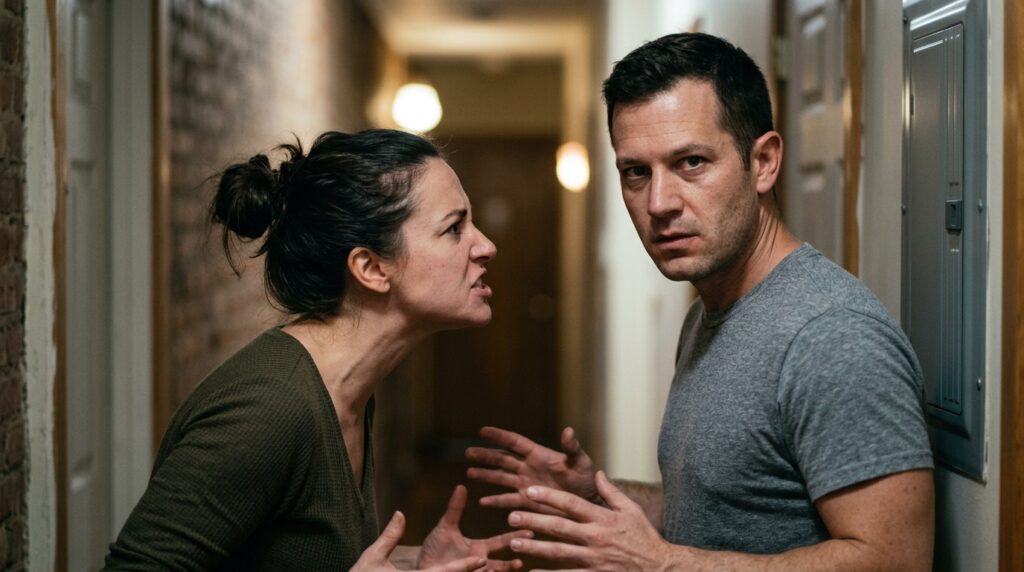
Sarah didn’t look back at the office. She took one step forward, her chest almost touching the security gate, her eyes narrowing until they were two hard, dark slits. “You’re crossing a line you don’t understand, David. Get out of the corridor.”