CHAPTER 2: THE ROAD TO THE GATEHOUSE
The diesel engine didn’t so much shut off as click into a metallic, cooling silence beneath the low-slung branches of the perimeter oaks. David sat for three seconds, his palm flat against the vinyl passenger seat where the blue-line county maps lay unrolled. Through the tinted windshield, the community clubhouse loomed—a heavy, faux-craftsman structure of stone veneer and slate tiles that cost forty thousand dollars a year just to power. It was designed to look old, to look rooted, but to David, it had the clinical chill of a regional bank branch.
He stepped out, the door hinge throwing a sharp, dry crack across the empty parking lot.
At the entrance, the glass door clicked before he could touch the handle. The digital magnetic striker released with a sound like a small caliber pistol clearing its chamber. Inside, the air conditioning was set to a crisp sixty-eight degrees, smelling of lemon-scented floor wax and damp commercial carpeting.
“The office doesn’t accept cash drop-offs on Wednesdays, David.”
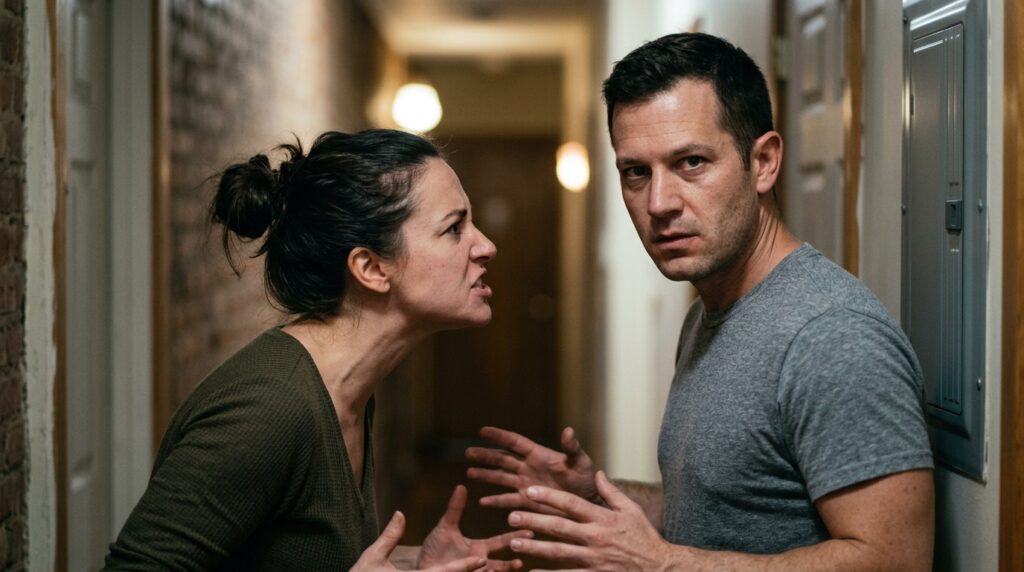
The voice came from behind the low, dry-stacked stone counter that divided the mailroom corridor from the administrative suite. The neighborhood helper didn’t look up from her screen. Her dark hair was still pinned in that severe, functional knot, but under the fluorescent tubes of the lobby, her skin looked translucent, nearly gray. Her fingers moved across a mechanical keyboard with a rhythmic, heavy snap-snap-snap that sounded like an industrial stitcher.
David adjusted the folder under his left arm. He didn’t close the distance immediately; he stayed three feet back, mapping the width of the lane. To his right, the heavy oak door leading to the board’s private conference room was pulled shut, but the brass latch hadn’t caught. A sliver of yellow light cut across the gray carpet.
“I’m not dropping off a check, Sarah,” David said, his voice level, stripped of the morning’s raw cold but retaining its hardness. He laid the first map on the stone ledger. The heavy bond paper rolled back against itself, its blue ink sharp against the limestone. “I’m dropping off an injunction. The daily accrual fine on my easement gate was logged through the portal at 1:14 AM. The portal user-ID belongs to this terminal.”
The stitching sound of the keyboard stopped.
Sarah’s hand didn’t drop from the mouse. She tilted her chin up, her gaze locking onto his with an unblinking, analytical focus. There was no heat in her eyes—only the cold, structural assessment of an administrative barrier that had encountered an unmapped obstacle.
“The automated system handles the time-stamps,” she said. Her voice was thin, balanced, and intentionally sparse. She leaned slightly forward, her elbows resting on the stone surface, shortening the space between them until David could smell the stale chicory coffee in her mug. “If your contractor left the trailer tongue projecting six inches past the shared utility curb, the sensor flags it. I don’t write the script, David. I just verify the logs.”
“The contractor wasn’t here last night,” David said. He pointed a single finger at the lower corner of the map, where the county notary’s gold foil seal was pressed into the linen backing. “The county completed the culvert clearout at three on Monday afternoon. They pulled the orange cones. They signed the clearance. Look at the initials on the midnight portal log, Sarah. They aren’t automated. Someone typed in an override to manually re-open the violation window.”
A small, rhythmic ticking began behind the stone wall—the clubhouse master clock adjusting its gears for the eight o’clock synchronization.
Sarah didn’t look down at the blue lines. She kept her eyes fixed on the bridge of his nose, her posture tightening until her shoulders looked straight, almost mechanical under her dark top. “The board doesn’t review county field notes during public hours. If you want to challenge the metric, you submit an appeal through the portal. It takes twenty-one business days for a compliance officer to audit the coordinate.”
“I don’t have twenty-one days,” David said. His fingers adjusted on the edge of the folder, his thumb finding the loose surveyor’s tack in his pocket. He could feel the cold iron of its head. “The daily accrual triggers a property lien at fifteen days. You know that. The committee changed the bylaws in October without a community quorum.”
“A quorum isn’t required for an infrastructure emergency,” she shot back, her tone dropping an octave, becoming sharp, transactional, probing. She didn’t deny the override. Instead, she reached under the counter, her arm moving with a deliberate, smooth economy of motion, and brought up a thick, black-bound ledger. The corner of the book hit the stone table with a heavy, dull thud that echoed down the narrow office lane. “Section four, paragraph nine. The association retains sovereign enforcement if a resident’s border maintenance threatens the structural integrity of the common drainage basin.”
She flipped the ledger open. The pages were heavy, cream-colored paper covered in precise, small columns of handwriting.
David’s eyes tracked the lines. He didn’t look at the text she was pointing to; his gaze drifted down to the bottom margin of the active page, where a series of small, pencil-drawn numbers were scribbled next to his lot number. They weren’t enforcement codes. They were decimal coordinates—four sets of longitudinal markers that didn’t match the subdivision plot. They matched the public access road that lay three hundred yards behind his barn, right where the old county timber line met the new commercial blacktop.
“Who logged those numbers, Sarah?” David asked, his voice dropping into a low, deliberate cadence.
Sarah’s hand went flat over the page, her palms covering the pencil marks with a sudden, rigid snap. Her fingers were white where they pressed into the paper. For the first time since he had entered the room, her gaze flicked toward the heavy oak door to her left, her pupils dilating as she listened to the muffled sound of a chair scraping against the floor inside the executive suite.
“Those are internal administrative references,” she whispered, her voice clipped, setting an immediate, defensive boundary. “You don’t have authorization to audit the ledger. Leave the maps on the counter and clear the lane, David. The director arrives at eight-thirty, and he doesn’t tolerate residents tracking mud onto the workspace carpet.”
She didn’t close the book. She held her hand over the secret like a soldier guarding a breach, her chin tilted up in a final, defiant challenge that signaled she had no intention of letting him see the next line.
David didn’t move his hand from the map. He could hear the low, distinct murmur of a second voice inside the locked office—a deep, resonant rumble that didn’t belong to any of the five elderly board members who lived on the circle. It was the voice of a man used to speaking over the roar of heavy machinery, and it was coming from the private office behind her chair.