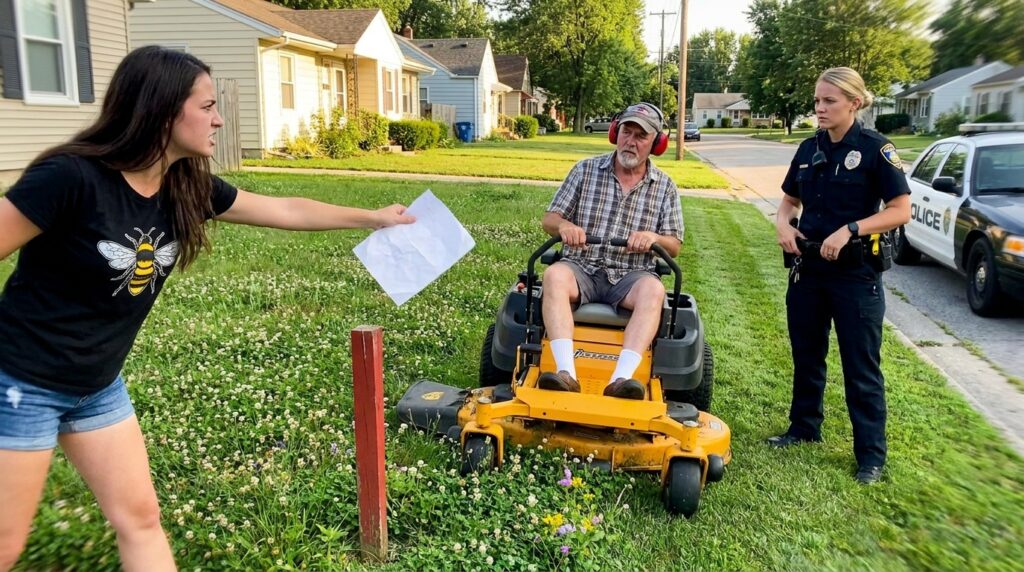
CHAPTER 8: THE SATURATION LINE
The rain didn’t fall in drops; it came down in grey, heavy sheets that turned the sun-bleached cedar fences of the Clover Line into dark, sodden boundaries. Maya stood on the curb, the hood of her yellow slicker thrown back, water streaming through her dark hair and pooling in the fabric of her bee-themed T-shirt. Beneath her sneakers, the clay of her curb strip had turned into a thick, slick paste, the crushed heads of her sweetclover clinging to her ankles like wet lace.
Two white state SUVs with the green emblem of the Environmental Protection Division sat idling at the curb, their orange strobe lights casting a rhythmic, metallic glare over the watching houses.
“You don’t have authorization to sink those shafts,” a man in a crisp, dark blue trench coat shouted over the downpour. He stood on Harold’s uniform lawn, his expensive leather shoes sinking three inches into the pristine Kentucky bluegrass. He was holding a plastic-sleeve folder against his chest—a formal corporate injunction bearing the gold seal of the Clover Ridge Development Trust. “This is private residential property subject to an active title dispute. Any subterranean sampling without corporate clearance is a trespass.”
The state inspector, a tall woman wearing mud-spattered hip boots and a heavy rubber apron, didn’t stop her work. She stepped over the red property stake, her boots sinking into Maya’s wild grass with a wet, heavy squelch. In her gloved hands, she held a two-inch steel core sampler, its T-bar handle slick with grease.
“Statute Forty-One-B doesn’t require your clearance, counselor,” the inspector called back, her voice flat, carrying the unyielding weight of official state authority. “We have a documented historical ledger indicating potential industrial runoff concealment dating back to seventy-four. The state has paramount easement access for public health assessment. Hold the tube, Miss Lin.”
Maya stepped forward, her hands closing around the cold, unpolished steel of the sampling cylinder. The metal was freezing against her bare palms, vibrating faintly as the inspector drove the foot-peg into the earth, biting past the shallow roots of the lawn and down into the grey, ancient clay beneath.
Across the street, Harold Vance stepped off his porch. He didn’t have his slicker on; his flannel shirt was already black with water, clinging to his thin ribs as he walked purposefully across the dividing line. He carried a heavy canvas tool bag, the oxidized iron handles clinking together with a sharp, transactional ring.
“The drainage line is six feet down,” Harold said to the lawyer, his voice steady, his old face hardened by the cold rain. He didn’t look back at his house. He looked straight at the corporate document in the man’s hands. “My father helped lay the clay pipe to hide the overflow. If you want to stop the test, you’ll have to explain to the county police why the trust has been paying the property taxes on the drainage easement since the day I moved in.”
The lawyer’s pen hesitated over the injunction, the rain already blurring the blue ink of his signature line. The power dynamic that had held the street captive for fifty years was dissolving in the mud, and the deep roots of Maya’s sanctuary were finally pulling the truth into the open light.