
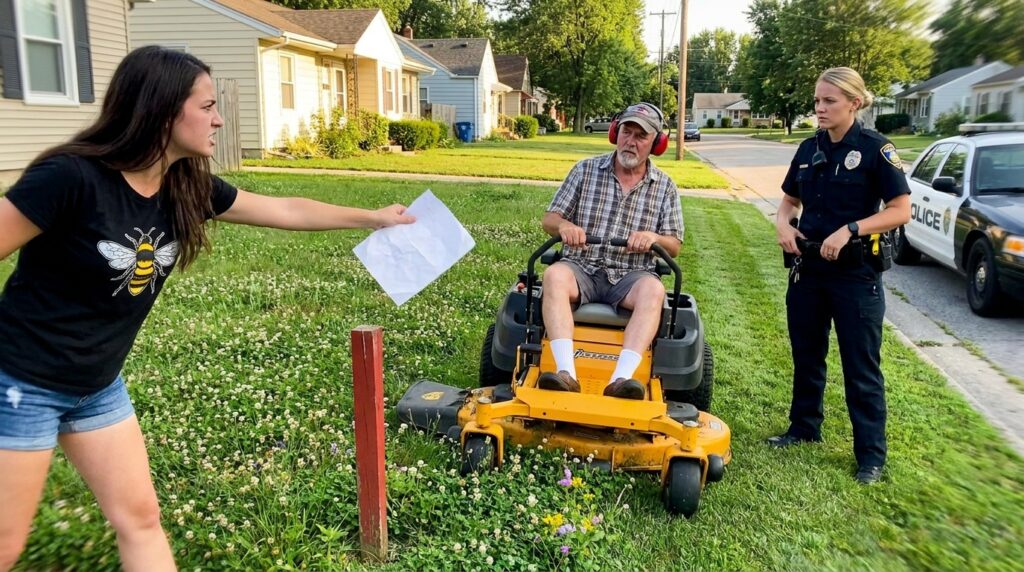
CHAPTER 3: THE UNMASKING
The glass jars of dried lavender on Mrs. Gable’s porch didn’t rattle, but the air inside the small kitchen felt thick with the sediment of thirty years of quiet resentment. Maya didn’t wait for an invitation. She carried the small brown paper sack of native wildflower seeds like a peace offering that had already spoiled in her hands, her fingers digging through the thin paper until she felt the hard, individual kernels of milkweed and coreopsis shifting against her skin.
“You should have used a ballpoint pen, Mrs. Gable,” Maya said, her voice dropping into the quiet space between the ticking of an old sun-faded cat clock on the wall and the low, steady hum of the refrigerator.
The old woman didn’t turn around from the sink. Her thin back, curved under the faded floral duster like a dried stalk of chicory, remained perfectly rigid. The smell of vinegar and stale white toast hung heavily in the air, a domestic film that seemed to coat the yellowing linoleum floor and the frayed lace curtains. When she finally turned, her spotted hands were dripping wet, holding a damp kitchen towel with frayed blue borders. She didn’t look at Maya’s face; she looked down at the brown paper bag.
“A ballpoint leaves an indentation in the wood beneath the pad,” Mrs. Gable said, her voice thin but perfectly clear, devoid of the fragile, neighborly tremor she had used at the fence. “A Smith-Corona doesn’t lie. It just hammers the ink straight through. I bought that machine in 1978 to type my husband’s medical invoices. It’s outlived him. It’s outlived a lot of things.”
“Why?” Maya stepped closer to the laminate kitchen table. Sitting on a crocheted doily near the window was the heavy, olive-drab steel frame of the typewriter, its margins set narrow, a faint smudge of the identical violet ink staining the nickel-plated spacebar. “You told me you liked the clover. You told me you hated the noise of Harold’s mower.”
“I do hate it,” Mrs. Gable snapped, her small blue eyes flashing with a sudden, brittle energy that seemed to age her ten years in a second. She dropped the damp towel onto the counter, her fingers trembling as she pointed toward the window, where the sun was casting long, desaturated shadows across the road. “But Harold is a fool who only understands what he can see with a measuring tape. He thinks he’s protecting his lawn. He doesn’t know what’s actually holding these houses up.”
Maya frowned, the sack of seeds slipping slightly in her grip. “What are you talking about?”
“Look in the tin by the breadbox, girl. If you’re going to dig up the dirt, you might as well see what’s buried under it.”
Maya paused, her internal calculation spinning against the quiet gravity of the room. She reached out, her hand brushing against a rusted, blue tin that once held holiday shortbread, its edges worn down to the bare, gray tinplate. The lid gave way with a dry, scraping protest. Inside, nestled beneath a handful of dried lavender heads, lay a bundle of yellowing carbon-copy documents, the edges soft and fraying into dust.
She pulled out the top sheet. It wasn’t a city ordinance. It was a legal instrument from 1974, stamped by the county registrar, bearing the names of the original developers and the first buyers of the plat—including Harold and Evelyn Vance. Maya’s eyes scanned the fading, purplish text, her chest tightening as she hit the bolded headers. It wasn’t a standard Homeowners Association agreement. It was a restrictive covenant with a mandatory forfeiture clause.
…failure to maintain the uniform visual baseline of the residential landscape shall constitute a material breach, triggering an automatic reversionary interest and immediate acceleration of the underlying lien…
“The banks didn’t want this ridge developed,” Mrs. Gable whispered, her hand resting on the olive-drab typewriter like a weapon she was too tired to carry. “They put a poison pill in the original titles to keep the values from dropping during the oil crash. If the neighborhood aesthetic falls below the standard for more than ninety days, the primary lender has the automatic right to foreclose. Not just fine you, Maya. Take the house.”
Maya felt the blood leave her face, the paper in her hand suddenly feeling as heavy as a lead plate. “Harold…”
“Harold’s mortgage was restructured twenty years ago after Evelyn got sick,” Mrs. Gable said, her voice softening into a bitter, faded grief. “He’s one missed valuation away from losing that porch. He doesn’t hate your bees, Maya. He’s terrified of them. If the city inspectors log your yard as an unmanaged nuisance, the automated audit hits his title next. He hired that driver because he thought if he cleared the line, the automated flag would clear too.”
The decoy secret—the idea that this was just a spiteful old man defending his pride—shattered on the kitchen table, leaving behind a raw, systemic reality that Maya hadn’t prepared for. She wasn’t fighting a neighbor; she was triggering an invisible machine designed fifty years ago to crush anyone who stepped out of line.
Before she could speak, a sudden, heavy shadow blocked the kitchen window. Across the street, a dark grey pickup truck pulled into Harold’s driveway, but it wasn’t Harold behind the wheel. Two men in dark suits stepped out, carrying clipboards and a long, mechanical laser transit—the official county property appraisers.
The ninety days were up. The audit had already begun.








