CHAPTER 4: THE PROPERTY LINE SUMMIT
“You shouldn’t be standing out here, Harold,” Maya said. Her voice didn’t rise above the humid afternoon breeze, but it cut through the low, idle thump of the appraisers’ truck across the asphalt.
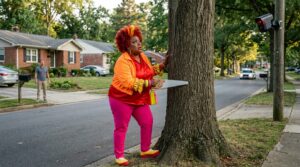
Harold Vance didn’t turn around right away. He was leaning against the rusted iron handrail of his porch steps, his knuckles white against the flaking black paint. The mid-day sun had burned through the haze, casting a flat, harsh glare over the desaturated bricks of his foundation. Up close, his skin looked as thin and brittle as the carbon copies tucked into Maya’s pocket, patterned with the tiny, gray tracks of broken capillaries. He looked down at his shoes, then out at the dark grey pickup truck where the two appraisers were adjusting their laser transit on the opposite curb.
“They’re measuring the grade,” Harold muttered. His voice lacked the aggressive volume he had used through the proxy of the mower driver. It was small, dry, and hollowed out by a deep, generational fatigue. “The grade has to match the county code from seventy-four. If the drainage from your weeds pools against my line, it changes the valuation index.”
“It’s not the drainage, Harold. I know about the covenant.”
The old man froze. The slight tremor in his right hand stopped, his fingers locking around the cold iron rail. A crow called from the top of a dead power pole down the street, a sharp, lonely sound that echoed off the uniform garage doors. Slowly, his head turned, his pale, clouded eyes finding Maya’s face. The anger wasn’t there anymore; it had been replaced by a raw, naked vulnerability that made him look less like a neighborhood tyrant and more like a piece of drift wood that had been left to dry too long on a salt flat.
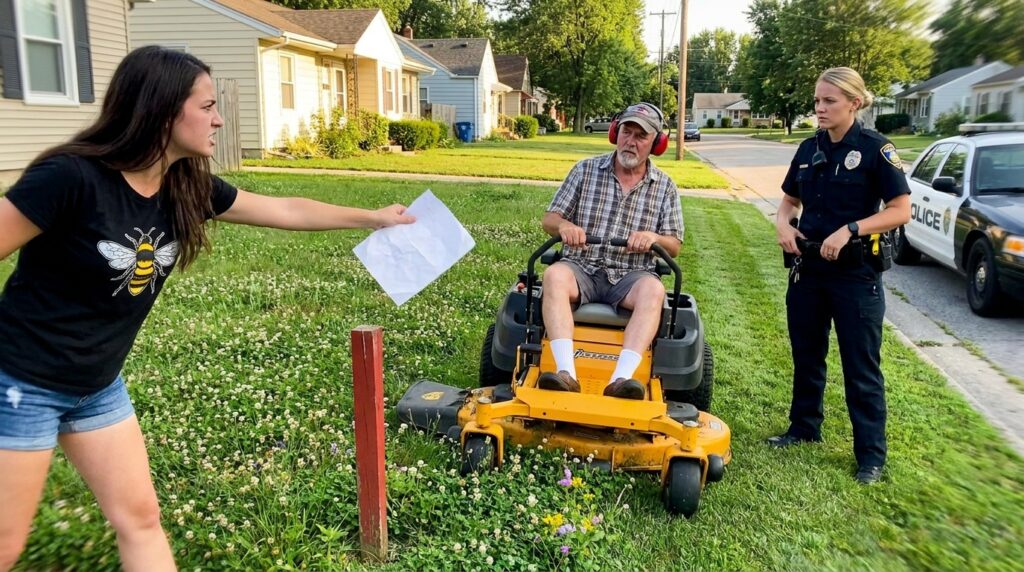
“Evelyn bought those seeds,” he whispered, his eyes dropping to the boundary stake between their yards where the rusted trowel still lay pinned by the thick clover roots. “The ones you planted. She kept them in the pantry behind the flour bin for fifteen years. She always wanted a wild strip. Said the grass here felt like an artificial carpet over something dead.”
Maya felt a sudden, heavy ache in her throat, the friction of her previous anger dissolving into the faded texture of a shared, hidden pain. She took two steps forward, crossing the line of her own crushed sweetclover, her sneakers pressing into the dry, stiff blades of his manicured lawn. “Then why did you try to destroy it?”
“Because if they see it, they look closer,” Harold said, his voice cracking as he pointed a trembling finger at the appraisers. “The covenant doesn’t just look at my grass, Maya. It looks at the whole line. If your lot is logged as an unmanaged blight, the automated clause triggers an evaluation on every contiguous title. My equity is gone. The bank has been waiting for an excuse to pull the note since the interest rates shifted. If they flag your sanctuary, my house goes back to the development trust by November.”
The sheer weight of the system hung over the empty suburban street, a cold, invisible structure that had pitted two people against each other over a patch of green earth. Maya looked down at her hands, still smudged with the grey clay of her garden. She had spent months treating this as a war for environmental sovereignty, a personal victory to be won with official surveys and legal stakes. But the victory felt hollow now, a jagged piece of glass that would slice open an old man’s life if she pulled too hard.
The two appraisers stepped off the curb, their heavy boots crunching against the loose gravel as they approached the boundary line. One of them, a younger man with a clean-shaven face and a state-issued badge clipped to his belt, lifted a clipboard, his pencil hovering over a form labeled Aesthetic Valuation Log.
“Afternoon,” the appraiser said, his eyes scanning the ragged, churned-up path where the yellow mower had bitten into the clover. “We received an automated notification regarding an unmanaged vegetation variance on this sector. Miss Lin, is this your parcel?”
Maya looked at Harold. The old man had pulled his arms tightly against his chest, his shoulders hunched as if he were trying to make himself small enough to disappear between the sun-bleached bricks of his house. The fading light caught the fraying edges of his collar, the silver hair at his temples damp with sweat. He was waiting for the blow to fall.
Maya reached into her back pocket, past the folded survey map, and pulled out a small, laminated card she had kept inside her wallet—the official municipal environmental certification stamp she had obtained from the state conservation department before she ever turned the first clod of earth. It bore a green state seal and a single, specific legal exemption clause: Protected Ecological Sanctuary under Statute 41-B.
“It’s not a variance,” Maya said, her voice steady, her eyes fixed on the appraiser’s clipboard. She stepped directly between Harold and the state official, holding the green seal out so the light caught the embossed signature. “The parcel is an intentional, registered habitat. Under state law, any municipal or private aesthetic covenants from prior to 1990 are automatically suspended for properties with a active ecological baseline certification. My yard isn’t a nuisance, sir. It’s an easement protection zone. And it extends across the contiguous line to any shared root systems.”
The appraiser blinked, his pencil pausing in mid-air. He leaned in, his thumb brushing the laminated edge of the certificate, checking the date stamp. The silence on the street shifted again, losing its mechanical tension, turning soft and slow-motion as the system’s gears ground against an unexpected barrier.
“Statute 41-B,” the appraiser muttered, shifting his clipboard to check a secondary reference sheet. “That covers the entire contiguous lot index if the vegetation is interdependent. If the clover roots extend into the adjacent easement…” He looked up, his eyes moving from Maya to the rusted trowel wedged deep between the thick, gray roots that crossed the property line into Harold’s soil. “Then the entire boundary is classified as an agricultural buffer. The valuation freeze is canceled. The title is exempt from the aesthetic audit.”
The younger man turned back toward the truck, waving his arm at his partner. “Pack it up, Dave. It’s a certified conservation zone. There’s nothing to log here.”
The truck door slammed shut a moment later, the dark grey vehicle pulling away from the curb with a low, heavy rumble that faded into the distance until the street was left to the quiet rustle of the leaves.
Maya turned back to Harold. The old man hadn’t moved from the rail, but his breathing had slowed, his chest rising and falling with a long, ragged relief. He looked down at the red-capped stake, then up at Maya, his mouth opening slightly as if he wanted to speak, to say something that had been stuck in his throat for twelve years. But he didn’t have the words. He just reached down, his spotted hand catching the fraying edge of his porch screen, and gave a single, slow nod before stepping back into the shadow of his hallway.
Maya walked back to the curb strip, kneeling once more in the dust beside the ruined clover. She reached out, her fingers catching the handle of the rusted brass trowel, and with a slow, steady pull, she left it right where it was—buried deep in the shared dirt, held fast by the roots that had already grown together.