
CHAPTER 4: THE IRON ON THE ASPHALT
The drop-forged hexagonal steel of the wrecking bar was cold where it had rested against the concrete floor of the tool shed, but it heated fast under Arthur’s bare palms.
He didn’t hurry down the steps. Each stride carried the dull, mechanical crunch of his boots against the porch planks, then the dry rasp of dying fescue. When the beveled chisel tip hit the concrete walk, it rang out—a sharp, bell-like strike that silenced the drone of the cicadas in the sweetgums.
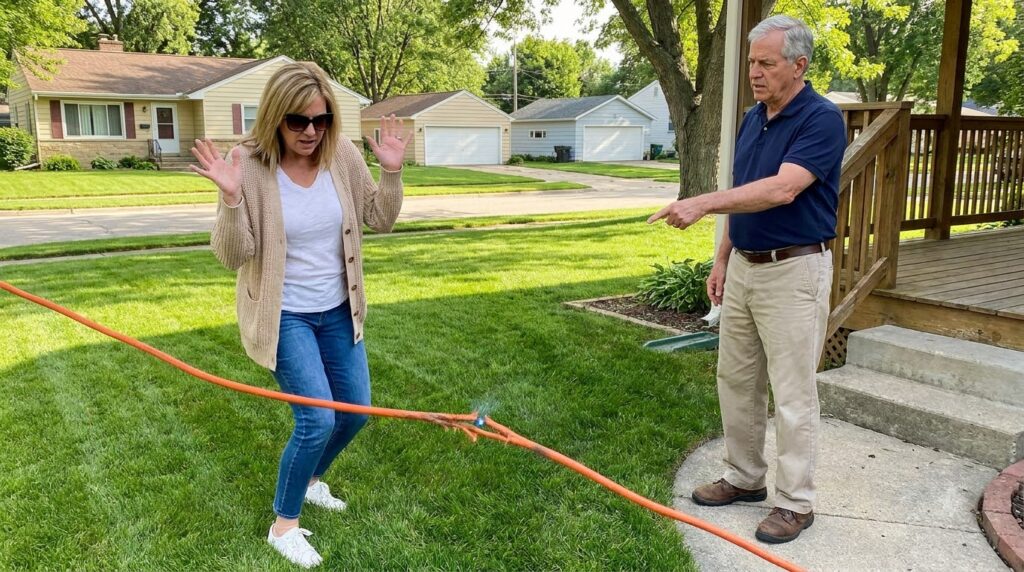
Karen had retreated past her manicured hedge line. She was on her phone now, holding it with both hands against her ear, her sunglasses crooked, eyes darting between Arthur and the mouth of the street.
The county truck was already past the mailboxes. Its broad chrome bumper glinted under the sun, air brakes hissing as it stopped parallel to Arthur’s ditch. The doors opened with a heavy clatter, two men stepping down onto the shoulder: one in a high-visibility vest with a clipboard tucked beneath his arm, the other wearing the dark brown utility uniform and badge of a deputy fire marshal.
Behind them, the neighborhood stirred.
Pete Miller came out first, leaving the sanctuary of his garage. He walked with his head down, hands jammed into the front pockets of his work trousers, stopping at the edge of his apron. Across from him, the Henderson woman stepped off her porch, followed by young Vance from number 408. They gathered along the asphalt seams like cattle herded toward an open chute, silent, their faces drawn tight with the shame of people who had already cashed their consideration checks.
“Arthur!” Miller called out, his voice cracking on the syllable. He didn’t cross the yellow-painted center seam of the roadway. “Just let him write the assessment, Art. It’s over. The state funded the interchange. The pool already voted eight to one.”
Arthur didn’t answer. He reached the corner post where the orange line lay coiled like a split serpent. He didn’t touch the wire. Instead, he drove the wedge of the pry bar straight down beneath the galvanized mounting plate of the tap box, into the two-inch gap between the cedar post and the fresh concrete footer.
“Don’t touch that line!” the fire marshal shouted from the curb, his leather boots crunching into the dry ditch gravel. He held a yellow carbon-pad book in his left hand. “That’s an active hazard call. You disturb that connection, sir, and I cite you for municipal tampering on site!”
Arthur put his full weight on the bar.
The three sleeve anchors screamed against the poured concrete. Dust puffed out—fine, gray flour of pulverized aggregate—as the expanding collars tore free, leaving ragged, round scars in the wall. The entire assembly came away with a wet, splintering crack, dangling by the heavy industrial feed line that ran straight into the turf.
“You’re thirty feet inside my boundary,” Arthur said, his voice flat, cutting clean through the low rumble of the idling diesel truck. He didn’t look at the marshal. He looked straight at Pete Miller. “Clara’s grandfather drove the corner pin forty yards past this oak before Shaker Ridge was laid out. You remember that, Pete? You were twelve years old when your dad borrowed our post-hole digger to fence your back pasture.”
Miller flinched. He looked at his boots, the scuffed leather coated in fresh lawn clippings, and said nothing.
“The easement filing was signed under Chapter 40 eminent utility provisions,” the man with the clipboard said, walking up beside the deputy marshal. His voice was clipped, nasal, practiced from dozens of condemnation hearings in county basements. “Emergency municipal declaration overrides historical boundary plats pending administrative review. We have a certified hazard record right here.”
“You have an extension cord with a knife slash in the jacket,” Arthur said.
He turned the wrecking bar in his hands, using the claw end to hook the orange cord. With one sharp, deliberate jerk of his forearms, he hauled the slack toward the sunlight.
The split section flopped over.
There were no burn patterns on the copper. The rubber hadn’t ruptured from heat or load; the edges were clean, cut with a straight utility blade, with half a gram of charcoal dust rubbed into the wound to mimic a short circuit.
Karen took another step back into her driveway, her phone dropping to her waist. Her lips were pressed together into a bloodless line.
“You staged an arc,” Arthur said, the silence on the street growing so heavy that the diesel exhaust from the idling truck seemed to coat every throat on the cul-de-sac. “Ran it off my side of the junction to manufacture an emergency shutoff. Because Clara’s name was still on the title registry, and the title company couldn’t write commercial insurance on the interchange until her estate cleared through probate.”
The man with the clipboard shifted his feet, glancing sideways at the fire marshal. The marshal didn’t reach for his citation book. He looked at the clean razor cut in the cord, then down at the severed anchors hanging from the box.
“They didn’t tell you that, did they?” Arthur asked Miller, his gaze pinning his neighbor against his own garage door. “They told you that if I held out, the state would pull the entire buyout package. They told you Clara’s estate was holding up your equity.”
Miller looked up, his jaw trembling. “The offer had a sixty-day clause, Art. If one lot refused, the road bypassed the section. The farm parcel goes to zero. We’d have the truck route two hundred yards behind our bedrooms with no sound wall and no compensation.”
“So you let her drill my footer,” Arthur said.
Nobody answered. A dry gust of wind rattled the sweetgum leaves, blowing a flurry of black mulch across the sidewalk, scattering it over the clean white shoes Karen was wearing.
Arthur pulled the wrecking bar back, resting the heel of the tool against his boot.
“The fire marshal can write whatever notice he likes,” Arthur said, turning back toward his porch. “The probate court cleared Clara’s release at nine o’clock this morning. The county clerk stamped the surviving tenant deed into the land book before noon. I own from the centerline of this ditch to the rear creek bed, free and clear, with no municipal encumbrance.”
He paused on the bottom riser of his porch, his back to the gathering crowd, his frame dark against the sunlit siding of the house.
“Now pull that truck out of my ditch,” he said without looking back. “Before I call the county sheriff for commercial trespass.”
The driver of the utility truck didn’t wait for the clipboard man to give an order. The reverse lights flicked on, the air brakes released with a loud, sharp hiss, and the heavy tires began backing down the blacktop, leaving the residents of Shaker Ridge standing in the hot, unmoving air of a street that had already been sold, but would never be paved.








