
CHAPTER 2: THE TAP AT THE CORNER PIN
The plastic tag didn’t rattle; it hung dead and stiff against the galvanized box, faded to the pale, chalky blue of an old milk crate left out in the weeds.
Arthur didn’t stand up right away. His thumb stayed hooked inside the loop of his jeans pocket, nails dark at the edges with engine grease he’d stopped trying to scrub out two winters ago. The numbers stamped into the lead wire of the seal were small, pressed with an inspector’s hand-die that had slipped on the second digit: 04-B-9912.
He knew that sequence. He had seen it on the certified mail packet that sat on the corner of his kitchen table for seven weeks, right beside the brass urn he hadn’t yet had the stomach to take down to the cemetery plot.
“Leave that alone, Arthur.”
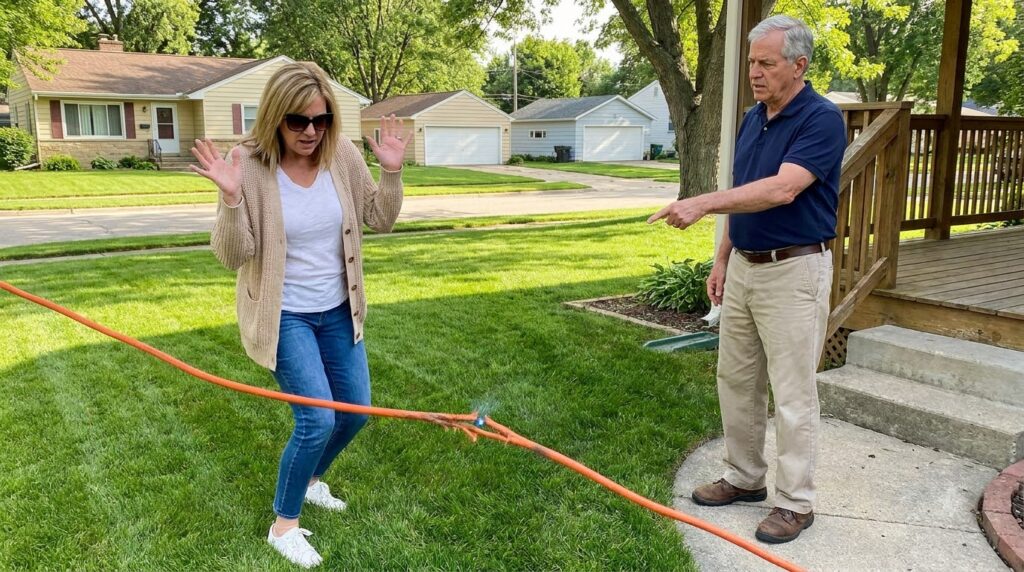
Karen’s voice had shifted. The high-strung, neighborly indignance was gone, replaced by a brittle, flattened tone that sounded like metal sliding over gravel. She hadn’t moved back toward her own yard. She stood at the seam where the street asphalt met the curb pan, her white leather shoes toeing the edge of the gutter. Behind her, the lawn of number 404 was dotted with white folding chairs and a pair of tall, rented stainless steel beverage dispensers catching the late afternoon glare like tin reflectors.
“You got a municipal lock on a tap box screwed into my cedar post,” Arthur said. He stayed in his crouch, his knees making a low, dry pop as he shifted his weight. “County doesn’t drop temporary junction boxes on private ground without an easement survey. They don’t use lead crimp tags anymore either. Switched to barcode zips five years back.”
“The board approved it,” she said, her arms coming up, crossing tight over the beige cardigan. The coral polish on her fingernails dug into the fabric of her sleeves. “It’s temporary infrastructure. We have an auxiliary permit for the summer social. It covers utility line extensions within twenty feet of the road boundary.”
“Your permit covers juice from your own panel,” Arthur said. He touched the split in the orange rubber casing with the tip of his pocketknife blade. The copper underneath wasn’t stranded wire from a hardware store spool. It was thick, solid-core gauge, the kind pulled out of industrial service drops. The insulation had been shaved back with an uneven hand, scarred with shallow hatch marks where a dull blade had slipped. “This isn’t house current. You’re pulling off the street transformer.”
Down the street, the front door of the Henderson house opened two inches. A slender hand reached out, grabbed the brass handle of the storm door, and pulled it shut with a muffled thunk that carried through the quiet cul-de-sac like a dry branch snapping underfoot.
Arthur stood up slowly. His lower back ached with the dull, constant iron ache of sixty-two years on his feet, but his balance was centered, his shoulders squared against the blinding glare bouncing off Karen’s oversized shades.
“You don’t want to dig into this,” she said. It wasn’t a shout. She lowered her head, looking at him over the rim of the dark lenses. Her eyes were bloodshot at the corners, rimmed with dry mascara that had begun to flake in the heat. “Go back on your porch, Arthur. Let the caterers run the secondary lead. It’s four hours. We’re done by nine, and the box comes down tomorrow morning.”
“Who gave you the seal?” he asked.
“It was through the association.”
“The association doesn’t have an inspector’s crimper,” Arthur said, taking two slow steps toward the property line pin—an iron rebar peg driven flush into the turf fifty years ago, now half-swallowed by the root of a pin oak. “And they don’t have the key to the utility riser behind my shed.”
Karen let out a short, hollow laugh that didn’t reach her face. She turned her head toward the street, looking not for help this time, but checking the line of sight toward Pete Miller’s driveway. Miller’s mower sat deserted in the grass, the green paint sun-faded to olive, the engine ticking as it cooled. “You think everyone on this street is blind, Arthur? You think people don’t see the roof on your barn? You think they don’t see the county assessor’s truck that’s come down this lane three times this month?”
Arthur paused. The heat seemed to thicken around the collar of his navy polo, smelling of parched sod and dry lime dust from the road repairs two blocks east. “The assessor comes when a deed changes hands. My deed hasn’t moved.”
“Not yet,” Karen whispered.
The word hung in the humid air, heavier than the ozone that had sparked from the wire.
She took a half-step back, her confidence returning in the form of a cold, transactional distance. “That wire stays where it is until the caterer’s van clears out tonight. If you touch that box, you’re interfering with a designated neighborhood easement. Pete signed it. The Hendersons signed it. Every lot between your corner and the main boulevard is on the registry.”
Arthur looked past her, across the blacktop to the manicured hedgerows, the clean asphalt driveways, the zero-turn mowers parked neatly behind closed carriage-style garage doors. Nobody was looking out their windows now. The cul-de-sac was still, frozen in the yellow light, waiting for the old man to pull his boots back across the line.
Instead of turning toward his porch, Arthur reached into his pocket and pulled out his folding knife. The carbon steel blade clicked into the brass bolster with a sharp, oily snap.
Karen’s chin jerked up. “Arthur. Don’t.”
He didn’t look at her. He bent down at the base of his cedar post, right where the heavy orange line disappeared into the grass, feeding directly from the unmetered side of the street main.
Beneath the turf, half-buried under three inches of fresh, black hardwood mulch that he had never bought, lay a second cable—not orange, but steel-braided conduit, locked into his foundation with three galvanized masonry anchors that were already weeping fresh rust.








