
CHAPTER 3: THE SKELETON IN THE FOOTER
The carbon blade didn’t cut. It struck the corrugated sheath with a harsh, skittering shriek that sent a jolt of vibration straight up the bone of Arthur’s forearm.
He didn’t pull back. He scraped sideways, clearing a two-foot furrow through the damp, dyed mulch. The rot beneath was sour, smelling of decomposing bark and stale ammonia. What emerged wasn’t temporary rigging. Three quarter-inch zinc sleeve anchors were driven cleanly into the poured concrete footer of his garage foundation, the collars weeping fresh orange rust into the hairline stress fractures of the masonry.
The steel-braided conduit had been bent with a hydraulic bender—too clean for amateur work, the curve hugging the ninety-degree footing before vanishing through an old drainage knockout he hadn’t checked since the spring rains.
“That’s not utility wire,” Arthur said. The gravel in his throat felt thicker, dried out by the midday heat. He reached down, his thumb testing the tension of the steel sleeve. It was cold, shielded, and dead-bolted to the bone of his house. “This is structural feed. Low-voltage monitor cable.”
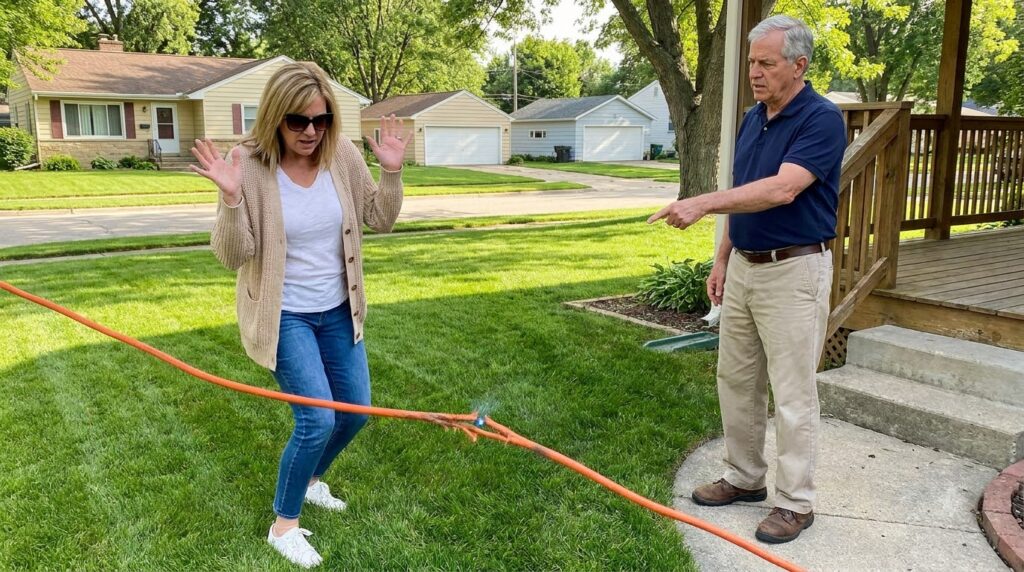
Across the curb, Karen didn’t move to stop him. She had backed up until her calves touched the bumper of a pearl-white crossover parked in her driveway. The sunglasses were pushed up onto the crown of her head now, tangling in blonde hair that had begun to frizz against the nape of her neck. Her skin looked pale beneath the faux bronzer, the defensive sneer replaced by the cold, vacant calculation of an adjuster running numbers after a wreck.
“You should have let Pete handle the cutover,” she said.
“Pete doesn’t know a hammer-drill from a lug wrench,” Arthur said. He stayed on one knee, his left hand tracing the edge of the newly drilled hole in his foundation. The gray concrete powder was still powdery under his fingertips, untouched by a single heavy downpour. It hadn’t been here forty-eight hours ago. “Who drilled my wall, Karen?”
“It’s not your wall if the perimeter was flagged by the drainage district, Arthur.”
She reached into the pocket of her cardigan, pulled out a laminated card on a retractable lanyard, and let it hang between two manicured fingers. It wasn’t an HOA pass. The laminate caught the sun, displaying a green state seal and a bold black font: Regional Transit & Logistics Corridor — Field Survey Unit.
Arthur’s hand stayed flat against the rough concrete footer. The vibration was faint, but it was there—a rhythmic, sub-audible hum pulsing through the braided conduit, not drawing power out, but sending telemetry in.
“The party,” Arthur murmured, looking toward the long banquet tables set up across the asphalt, the white linens fluttering under the drone of an industrial fan. “The seventy people arriving in twenty minutes.”
“There is no party, Arthur.” Her voice dropped low enough that it barely carried past the curb, flattened by the dry heat radiating from the street. “Look at the tables. Look at the driveways.”
Arthur turned his head.
The folding chairs were set up, but no cars were parked along the lane. No catering van had backed into number 404. Across the street, Pete Miller hadn’t gone back to his yard; he was standing inside his dark garage, the side door cracked just wide enough for the barrel of his silhouette to be visible. Further down, at the mouth of the cul-de-sac where Shaker Ridge Road met the two-lane state route, a pair of orange safety barrels sat in the breakdown lane, flanked by an idling county utility truck with its amber roof-bar spinning silently.
They weren’t waiting for guests. They were waiting for an inspector to sign off on an open trench.
“The orange line,” Arthur said, the realization settling in his gut like a swallowed river stone. “You didn’t run it to steal juice.”
“If an unpermitted, high-draw line shorts out across a contested easement,” Karen said evenly, her voice devoid of any pretense of neighborly venom, “the county fire marshal red-tags the access parcel immediately. Forty-eight-hour structural evacuation order for anything within thirty feet of the hazard.”
She pointed a coral-tipped finger toward his front porch, then down toward the iron rebar pin half-buried under the oak root.
“Your porch is twenty-six feet from that split wire, Arthur. Once the fire marshal’s tag hits that door, the emergency access easement executes automatically. Pete signed his. The Hendersons signed theirs three weeks ago when the buyout pool cleared escrow.”
Arthur rose to his full height. His joints clicked, his boots sinking a quarter-inch into the turf he had fertilized every autumn since Carter was in the White House.
“The county docket number on that seal,” he said, staring at her face until she finally broke eye contact, looking down at her clean white sneakers. “04-B-9912. That was Clara’s medical probate release. The deed couldn’t transfer while her name was on the county register.”
“Pete brought the probate filing to the zoning board meeting,” Karen said, her chin coming up in a final, defensive jerk, though her voice lacked any bite. “The lane needs an outlet to the state highway. The logistics terminal needs the turning radius. Eleven families took the check, Arthur. Eleven. Every single person on this cul-de-sac is packed and waiting for the closing date.”
She stepped off the curb, crossing the line of asphalt until she was three feet from him, stopping just short of the scorched orange cord.
“Nobody wants to hurt an old man,” she said quietly. “Take the pool payout. Walk away before the marshal posts the notice. If you pull that conduit out of the foundation, you’re interfering with a state right-of-way installation. That’s a Class C felony before sunset.”
Arthur looked past her shoulder. Down at the mouth of the street, the county truck clicked into gear, its reverse beeper sounding three rhythmic, metallic chirps as it backed toward his ditch.
He didn’t reach for the cord. He folded the carbon blade against his thigh, slipped the knife back into his pocket, and walked past her toward his front steps.
“Arthur,” she called out, a note of real panic cutting through the corporate composure. “Where are you going?”
Arthur didn’t turn around. His boot hit the first wooden riser with a solid, hollow thump. “I’m going to get my pry bar.”








