
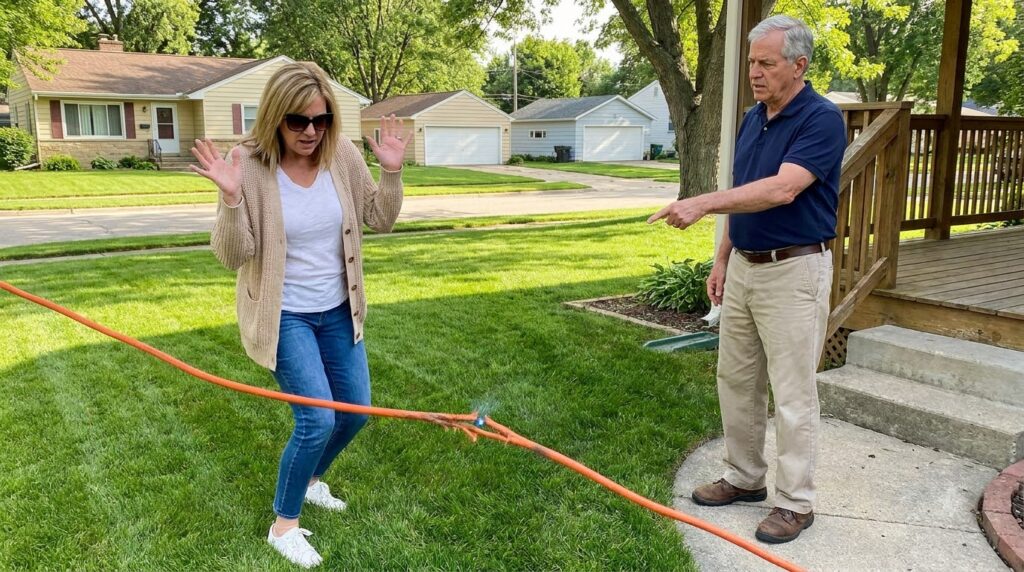
CHAPTER 1: THE TENSION ON THE GRASS
“Drop it. That cord is damaged.”
Arthur didn’t raise his voice, but the words had the dry, scraping grit of a flathead shovel biting into limestone. He stood on the bottom riser of his porch steps, work boots planted firmly behind the invisible boundary where his mowed fescue met the sidewalk slab. His hands stayed at his sides, fingers loose, thumb brushing the brass casing of his pocket knife.
Across the lawn, Karen froze. Her late-afternoon tan looked powdery under the hard suburban sun, her oversized designer sunglasses sliding down the bridge of her nose. Her fingers—manicured, tipped in pale coral—were clamped around a thick, heavy-duty outdoor extension cord the color of cheap road safety paint.
Between her grip and the turf, the rubber insulation had split wide open, exposing a gnarl of blackened copper. A faint, sharp tick split the humid air, followed by a blue-white needle of light and the distinct, sulfurous sting of ozone.
Karen snatched her hand back with an involuntary, sharp intake of air, stumbling two paces into the dry ditch grass near the curb. Her white leather sneakers squeaked against the asphalt. “It was working fine!” she snapped, her chest heaving beneath her beige cardigan. Her voice had that practiced, shrill cadence of someone used to delegating inconvenience to customer service counters. “We have seventy people arriving in twenty minutes for the block reception, Arthur. It’s just the lawn. It’s grass.”
“It’s my grass,” Arthur said. He hadn’t blinked. His early-sixties frame carried no extra bulk—just the sinewy, dried-out resilience of a man who still greased his own tractor joints and cleared his own storm gutters. “And that line is shorting out against the ground. Pack it up.”
“You don’t own the easement,” she shot back, stepping toward the wire again, though her fingers hovered an inch above the scorched split, unwilling to risk a second bite. She looked past him, scanning the front porch, the neat stack of split cedar beside his garage, the weathered aluminum flag mount screwed into the trim. Searching for an angle. A legal technicality. “The committee authorized the overflow setup. I told you three days ago.”
“You told the air,” Arthur replied evenly. “I told you no.”
Down the cul-de-sac, a garage door hummed shut. Across the asphalt, Miller was leaning against his riding mower, garden hose dangling in his grip, water puddling wastefully around his front tires. Two doors down, the Henderson woman stood behind the sheer curtains of her bay window, her silhouette static and dark against the glass.
Karen felt the audience. Her chin lifted, regaining the rigid, polished authority she wore like armor. She turned toward Miller, raising an arm in a sweeping, theatrical summon. “Pete! Could you come over here for a second? We’ve got an issue with the hookup!”
Miller didn’t move. He deliberately reached down, turned the brass spigot off, and walked inside his garage without looking back. The latch clicked shut. The street returned to the low, droning hum of distant highway traffic and the dry rattle of cicadas in the sweetgums.
Arthur watched the woman’s composure crack, just a hairline fracture beneath the sunglasses.
He didn’t gloat. He walked four paces forward, stopping three feet short of the resting orange snake. He knelt down, knees clicking, and used a dry hickory twig from the lawn to flip the wire over.
There was no plug at the far end where it met his exterior outlet. Instead, the wire was spliced into a crude, heavy-gauge tap, locked shut with a faded blue tag that bore an official county emblem—stamped with a case number dated two days prior to Arthur’s own wife’s funeral.








