
CHAPTER 2: THE PAPER LAUNDRY
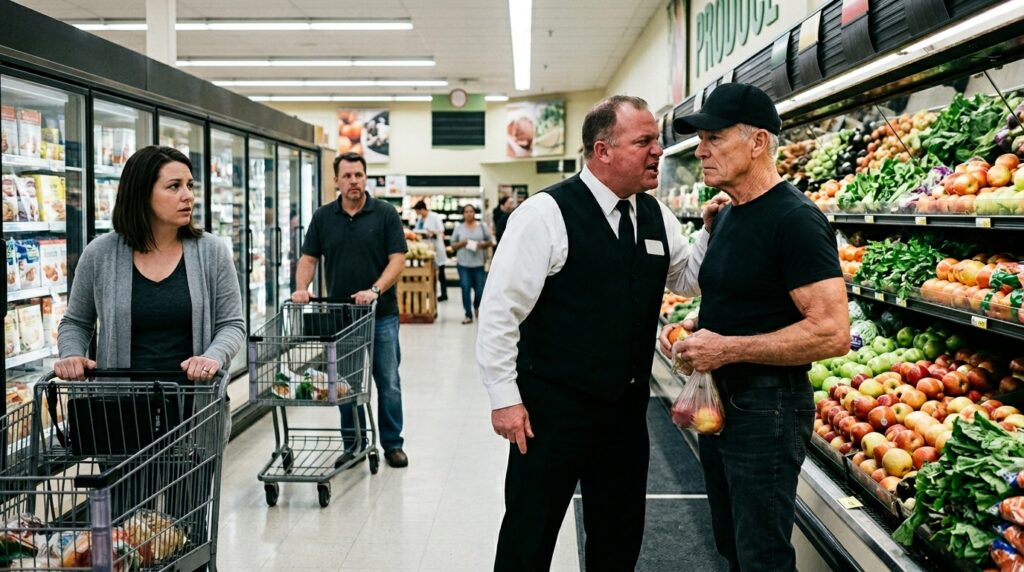
The fluorescent light overhead flickered with a dry, rhythmic hum, casting a sickly yellow hue over the manager’s pale face. The smell of split bleach from a distant aisle drifted down the lane, mixing with the sharp, metallic tang of copper from where Miller’s lip had split against the tile.
“You,” Miller whispered, his fingers clawing at the slick floor wax, trying to push his stocky frame away from the veteran’s heavy boots. “The captain said you died in ’98. In the warehouse fire outside Frankfurt.”
The veteran’s face didn’t move. To the two shoppers frozen by the freezer glass, he looked like a statue carved from salt and gray clay. But beneath the black fitted shirt, his chest stayed flat, his breath held hard in his lungs to stop the sudden, violent surge of an old adrenaline. Twenty-eight years of quiet anonymity—of cutting lawns, changing oil, and paying cash for bruised apples—vibrated against the sound of that specific rank.
Captain.
“Get up,” the veteran said. His voice was too quiet for the cavernous space of the store, but it carried the dead weight of an iron grate dropping into place.
He didn’t offer a hand. He didn’t look at the shoppers, who were already backing away, their cart wheels squeaking like mice against the linoleum as they abandoned their groceries to find the exit. The store was empty now, save for the distant, automated chime of the front doors sliding open for a customer who would see the silence and turn around.
Miller didn’t get up. He dragged his right leg, the knee clicking again as he hauled himself into a sitting position against the base of the organic potato bin. Sweat had cut clean tracks through the dust on his forehead. “He’s got the deed, Vance. He’s had the county surveyor out three times this month. It’s not about the aisle. It was never about the aisle.”
Vance. The name felt heavy, unpracticed, like a tool left out in the rain until the rust froze the hinge. He hadn’t used it since the administrative discharge papers were stamped in New Jersey.
“Who has the deed?” Vance asked. He kept his palms flat against his thighs, his posture angled toward the service door at the back of the produce wall. If the police were coming, the sirens would carry through the thin aluminum insulation of the roof before the lights hit the parking lot. He had four minutes, maybe less, if the cashier up front had already hit the silent alarm under the register.
“The county asset board,” Miller spat, wiping his mouth with the back of a sleeve that was already graying from the floor. “But the money’s coming from Apex Holdings. They bought out the regional management firm six weeks ago. They told me to clear the lane. Said if you stayed stubborn about the perimeter line on your lot, we’d make it a public safety issue. A crazy old man causing a public nuisance.”
Vance looked at the manager’s name badge, now dangling over a stained pocket. Arthur Miller. Floor Supervisor. A small man with a small title, hired to carry out the friction of an invisible machine. The world was full of them now—men who wore polyester vests but spoke with the legal weight of a bulldozing crew.
“You’re lying,” Vance said, though the iron in his stomach told him otherwise. His house sat on three acres of gravel and scrub pine behind the drainage canal, a piece of land so dry and worthless he’d bought it for taxes forty years ago. There was nothing there but a well-pump and an old tin shed full of rusted lawnmower parts.
“Go look in the cage,” Miller said, his voice dropping as a distant, metallic click signaled the back door of the store locking automatically for the night shift. “The regional manager left the compliance ledger in the drawer. The account numbers aren’t corporate grocery, Vance. They’re logistics. The old freight manifests from the sector base. The ones that went missing before the unit dissolved.”
The friction of the thought was like sandpaper on a raw nerve. Vance didn’t answer. He turned on his heel, his work boots leaving no marks as he walked past the manager, toward the heavy swinging doors that led to the back office.
The back room smelled of rotting cabbage and damp cardboard. A single desk sat under a cage-protected bulb that cast long, barred shadows across the concrete floor. The desk drawer wasn’t locked—the regional manager hadn’t expected anyone to look past the inventory sheets for canned soup.
Vance’s fingers, thick and calloused from decades of manual labor, flipped through the green-tinted carbon receipts. His eyes skipped the produce tallies, fixed instead on a series of wire transfers stamped with a three-digit routing code he hadn’t seen since the Berlin wall came down.
It wasn’t a corporate account. It was a private security ledger, and every third line carried a deduction for “Site Clearance” billed to an LLC registered in Delaware. At the bottom of the final sheet, printed in the small, precise font of an old military typewriter, was a single operational name: Project Ironwood.
Vance dropped the paper. The surface of the desk was gray with grease, and his thumb left a clean swirl in the dust. The ledger didn’t show a land dispute; it showed a targeted elimination. The manager hadn’t been trying to clear a customer; he’d been testing a perimeter.
A sharp, electronic chirp cut through the dark.
Vance froze, his hand remaining inches above the green carbon paper. The sound came from the pocket of Miller’s discarded vest, hanging from a hook behind the door. A small, ruggedized radio—not the standard store walkie-talkie, but a high-frequency tactical unit with a whip antenna—was pulsing with static.
A voice came through the small speaker, dry and rhythmic, filtered through three layers of digital encryption.
“Supervisor, status on the aisle block. The transport is two minutes from the loading bay. Confirm the target is contained.”
Vance did not move. He looked down at his own reflection in the dark glass of a broken computer monitor on the desk. An old man, gray at the temples, wearing clothes that smelled of gasoline and old dirt. The trap hadn’t sprung when he threw the manager; the trap had been waiting for him to walk back into the light.
From the hallway outside, the sound of a heavy bolt sliding into place on the loading dock door echoed through the concrete walls.








