
CHAPTER 2: THE STAINS OF THE STATE LINE
“You always did have an eye for inventory, Miller,” Mac said. He didn’t turn his body to face the doorway. Instead, he took a slow, deliberate sip of his lukewarm coffee, letting the bitter taste sit on the back of his tongue like iron slag. The heat of the mug was the only solid thing left in the room.
The man in the suit—Miller—didn’t flinch at the name. He stepped further into the diner, his leather-soled shoes making a dry, scratching sound against the grit on the floorboards. The draft from the open door carried the unmistakable smell of sun-baked pine and the sulfurous rot of the nearby salt flats.
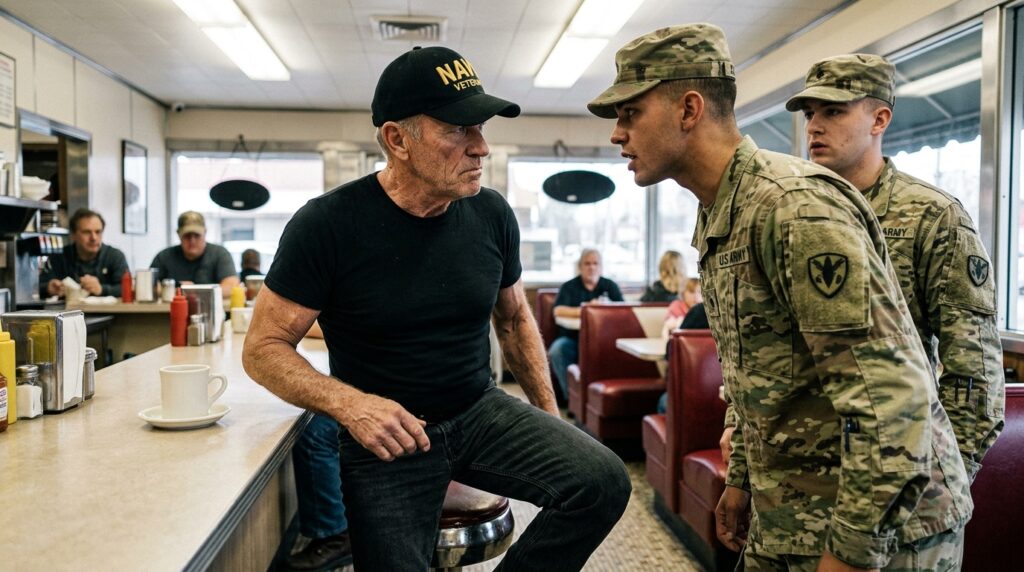
“The Colonel doesn’t like loose ends, Mac. Especially not the kind that leave three crates of heavy hardware sitting in a barn behind a tractor that hasn’t run since the Bush administration,” Miller replied. His voice was flat, dried out by years of reading manifests in windowless offices. He didn’t look at the two active-duty soldiers groaning on the floor. To him, they were just spilled oil on a garage floor—an inconvenience to be cleared away.
“Those crates were empty when I hauled them across the state line,” Mac said. He finally set the mug down. The porcelain base scraped against the formica with a small, grating shriek. “They were filled with gravel and scrap iron to balance the manifest weight. You know it. The Colonel knows it.”
“The paper says otherwise,” Miller said. He reached into his breast pocket and pulled out a small, yellowed slip of carbon paper. The edges were frayed and soft from years of handling, the purple ink faded to a faint, bruised smudge. He laid it on the counter right next to Mac’s grease-stained napkin. “And in our line of work, the paper outlives the man.”
Mac looked down at the slip. His eyes didn’t track the numbers—he knew them by heart—but his gaze locked on the bottom corner. There was a thumbprint there, dark and rusted into the fiber of the paper. It wasn’t ink. It was the hydraulic fluid from the crane they’d used to load the sealed containers back in Subic Bay before the world turned over.
The micro-mystery wasn’t the paper, though. It was the mud on Miller’s shoes. It was the same thick, iron-red clay that coated the rocker panels of the sedan outside. This wasn’t the gray silt of the local riverbed or the pale sand of the highway expansion. It was the deep, bloody clay from the southern valley—the area around the old tactical storage depot that had been decommissioned and welded shut back in the late nineties.
Miller hadn’t come from the regional headquarters up north. He had been down in the dirt, digging through the old foundations.
“The boys were a nice touch,” Mac murmured, nodding toward the soldier who was currently trying to wipe the blood from his mouth with a sleeve. “A bit loud, though. You used to use professionals.”
“They aren’t mine,” Miller said, and for the first time, a small crack appeared in his gray mask. His eyes flicked to the diner window, scanning the shimmering heat waves rising off the highway asphalt. “They’re Third Battalion. Local boys out on a weekend pass from the fort. They just happened to be looking for a fight, and I happened to tell them an old man at the counter was talking trash about their deployment.”
Mac leaned back, his spine popping with a dry, wooden sound. “A decoy.”
“A gauge,” Miller corrected. “The Colonel wanted to see if your hands were still steady. If you could still drop a man without looking him in the eye. They are. So now we can talk about the real problem.”
Mac’s hand remained deep in his pocket, his thumb tracing the cracked glass of the rusted compass. He could feel the friction of the metal casing, the tiny ridges of corrosion that had eaten into the brass over fifty years of damp storage. The needle inside remained dead, locked toward a horizon that didn’t exist anymore. But the weight of it kept him anchored while the air in the diner grew thick with the smell of old frying oil and impending rain.
“I don’t have anything left to say to the Colonel,” Mac said. His voice dropped an octave, the gravel hardening into flint. “I took my retirement in the woods. I don’t draw a pension, and I don’t look at the news. That was the trade.”
“The trade changed when the storage depot down in the valley went up for private auction last Tuesday,” Miller said. He leaned down, his face inches from Mac’s profile. The smell of peppermint gum and stale coffee came off him. “The buyers found the false floor in the logistics office, Mac. The ledger isn’t there. The one with the signatures for the asset liquidation.”
Mac didn’t move a muscle, but inside, the gears of his mind shifted with a cold, heavy clunk. The ledger. That was the decoy Miller was dangling. They thought he had taken the paper trail that proved the Colonel had been selling off surplus communication arrays to foreign syndicates. They thought he was holding a knife to their throats from his cabin in the pines.
But Mac knew the real truth—a truth so heavy it had kept him silent for thirty years. The ledger wasn’t a list of equipment. It was a roster of names. Names of men who had been left behind in the gray zones of the map so the budget lines would balance out to zero.
“I don’t have your book, Miller,” Mac said softly. He stood up, his height forcing the younger man to take a half-step back to clear his perimeter. The movement was old, practiced, and entirely devoid of heat. “And if I did, it would have been ash before the turn of the century.”
“We’re going to have to verify that,” Miller said. He didn’t draw a weapon, but his hand stayed tucked inside his coat, his fingers locked on something heavy and dark. Outside, the sky was turning the color of an old zinc tub, the first heavy drops of summer rain hitting the hot roof with the sound of falling gravel. “The Colonel’s waiting at the crossroads. You can come in the sedan, or we can let the local sheriff handle the assault charges for these two boys. Either way, you’re leaving the diner.”
Mac looked past Miller’s shoulder, out through the scratched glass of the door. The red clay on the sedan’s wheels was beginning to run, dissolving into long, pink streaks under the downpour, exposing the pitted, gray steel beneath the illusion of travel.
“The sheriff won’t come,” Mac said, his hand tightening around the brass compass until the metal bit into his palm. “His manifold finally gave out ten minutes ago. I heard it pass my ridge before I came down here.”
He took a step forward, his boot coming down inches from the fingers of the soldier on the floor.








