
CHAPTER 5: THE THRESHOLD LINE
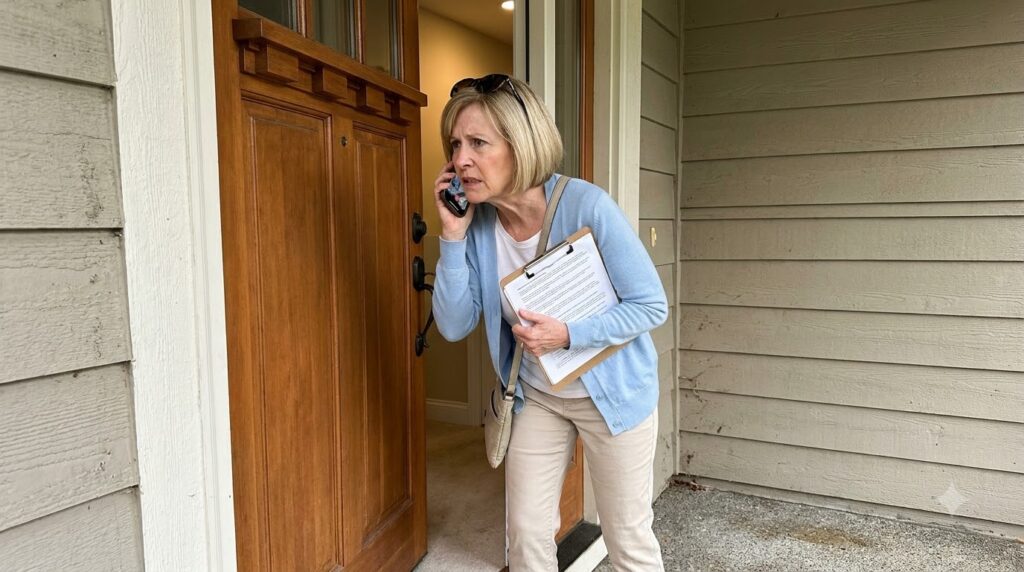
The words left Brenda’s mouth with the clipped, practiced precision of someone who believed that repeating an assertion into a speaker made it law. “Yes, I’m still here at the door.”
She didn’t glance down at Officer Hayes. She didn’t look at Maya. She remained planted on the painted porch floorboards, her hips braced firmly against the wrought-iron railing, her body forming a physical wedge in the entry lane. The light blue knit of her cardigan strained across her back as she pressed her shoulder closer to the door jamb, ensuring no one could squeeze past her with a box without making physical contact.
Maya didn’t pull the door wider, nor did she retreat into the hallway. She kept her right hand resting flat against the inner brass latch, her boots grounded behind the wooden threshold. The space between them was less than eighteen inches—a narrow ribbon of air thick with the smell of sun-warmed porch timber, dust, and Brenda’s sharp lavender perfume.
“Ms. Miller,” Officer Hayes said, his voice dropping an octave, losing every trace of casual neighborly patience. He stepped up onto the top landing, his leather belt creaking as he turned to face her directly. “Put the phone down.”
Brenda kept the receiver pressed to her ear, her short blonde fringe dusting her forehead as she nodded stiffly into the line. “I am currently updating municipal code enforcement on an ongoing obstruction—”
“Ms. Miller,” Hayes repeated, his palm coming down firmly on the iron top rail of the porch, framing her against the house. “You are standing on private property. The owner of record has asked you to leave the entryway. I have verified the deed through county dispatch. If you do not step down off these steps right now, you are actively interfering with a lawful resident and obstructing an officer.”
A strange, taut silence settled over the porch. Down at the curb, Greg paused with a heavy wardrobe box balanced against his knee, his eyes darting between the officer and the doorway. Across the street, the neighbor on the lawnmower leaned further over his handlebars, his hand resting motionless on the throttle.
Brenda’s chest rose and fell in short, shallow hitches. For a second, the mask of official composure fractured. Her jaw twitched, and her eyes flicked down to the wooden clipboard clutched beneath her elbow.
Maya watched the movement closely. From this angle, with the afternoon sun hitting the porch at a sharp thirty-degree slant, the top yellow page on Brenda’s board pulled slightly away from the wooden backing. Beneath the yellow pad, glued directly to the hardboard core, was a second layer of paper—a crisp white sheet with a dark purple notary stamp visible along the bottom edge.
It wasn’t an HOA violation form. It wasn’t a municipal maintenance order. It was an estate document bearing a official county archive seal.
“This entire street knows Arthur wanted the committee involved,” Brenda said into the phone, her voice cracking slightly before she finally pulled the device an inch away from her cheek. She didn’t lower it to her waist; she held it suspended near her collarbone like a weapon she wasn’t ready to holster. “He brought me the paperwork himself last autumn. He didn’t want the house falling into the hands of someone who would sell it off to developers.”
“My uncle had vascular dementia, Brenda,” Maya said, her voice quiet, steady, and carrying across the porch without a hint of tremor. “He didn’t bring you anything. You walked into his living room when he couldn’t remember what month it was, and you had him put his name on a piece of paper you printed at home.”
“That is a slanderous accusation!” Brenda snapped, her elbow tightening instantly, clamping the clipboard flush against her ribs as if trying to hide the purple notary stamp peeking out from beneath the pad.
“Then show the officer the whole document,” Maya said, stepping half an inch closer to the doorframe, her eyes pinned to the hidden white corner. “Not just the yellow signature page you clipped over the top. Turn the pad over.”
Brenda’s face drained of color, the blotchy pink on her cheeks turning a dull, chalky gray under the bright afternoon sun. She took a involuntary step backward, her heel catching the edge of the top step.
Officer Hayes saw the movement. He didn’t reach for his holster, but his posture straightened, his broad shoulders cutting off her angle toward the driveway. “Ms. Miller. Step down to the walkway. Now.”
Brenda looked at the officer, then at Maya, and finally toward the street, where two more neighbors had walked out onto their front lawn to watch. The public authority she had spent a decade building on this block—the neat blue cardigan, the clipboard, the unyielding phone calls—was evaporating in the humid air right in front of the people she had tried to rule.
“This isn’t over,” Brenda whispered, her lips barely moving as she lowered the phone to her side. Her knuckles were white where they gripped the wooden board. “Arthur signed it. It’s on record.”
“Step down, Ms. Miller,” Officer Hayes ordered again, pointing a gloved finger toward the concrete path leading to the road.
Brenda turned slowly, her shoulder dragging along the iron handrail as she finally yielded the entry lane. She took the three concrete steps one by one, her head held unnaturally high, though she refused to turn back to look at the porch.
As her boots hit the gravel walkway, Greg let out a long breath, shifting the wardrobe box on his hand truck and stepping up toward the house.
Maya remained standing at the open door, watching Brenda walk down the driveway. The physical boundary of the threshold was hers, but as she looked at the hidden notary stamp she had just caught a glimpse of, she knew the fight over Arthur’s house wasn’t about lawn codes or driveway parking at all.








