
CHAPTER 2: SIFTING THE ASHES
The stroke of the A was unmistakable. Arthur Vance had a tremor in his right hand for the last five years of his life, turning his capital letters into jagged, uncertain staircases. Seeing that jagged script pressed against the yellowed paper under Brenda’s thumb sent a sudden, cold jolt through Maya’s stomach.
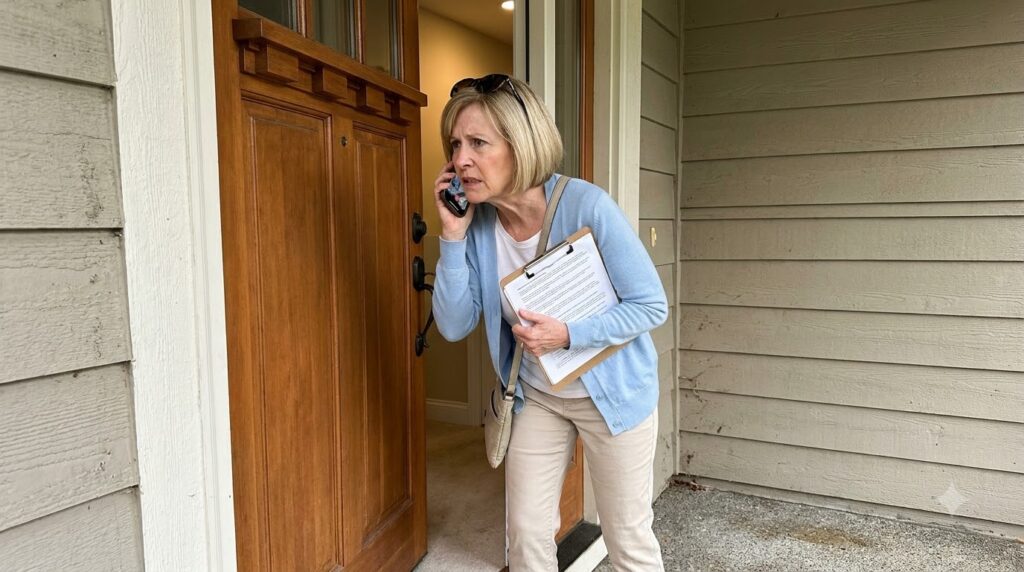
Brenda didn’t notice the freeze in Maya’s posture. She was already speaking into the receiver, her voice pitched in that sharp, practiced cadence designed to sound like an authority figure managing an unruly child.
“I have a female, mid-thirties, refusing to clear the entryway,” Brenda informed the unseen operator, her eyes remaining fixed on Maya’s face like a pair of dull glass beads. “She’s claiming relation to the deceased owner, but there is no record of an approved transfer with the neighborhood committee. I am standing on the porch now.”
Maya didn’t raise her voice. She didn’t reach through the four-inch gap to snatch the clipboard, though every instinct honed by months of dealing with aggressive creditors and greedy distant relatives urged her to rip the paper free. Instead, she leaned her shoulder against the solid oak jamb, letting the weight of the door settle firmly against her palm.
“Brenda,” Maya said, her voice dropping into a quiet, deliberate rasp that cut straight through the woman’s phone dialogue.
Brenda paused mid-sentence, her eyebrows twitching upward beneath her blonde fringe. “I am on the phone with municipal dispatch.”
“You are holding a piece of paper with my uncle’s signature on it,” Maya said, keeping her gaze pinned to the worn wooden edge of the clipboard. “Arthur hasn’t lived in this house for six months. He spent his last ninety days in hospice. Where did you get that document?”
A tiny, almost imperceptible shift occurred in Brenda’s stance. Her forward lean faltered by a fraction of an inch, her elbow tightening against her ribs, pulling the clipboard closer to the light blue knit of her cardigan. For a half-second, the defensive posture cracked, revealing the sharp, defensive panic of a person caught reaching into someone else’s coat pocket.
“This is official neighborhood correspondence,” Brenda said into the phone, though her tone had lost its crisp edge, turning brittle and defensive. “She is attempting to intimidate an authorized representative. Please dispatch a unit.”
Down at the curb, the heavy clatter of Greg’s parcel truck died down as he shut off the diesel engine. The courier pulled his cap off, wiping his brow with the back of his forearm while eyeing the porch. Across the street, the neighbor on the riding mower hadn’t restarted his engine; he sat motionless, his arms resting on the plastic steering wheel, taking in every second of the standoff.
Maya stepped back just half an inch, pulling her smartphone from her back pocket with her left hand while her right remained anchored to the door latch. She unlocked the screen with her thumb, navigating directly to the encrypted folder containing the digital probate filings, the stamped land-deed transfer, and the municipal occupancy certificate issued by the county clerk three weeks prior.
“I’m not going to argue with you on this porch,” Maya said, holding the screen up against the glass pane beside the doorframe so the high-resolution county seal glowed clearly against the wood. “The county registered this deed on the fourth. The estate is settled. Whatever note you have on that board has nothing to do with property rights.”
Brenda glanced at the glowing screen for a brief, furious second before snapping her head back toward the driveway. “A digital image proves nothing. Anyone can edit a PDF on a home computer. The neighborhood standards agreement requires physical verification on site.”
She didn’t wait for a response. Turning her back slightly toward the doorway, Brenda took two deliberate steps toward the top of the porch stairs, keeping her body wedged just close enough to the handrail to block anyone from bringing more boxes up the concrete steps. She kept the phone pressed hard against her ear, repeating her location in a clipped, demanding bark.
Maya let the door swing closed just enough to engage the brass deadbolt with a heavy, metallic clack.
Inside the shaded hallway, the silence returned, thick and suffocating. Maya stood with her forehead resting against the cool, painted wood of the closed door for three long breaths, listening to the muffled cadence of Brenda’s voice outside.
Her mind raced back through the chaotic weeks following Arthur’s funeral—the endless cardboard boxes, the dusty filing cabinets in his study, the missing utility bills, and the strange, vague notes Arthur had left in his daily journal during his final year. B. came by about the hedge. Signed the paper so she’d leave the porch.
At the time, Maya had assumed it was a trivial dispute over landscaping. But looking at the sharp, aggressive way Brenda guarded that wooden board, a darker realization began to take root. Brenda wasn’t just enforcing arbitrary neighborhood rules. She had been coaxing an ailing, isolated old man into signing documents long before he passed away—and whatever was written on that top yellow sheet was the key to why she was fighting so desperately to keep Maya outside the threshold.
Outside, the distant whine of a siren echoed from the direction of the main avenue.








