
Chapter 6: When the Sirens Came Again
Several months later, another ambulance came down the same street.
This time, nobody knew who had called it.
Neighbors heard the siren and stepped outside.
A delivery truck was parked near the curb.
A trash bin had tipped over.
For a brief moment, the road looked crowded.
Then Karen appeared.
She didn’t climb onto anything.
She didn’t raise her voice.
She simply walked toward the delivery driver and pointed toward the curb.
“Move the truck,” she said.
The driver looked confused.
Karen glanced at the approaching ambulance.
“Emergency vehicle.”
The truck moved.
The ambulance passed.
Karen stood quietly on the sidewalk until the siren faded.
Across the street, Ruth watched from her porch.
She smiled.
Later that evening, Susan visited Margaret.
They sat together near the front window.
Margaret looked outside at the quiet street.
“Is that Karen?”
Susan looked.
Karen was helping an elderly neighbor bring groceries inside.
“Yes.”
Margaret nodded.
“She changed.”
Susan smiled.
“Maybe.”
Neither woman pretended that one apology could transform a person overnight.
People carried their histories.
They carried grief, fear, pride, mistakes, and regrets.
Sometimes those things made people behave in ways they later wished they could undo.
But Margaret had learned something during her recovery.
Justice wasn’t always about punishment.
Sometimes it was about making sure the next person didn’t have to suffer the same consequences.
And Karen had learned something too.
A home could be private.
A driveway could belong to one person.
A disagreement could feel deeply personal.
But an emergency belonged to everyone.
When someone needed help, there was no room for ownership, pride, or winning an argument.
There was only the road ahead.
And when the sirens came, you moved.
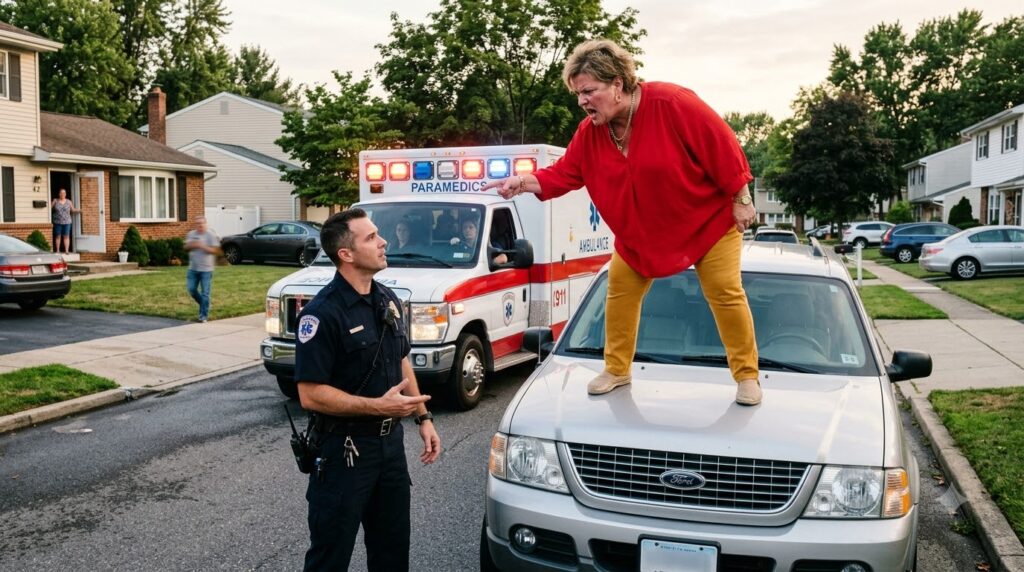
Karen never stood on the hood of her SUV again.
She never heard the phrase “If someone dies, that’s not my problem” without remembering the silence that followed.
Years later, people in the neighborhood still remembered the woman who once tried to stop an ambulance with her own body.
But that was no longer the only thing they remembered.
They remembered the apology.
They remembered the policy changes.
They remembered Margaret coming home.
And, perhaps most importantly, they remembered that sometimes the strongest thing a person can do after making a terrible mistake is stop defending it—and finally make room for someone else to get through.








