Chapter 5: A Different Kind of Apology
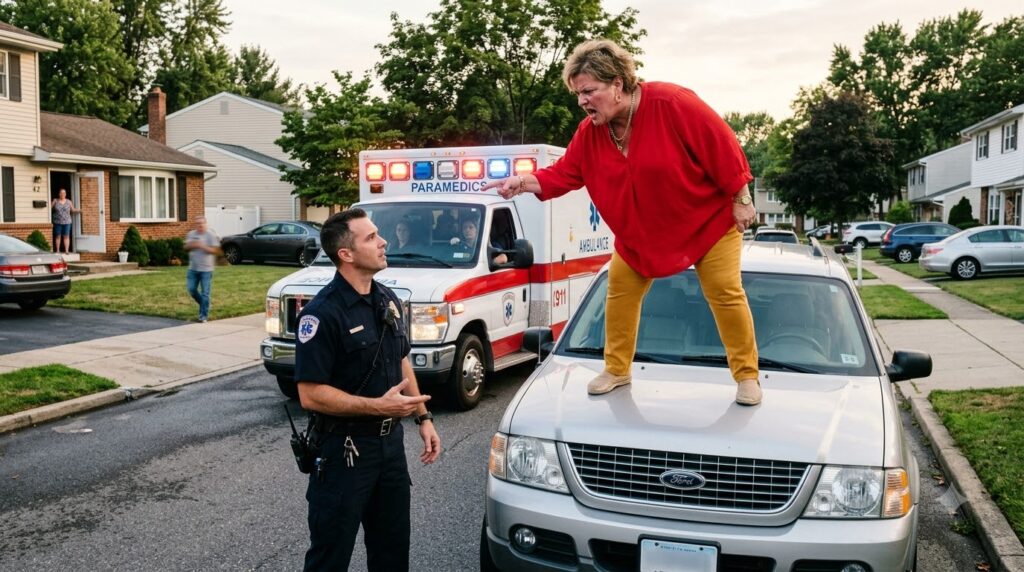
Karen’s apology did not erase the incident.
Daniel and his partner still had to document what happened.
The ambulance service also reviewed the response because access to an emergency scene had been obstructed.
There were consequences.
Karen was required to cooperate with the investigation and received a formal warning regarding interference with emergency access.
The neighborhood association also changed its emergency-access policy.
Clear markings were added to the narrowest parts of the street.
Residents were reminded that emergency vehicles had priority at all times.
No exceptions.
No matter whose driveway was nearby.
No matter who believed the street belonged to them.
But the most meaningful change happened quietly.
Karen stopped treating every inconvenience as a personal offense.
She began moving her trash cans farther from the road.
She stopped confronting delivery drivers.
She even apologized to Harold for trying to silence him at the meeting.
The biggest surprise came several weeks later.
Margaret returned home from the hospital.
She was weaker than before, but she was alive.
Susan helped her settle back into the house.
One afternoon, Margaret saw Karen walking toward her.
Karen stopped at the edge of the yard.
For a moment, neither woman spoke.
Then Karen held out a small envelope.
Inside was a handwritten note.
Margaret read it.
It was not dramatic.
There were no excuses.
Karen simply acknowledged that an ambulance had once represented the worst moment of her life—and that she had allowed that fear to become someone else’s burden.
Margaret folded the note.
Then she looked at Karen.
“You can’t take back what happened.”
Karen nodded.
“I know.”
“But you can decide what happens next.”
Karen nodded again.
This time, she didn’t defend herself.
She simply said, “I’m trying.”
Margaret smiled faintly.
“Then keep trying.”
It was not forgiveness in the grand, cinematic sense.
It was something more ordinary.
A door left open.