Chapter 4: The Reason Behind the Road
The explanation emerged slowly.
Months earlier, Karen’s husband had died after a medical emergency at home.
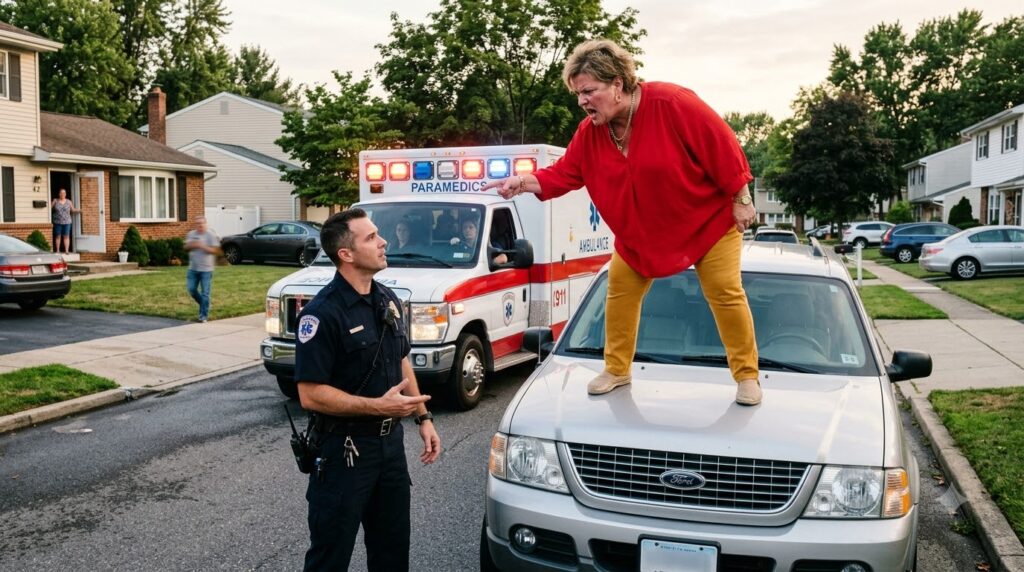
An ambulance had arrived that night.
Karen had spent several minutes standing in the driveway, panicked and confused, while the crew tried to bring equipment inside.
Her husband survived that night but died several weeks later.
Afterward, Karen became increasingly protective of the area around her house.
She complained about emergency vehicles.
She complained about neighbors parking too close.
She complained about anyone who, in her words, treated the street like “a public loading zone.”
None of that excused what had happened.
But it explained something.
Karen had begun associating ambulances with the worst day of her life.
The sight of one outside her house triggered fear, anger, and a need to control everything around her.
Harold knew this because Karen had once told him.
But he had never expected her grief to turn into something so destructive.
Susan heard the story and felt conflicted.
She could understand pain.
Her father had died too.
But understanding pain did not mean pretending the ambulance incident had been acceptable.
The neighborhood association asked Karen to meet privately with Susan.
At first, Karen refused.
Then she agreed.
They sat across from each other in a small community room.
No cameras.
No neighbors.
No audience.
Karen looked exhausted.
Susan spoke first.
“You were angry at the ambulance.”
Karen stared at the table.
“I was angry at everything.”
Susan waited.
After a long silence, Karen finally admitted that every time she heard a siren, she remembered the night her husband died.
But she also insisted she hadn’t meant to hurt anyone.
Susan answered carefully.
“I believe you didn’t want anyone hurt. But your actions still put someone else’s family in danger.”
Karen’s eyes filled with tears, though she quickly looked away.
For once, there was no shouting.
No pointing.
No dramatic gesture.
Just two women sitting in the uncomfortable space between grief and responsibility.
Susan could have demanded an apology.
Instead, she asked Karen to do something harder.
Tell the truth.
Not just about the ambulance.
About why she had become so controlling.
Karen eventually agreed.
The next neighborhood meeting was different.
She stood at the front of the room without her sunglasses.
She didn’t blame the EMT.
She didn’t blame the driveway.
She didn’t blame the ambulance.
She admitted she had been wrong to block it.
And then she said something nobody expected.
She wanted to make sure nobody else made the same mistake she had.