
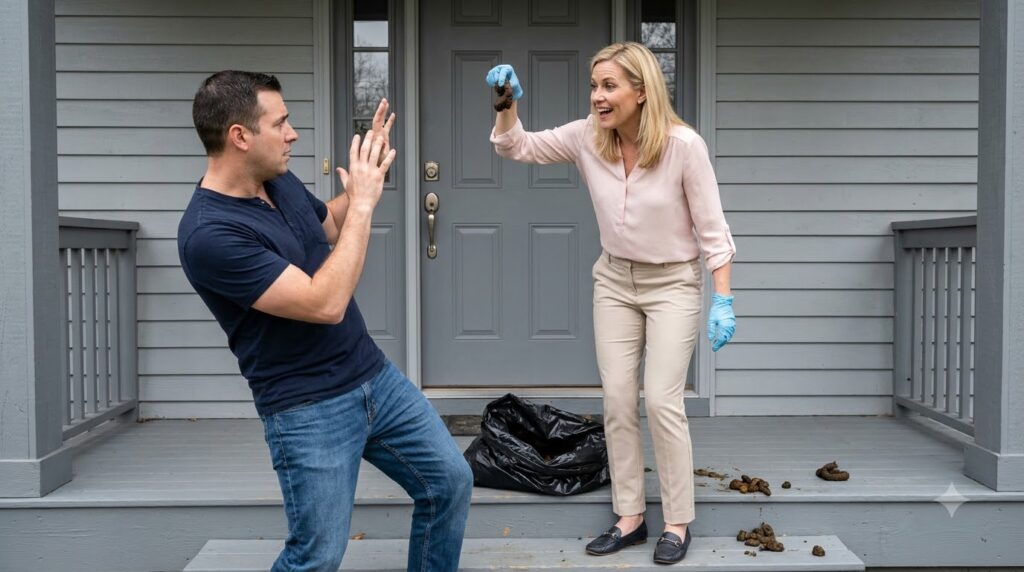
CHAPTER 4: THE ACCUSATION ON THE DRIVEWAY
Mark stepped off the threshold onto the porch, keeping a six-foot gap between his boots and the damp waste scattered across the gray pine steps. Below, near the base of the walkway, Deputy Miller stopped with his hands resting easily near his duty belt. Code Enforcement Officer Vance stood a half-step behind him, his yellow notepad already flipped open, his ballpoint pen clicking once in the humid morning air.
Before the deputy could speak, Brenda pivoted smoothly toward the cruiser, her posture collapsing from aggressive hostility into a trembling, hand-over-heart performance of civic distress.
“Deputy, thank God you’re here,” she said, her voice dropping into an breathy rasp. She smoothed her pale pink blouse with her ungloved left hand, though her right hand remained encased in the bright yellow latex. “I didn’t know who else to call. I attempted to reason with Mr. Vance this morning regarding the health hazards on his property, and he became immediately aggressive. He threatened me from his doorway!”
Deputy Miller’s eyes shifted from Brenda’s trembling hand down to the dark, foul pile on the wooden step, and finally up to Mark, who stood motionless in his navy shirt and blue jeans, holding his tablet and the accordion folder.
“Morning,” Deputy Miller said, his tone flat, unreadable. “We got a call for a disturbance and hazardous dumping. Who am I speaking with?”
“I’m Brenda Miller,” she offered rapidly, stepping into the officer’s path to block his view of the sidewalk. “I live three doors down. I’m the primary liaison for the neighborhood standards group. We’ve been tracking severe sanitation violations coming from this address for months.”
Mark didn’t interrupt. He watched the subtle movement of Deputy Miller’s jaw, noting the way the deputy’s eyes lingered on the single yellow glove Brenda still wore.
“Is this your property, sir?” Deputy Miller asked, looking up at Mark.
“It is, Deputy,” Mark replied evenly. “My name is Mark Vance. And that waste was dumped on my porch fifteen minutes ago by Ms. Miller.”
Brenda let out a loud, theatrical gasp, turning her head toward the street where Mr. Henderson and two other neighbors stood near the curb line. “That is an absolute lie! Deputy, he keeps unlicensed, untethered animals in his locked rear shed! The smell has been unbearable. I simply went to inspect the boundary line after hearing distress noises, found this accumulated outside his structure, and brought it forward as physical proof of the public hazard he’s maintaining!”
From her trousers pocket, Brenda produced a folded 4×6 glossy photograph, holding it out to Officer Vance with two gloved fingers.
“Look at this,” Brenda urged, her voice tight with triumphant energy. “I took this through the gap in his shed siding yesterday evening. Wire breeding cages stacked three high! Commercial waste bags! He’s running an illegal commercial kennel right here on Oakridge Drive!”
Officer Vance took the photograph, squinting in the bright glare of the morning sun. Deputy Miller leaned over his shoulder to review it.
Mark felt a cold, sharp spike of danger prickle at the back of his neck. For a second, the narrative shifted under his feet. The photograph in Officer Vance’s hand unequivocally showed industrial wire cages, stacked food bags, and heavy plastic tubs—the exact physical markers of an unpermitted commercial operation.
“Well, Mr. Vance?” Deputy Miller asked, his voice hardening as he looked up from the image. “This is a residential zone. If you’ve got an unpermitted animal housing facility in that shed, code enforcement is going to have to inspect it right now.”
Brenda turned back toward Mark, her eyes burning with a cruel, victorious light. She had introduced the decoy secret smoothly, weaponizing official procedure to force an immediate search of his outbuilding. If the deputy entered his yard based on her photo, the neighborhood would see Mark being investigated for criminal animal neglect, instantly validating months of fake yellow notices.
Mark took a slow, deep breath, steadying his hands against the frame of his tablet. He had reached the edge of her trap, but she had overlooked the fundamental law of digital optics: metadata never lies.
“Deputy,” Mark said, his voice cutting cleanly through the murmur of the gathering neighbors. “I’ll open my shed for you right now. You can inspect every square inch. But before you walk into my backyard, I suggest you take a closer look at the background of that photograph—and then look at the video recorded on my server thirty minutes ago.”
Mark unlocked his tablet screen, tapped the primary playback file, and turned the high-definition display toward the deputy.
“Because that photo isn’t from my shed,” Mark added, his voice dropping into a razor-sharp edge. “It’s from hers.”








