
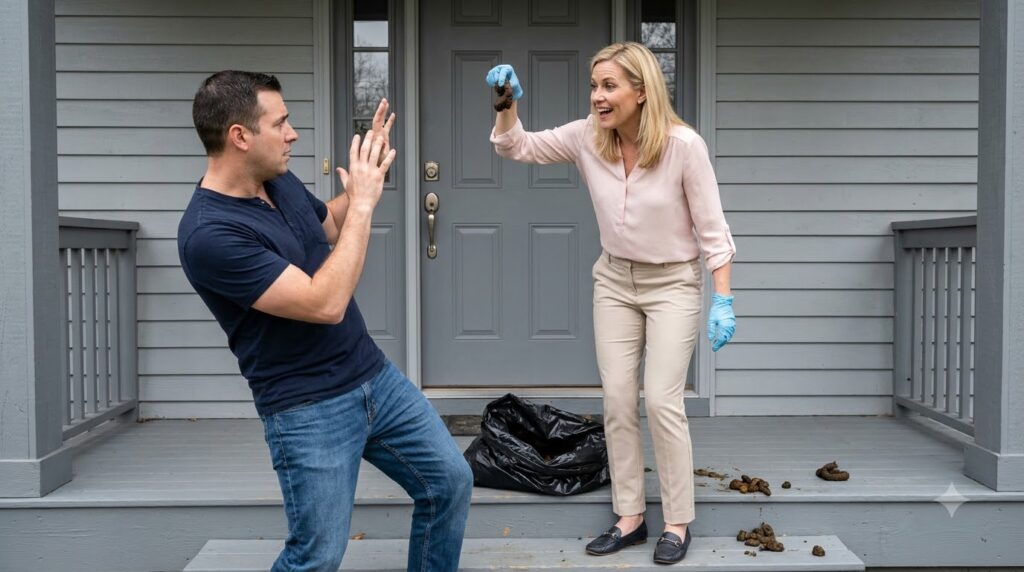
CHAPTER 2: THE AMBER LIGHT ON THE GLASS
“You’re making a mistake, Mark,” Brenda said, though her hand trembled slightly, causing a fleck of dark matter to dislodge from the raised clump and strike the white paint of the door frame with a wet, flat sound. “You think having a quiet job and a camera under the eaves makes you immune to community standards? Everyone on this street knows what you’ve been hiding in that back shed.”
Mark didn’t answer. He took one step backward, his dark loafers making no sound on the hardwood of the foyer, and grabbed the brass interior handle.
“Don’t you turn your back on me!” she barked, her voice pitching higher, pushing toward the manicured lawns across the street where Mr. Henderson had taken two deliberate paces away from his stationary lawnmower. “Look at this filth! Look at what your neglect brings onto our property lines! I’m giving you one chance to clean this up before I call County Code Enforcement and tell them about the illegal animals you’re housing back there!”
Mark maintained his calculated silence. He let the silence stretch, heavy and oppressive, until Brenda’s eyes flicked nervously from his impassive face down to the small amber LED glowing steadily on his security panel near the coat rack.
Without breaking eye contact, Mark pulled the door toward him until only a four-inch gap remained. The heavy pine slab acted as a physical shield, cutting off her angle of movement while keeping her locked in the frame of both camera lenses.
“You have sixty seconds to step off my porch, Brenda,” Mark said, his voice flat, stripped of all emotion, carrying the cold weight of an ultimatum. “The camera in the casing above your head is streaming at sixty frames per second directly to off-site cloud storage. Every word you say, every inch you move that glove, is being logged with a GPS timestamp.”
Brenda’s jaw tightened. For a fraction of a second, the triumphant mask slipped, revealing a flash of sharp, panicked calculation. She looked up at the black glass dome mounted beneath the soffit. The tiny red indicator light blinked twice in the morning shade.
“You think a camera scares me?” she hissed, though she pulled her arm back two inches, lowering the clump slightly so it no longer hovered directly over his eye line. “I’m protecting this neighborhood. I’m documenting a public nuisance. When Officer Vance gets here, he’s going to inspect that shed of yours, and we’ll see who gets cited!”
Mark didn’t argue. He pulled the door shut until the latch clicked into the strike plate, then turned the deadbolt with a sharp, heavy snap that echoed through the foyer.
Inside the quiet dark of his house, the ambient hum of the refrigerator felt unnaturally loud. Mark walked smoothly to the kitchen island, picked up his digital tablet, and unlocked the interface. The screen bloomed to life, split into four distinct camera feeds.
On the top-left feed—the wide-angle porch camera—Brenda was still standing near the top step. She was pacing now, a tight, erratic pattern that brought her dark loafers within inches of the scattered waste. Through the high-definition lens, Mark noticed a detail he had missed during the immediate threat: despite the damp, muddy trail of animal waste spilling across his gray pine steps, the soles and leather vamps of Brenda’s loafers were immaculate. Not a single speck of soil or waste clung to her shoes.
She hadn’t stepped in it while dragging it. She had carried it carefully, deliberately, wearing gloves she had brought from her own pocket.
Mark tapped the touch screen, opening the playback buffer for the rear-yard camera that monitored the property line between his lot and the narrow access alley behind the houses. He scrubbed the timeline back thirty minutes, skipping through the static gray light of dawn.
At 7:42 AM, a shadow moved near the tall cedar fence that separated his backyard from the overgrown perimeter of Brenda’s lot.
Mark zoomed in, setting the digital enhancement to sharpen the contrast against the morning mist. On the screen, a figure in a pale pink blouse appeared behind the fence boards. But she wasn’t looking at his house or his shed. She was bent low near her own detached garage, lifting heavy plastic tubs out of a side door before transferring their contents into a black industrial trash bag.
Mark paused the frame. In the corner of the feed, partially obscured by the untrimmed pyracantha bushes on her side of the property line, lay three large wire cages stacked beneath a blue tarp—and beside them, stacked three high, were commercial-grade bags of high-protein canine feed.
The realization settled in Mark’s chest with the cold, heavy precision of an iron latch falling into place. Brenda didn’t think he had animals in his shed. She was running her own unpermitted operation, and the complaints she had been logging against him for six months weren’t about property values at all. They were a pre-emptive strike, designed to create a paper trail of noise and sanitation complaints against his address before the smell from her own yard crossed the fence line.
Outside, the muffled sound of a heavy car door slamming echoed down the cul-de-sac, followed by the distinctive, low-frequency rumble of a municipal Ford Explorer idling at the curb.
Mark locked the tablet screen, slid it into the back pocket of his blue jeans, and turned back toward the front entryway. It was time to clear the porch.








