
CHAPTER 3: THE PAPER ARCHIVE ON OAKRIDGE
The deadbolt disengaged with a solid, metallic snap that echoed down the quiet hallway. Mark didn’t open the door immediately. He stood in the cool shadow of the foyer, his fingers resting lightly against the smooth brass hardware, watching through the narrow side window as the white Ford Explorer pulled up to the curb.
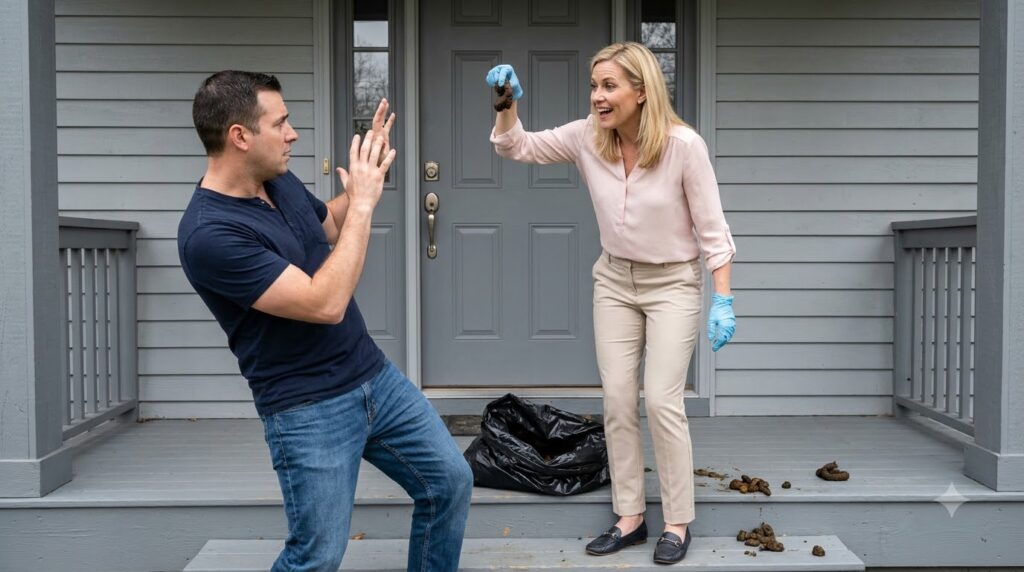
Brenda stood motionless on the gray decking, her yellow-gloved hand still hovering near her waist, her posture rigid as she watched the municipal vehicle’s doors open. For eight months, she had worked to control this exact stretch of concrete.
Mark pulled open the top drawer of his entryway console table. Inside lay an accordion folder, neatly tabbed and organized by date. He pulled it out, feeling the distinct weight of thirty-two individual sheets of paper—the physical paper trail Brenda had spent half a year crafting to build her trap.
He opened the tab labeled Notices & Correspondence.
The first note had arrived three weeks after he closed on the house: a handwritten card tucked under his windshield wiper, complaining about the angle at which his sedan was parked relative to the curb line. The language was polite, almost neighborly, but signed with an official-sounding title: Oakridge Neighborhood Civics Committee. There was no such committee registered with the county.
By month three, the polite notes had turned into formal-looking printed warnings printed on yellow cardstock. They cited fabricated municipal codes—alleging improper trash bin placement times, unclipped lawn borders near utility poles, and unauthorized exterior modifications. Each notice bore a stamped serial number in red ink, designed to mimic a court-issued summons.
Mark ran his thumb over the rough texture of the latest notice, dated four days prior. It alleged a severe, ongoing sanitary violation originating from his locked rear shed.
He remembered the morning it was posted. He had walked out to find Brenda standing at his property line, a clipboard tucked under her arm, watching him peel the adhesive tape off his front porch pillar. When he had asked her directly who had authorized the notice, she had merely smiled, adjusted her sunglasses, and said, “The community speaks through its records, Mark. If you have nothing to hide behind that locked shed door, you wouldn’t mind letting the board do a quick walkthrough.”
He hadn’t let her in. He had documented the notice, photographed the adhesive residue on his paint, and filed it away.
Now, looking at the tablet screen resting on his console, Mark replayed the 7:42 AM feed from his rear fence line. The wire cages stacked under the tarp behind Brenda’s garage weren’t just a violation of residential zoning—they were the exact source of the noise and odor she had been attributing to his lot in her yellow notices. Every time a neighbor had asked about the faint yapping at dusk, Brenda had pointed across her fence toward Mark’s property, citing her own filed complaints as proof.
She hadn’t just created a nuisance; she had engineered a parallel legal reality, using fabricated documentation to shield her commercial enterprise behind a wall of civic outrage.
Outside, the crunch of heavy boots on the gravel driveway announced the arrival of the authorities. Through the side glass, Mark saw Deputy Miller adjust his duty belt as he stepped past the bumper of the cruiser, accompanied by Code Enforcement Officer Vance, who carried a yellow legal pad and a digital camera.
Brenda was already descending the porch steps to meet them, her arm outstretched, her yellow glove pointing dramatically back toward Mark’s front door. Her voice carried through the glass, high-pitched and sharp with manufactured authority.
Mark slid the accordion folder under his arm, picked up the digital tablet, and turned the brass handle once more. The time for documentation was over. The physical confrontation on the porch was about to meet the cold weight of verifiable data.








