
The Cold Geometry of Oakridge Drive and the Boundary Line on the Porch

CHAPTER 1: THE WEIGHT OF PLASTIC ON PINE

The heavy impact of industrial plastic against gray painted pine rattled the entryway glass before the latch had even settled in the jamb.

Mark Vance stopped with his hand three inches from the deadbolt. The sound was wrong for a delivery—too dull, too wet, lacking the hollow bounce of cardboard or the sharp slap of a folded envelope. Through the frosted side pane, a sharp shadow blurred against the morning light.

He turned the brass knob, pulled the door inward, and stepped into the sharp morning air.

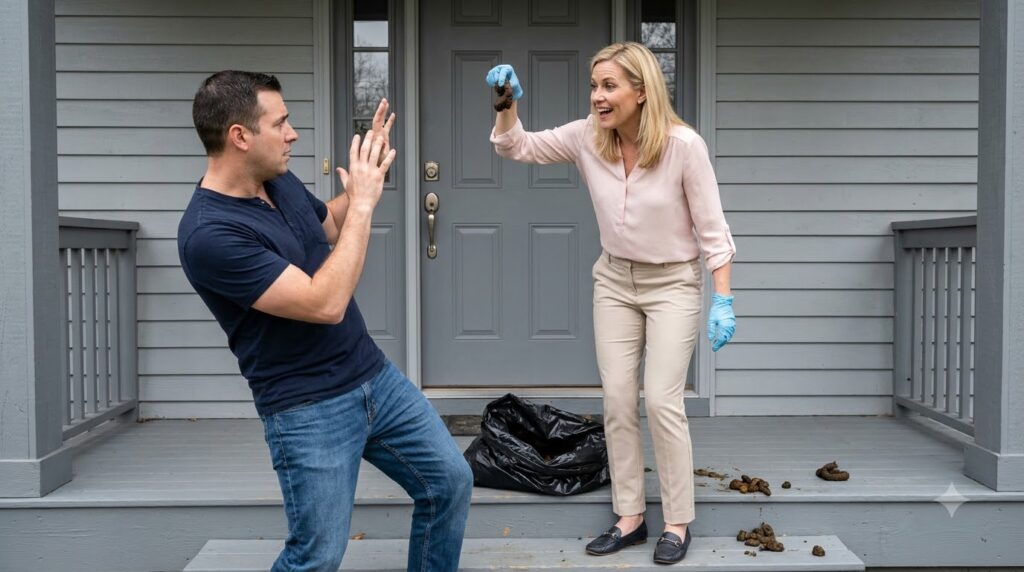
Standing center-right on the top step of his porch was Brenda Miller. She wore a pale pink blouse, pressed beige trousers, and dark loafers that showed no dust. Her shoulder-length blonde hair was combed flat, framing a face locked in a tight, triumphant grin. In her left hand, she held the twisted neck of a heavy black trash bag, its bottom split wide across the gray wooden decking.

Spread across the entrance—spilling over the threshold and caking the clean pine step—was a dark, foul mound of animal waste.

Before Mark’s mind could fully parse the sheer absurdity of the sight, Brenda crouched with practiced, rapid efficiency. Her right hand, encased in a bright yellow disposable glove, plunged into the center of the pile. She scooped up a heavy, wet clump, snapped her torso upright, and thrust her arm forward.

The gloved fist stopped six inches from Mark’s face.

Mark’s posture broke instantly. His weight thrown backward, shoulders tightening, he recoiled off-balance against the white door frame. He threw both hands up defensively between his face line and the raised threat, his gaze locked on the wet, brown mass held aloft like a weapon.

“Don’t throw that at me!” Mark’s voice cut through the quiet cul-de-sac, sharp, loud, and entirely devoid of its usual quiet restraint.

Brenda did not lower her arm. Her knuckles tightened around the clump, her smile stretching into something rigid and weaponized. “You think you can just ignore standard rules on this block, Mark?” she sneered, her voice carrying easily across the manicured lawns. “You think you’re above basic hygiene? You’re going to take responsibility for your mess one way or another!”

Mark took a deliberate half-step back into the shadow of the doorway, keeping his hands lifted in a clear, non-threatening posture while his chest rose and fell in controlled rhythm. His heart hammered against his ribs, but the initial jolt of alarm was already cooling into something hard and analytical. He looked past the yellow glove, past the pale pink blouse, and caught the subtle tremor in Brenda’s jaw.

She wanted a lunge. She wanted him to strike her arm, to grab her wrist, or to shout a profanity that would rewrite the narrative before the street could witness it.

“Put it down and get off my porch, Brenda,” Mark said. His tone dropped out of its initial alarm, settling into a low, flat line.

“Or what?” Brenda taunted, stepping closer to the threshold, her arm still raised above her shoulder line. “You going to make me? The whole street knows what you’ve been doing!”

Across the asphalt, the distant hum of a lawnmower sputtered and died. Mr. Henderson leaned over the handlebars of his mower, his eyes tracking the scene from sixty feet away. Down the sidewalk, a delivery driver paused with a parcel in his hand, staring at the woman in the pink blouse holding a handful of filth over a neighbor’s doorstep.

Mark did not look at the witnesses. He reached behind his back, his fingers finding the small black sensor on the interior wall, and pressed his thumb against the silent panic button linked to his home security network. A faint, amber LED flickered twice near the ceiling mold.

Above Brenda’s head, mounted flush against the white trim of the porch roof, the black glass lens of a 4K camera caught the morning sun—and the small red light embedded in its housing pulsed once.


CHAPTER 2: THE AMBER LIGHT ON THE GLASS

“You’re making a mistake, Mark,” Brenda said, though her hand trembled slightly, causing a fleck of dark matter to dislodge from the raised clump and strike the white paint of the door frame with a wet, flat sound. “You think having a quiet job and a camera under the eaves makes you immune to community standards? Everyone on this street knows what you’ve been hiding in that back shed.”

Mark didn’t answer. He took one step backward, his dark loafers making no sound on the hardwood of the foyer, and grabbed the brass interior handle.

“Don’t you turn your back on me!” she barked, her voice pitching higher, pushing toward the manicured lawns across the street where Mr. Henderson had taken two deliberate paces away from his stationary lawnmower. “Look at this filth! Look at what your neglect brings onto our property lines! I’m giving you one chance to clean this up before I call County Code Enforcement and tell them about the illegal animals you’re housing back there!”

Mark maintained his calculated silence. He let the silence stretch, heavy and oppressive, until Brenda’s eyes flicked nervously from his impassive face down to the small amber LED glowing steadily on his security panel near the coat rack.

Without breaking eye contact, Mark pulled the door toward him until only a four-inch gap remained. The heavy pine slab acted as a physical shield, cutting off her angle of movement while keeping her locked in the frame of both camera lenses.

“You have sixty seconds to step off my porch, Brenda,” Mark said, his voice flat, stripped of all emotion, carrying the cold weight of an ultimatum. “The camera in the casing above your head is streaming at sixty frames per second directly to off-site cloud storage. Every word you say, every inch you move that glove, is being logged with a GPS timestamp.”

Brenda’s jaw tightened. For a fraction of a second, the triumphant mask slipped, revealing a flash of sharp, panicked calculation. She looked up at the black glass dome mounted beneath the soffit. The tiny red indicator light blinked twice in the morning shade.

“You think a camera scares me?” she hissed, though she pulled her arm back two inches, lowering the clump slightly so it no longer hovered directly over his eye line. “I’m protecting this neighborhood. I’m documenting a public nuisance. When Officer Vance gets here, he’s going to inspect that shed of yours, and we’ll see who gets cited!”

Mark didn’t argue. He pulled the door shut until the latch clicked into the strike plate, then turned the deadbolt with a sharp, heavy snap that echoed through the foyer.

Inside the quiet dark of his house, the ambient hum of the refrigerator felt unnaturally loud. Mark walked smoothly to the kitchen island, picked up his digital tablet, and unlocked the interface. The screen bloomed to life, split into four distinct camera feeds.

On the top-left feed—the wide-angle porch camera—Brenda was still standing near the top step. She was pacing now, a tight, erratic pattern that brought her dark loafers within inches of the scattered waste. Through the high-definition lens, Mark noticed a detail he had missed during the immediate threat: despite the damp, muddy trail of animal waste spilling across his gray pine steps, the soles and leather vamps of Brenda’s loafers were immaculate. Not a single speck of soil or waste clung to her shoes.

She hadn’t stepped in it while dragging it. She had carried it carefully, deliberately, wearing gloves she had brought from her own pocket.

Mark tapped the touch screen, opening the playback buffer for the rear-yard camera that monitored the property line between his lot and the narrow access alley behind the houses. He scrubbed the timeline back thirty minutes, skipping through the static gray light of dawn.

At 7:42 AM, a shadow moved near the tall cedar fence that separated his backyard from the overgrown perimeter of Brenda’s lot.

Mark zoomed in, setting the digital enhancement to sharpen the contrast against the morning mist. On the screen, a figure in a pale pink blouse appeared behind the fence boards. But she wasn’t looking at his house or his shed. She was bent low near her own detached garage, lifting heavy plastic tubs out of a side door before transferring their contents into a black industrial trash bag.

Mark paused the frame. In the corner of the feed, partially obscured by the untrimmed pyracantha bushes on her side of the property line, lay three large wire cages stacked beneath a blue tarp—and beside them, stacked three high, were commercial-grade bags of high-protein canine feed.

The realization settled in Mark’s chest with the cold, heavy precision of an iron latch falling into place. Brenda didn’t think he had animals in his shed. She was running her own unpermitted operation, and the complaints she had been logging against him for six months weren’t about property values at all. They were a pre-emptive strike, designed to create a paper trail of noise and sanitation complaints against his address before the smell from her own yard crossed the fence line.

Outside, the muffled sound of a heavy car door slamming echoed down the cul-de-sac, followed by the distinctive, low-frequency rumble of a municipal Ford Explorer idling at the curb.

Mark locked the tablet screen, slid it into the back pocket of his blue jeans, and turned back toward the front entryway. It was time to clear the porch.

CHAPTER 3: THE PAPER ARCHIVE ON OAKRIDGE

The deadbolt disengaged with a solid, metallic snap that echoed down the quiet hallway. Mark didn’t open the door immediately. He stood in the cool shadow of the foyer, his fingers resting lightly against the smooth brass hardware, watching through the narrow side window as the white Ford Explorer pulled up to the curb.

Brenda stood motionless on the gray decking, her yellow-gloved hand still hovering near her waist, her posture rigid as she watched the municipal vehicle’s doors open. For eight months, she had worked to control this exact stretch of concrete.

Mark pulled open the top drawer of his entryway console table. Inside lay an accordion folder, neatly tabbed and organized by date. He pulled it out, feeling the distinct weight of thirty-two individual sheets of paper—the physical paper trail Brenda had spent half a year crafting to build her trap.

He opened the tab labeled Notices & Correspondence.

The first note had arrived three weeks after he closed on the house: a handwritten card tucked under his windshield wiper, complaining about the angle at which his sedan was parked relative to the curb line. The language was polite, almost neighborly, but signed with an official-sounding title: Oakridge Neighborhood Civics Committee. There was no such committee registered with the county.

By month three, the polite notes had turned into formal-looking printed warnings printed on yellow cardstock. They cited fabricated municipal codes—alleging improper trash bin placement times, unclipped lawn borders near utility poles, and unauthorized exterior modifications. Each notice bore a stamped serial number in red ink, designed to mimic a court-issued summons.

Mark ran his thumb over the rough texture of the latest notice, dated four days prior. It alleged a severe, ongoing sanitary violation originating from his locked rear shed.

He remembered the morning it was posted. He had walked out to find Brenda standing at his property line, a clipboard tucked under her arm, watching him peel the adhesive tape off his front porch pillar. When he had asked her directly who had authorized the notice, she had merely smiled, adjusted her sunglasses, and said, “The community speaks through its records, Mark. If you have nothing to hide behind that locked shed door, you wouldn’t mind letting the board do a quick walkthrough.”

He hadn’t let her in. He had documented the notice, photographed the adhesive residue on his paint, and filed it away.

Now, looking at the tablet screen resting on his console, Mark replayed the 7:42 AM feed from his rear fence line. The wire cages stacked under the tarp behind Brenda’s garage weren’t just a violation of residential zoning—they were the exact source of the noise and odor she had been attributing to his lot in her yellow notices. Every time a neighbor had asked about the faint yapping at dusk, Brenda had pointed across her fence toward Mark’s property, citing her own filed complaints as proof.

She hadn’t just created a nuisance; she had engineered a parallel legal reality, using fabricated documentation to shield her commercial enterprise behind a wall of civic outrage.

Outside, the crunch of heavy boots on the gravel driveway announced the arrival of the authorities. Through the side glass, Mark saw Deputy Miller adjust his duty belt as he stepped past the bumper of the cruiser, accompanied by Code Enforcement Officer Vance, who carried a yellow legal pad and a digital camera.

Brenda was already descending the porch steps to meet them, her arm outstretched, her yellow glove pointing dramatically back toward Mark’s front door. Her voice carried through the glass, high-pitched and sharp with manufactured authority.

Mark slid the accordion folder under his arm, picked up the digital tablet, and turned the brass handle once more. The time for documentation was over. The physical confrontation on the porch was about to meet the cold weight of verifiable data.

CHAPTER 4: THE ACCUSATION ON THE DRIVEWAY

Mark stepped off the threshold onto the porch, keeping a six-foot gap between his boots and the damp waste scattered across the gray pine steps. Below, near the base of the walkway, Deputy Miller stopped with his hands resting easily near his duty belt. Code Enforcement Officer Vance stood a half-step behind him, his yellow notepad already flipped open, his ballpoint pen clicking once in the humid morning air.

Before the deputy could speak, Brenda pivoted smoothly toward the cruiser, her posture collapsing from aggressive hostility into a trembling, hand-over-heart performance of civic distress.

“Deputy, thank God you’re here,” she said, her voice dropping into an breathy rasp. She smoothed her pale pink blouse with her ungloved left hand, though her right hand remained encased in the bright yellow latex. “I didn’t know who else to call. I attempted to reason with Mr. Vance this morning regarding the health hazards on his property, and he became immediately aggressive. He threatened me from his doorway!”

Deputy Miller’s eyes shifted from Brenda’s trembling hand down to the dark, foul pile on the wooden step, and finally up to Mark, who stood motionless in his navy shirt and blue jeans, holding his tablet and the accordion folder.

“Morning,” Deputy Miller said, his tone flat, unreadable. “We got a call for a disturbance and hazardous dumping. Who am I speaking with?”

“I’m Brenda Miller,” she offered rapidly, stepping into the officer’s path to block his view of the sidewalk. “I live three doors down. I’m the primary liaison for the neighborhood standards group. We’ve been tracking severe sanitation violations coming from this address for months.”

Mark didn’t interrupt. He watched the subtle movement of Deputy Miller’s jaw, noting the way the deputy’s eyes lingered on the single yellow glove Brenda still wore.

“Is this your property, sir?” Deputy Miller asked, looking up at Mark.

“It is, Deputy,” Mark replied evenly. “My name is Mark Vance. And that waste was dumped on my porch fifteen minutes ago by Ms. Miller.”

Brenda let out a loud, theatrical gasp, turning her head toward the street where Mr. Henderson and two other neighbors stood near the curb line. “That is an absolute lie! Deputy, he keeps unlicensed, untethered animals in his locked rear shed! The smell has been unbearable. I simply went to inspect the boundary line after hearing distress noises, found this accumulated outside his structure, and brought it forward as physical proof of the public hazard he’s maintaining!”

From her trousers pocket, Brenda produced a folded 4×6 glossy photograph, holding it out to Officer Vance with two gloved fingers.

“Look at this,” Brenda urged, her voice tight with triumphant energy. “I took this through the gap in his shed siding yesterday evening. Wire breeding cages stacked three high! Commercial waste bags! He’s running an illegal commercial kennel right here on Oakridge Drive!”

Officer Vance took the photograph, squinting in the bright glare of the morning sun. Deputy Miller leaned over his shoulder to review it.

Mark felt a cold, sharp spike of danger prickle at the back of his neck. For a second, the narrative shifted under his feet. The photograph in Officer Vance’s hand unequivocally showed industrial wire cages, stacked food bags, and heavy plastic tubs—the exact physical markers of an unpermitted commercial operation.

“Well, Mr. Vance?” Deputy Miller asked, his voice hardening as he looked up from the image. “This is a residential zone. If you’ve got an unpermitted animal housing facility in that shed, code enforcement is going to have to inspect it right now.”

Brenda turned back toward Mark, her eyes burning with a cruel, victorious light. She had introduced the decoy secret smoothly, weaponizing official procedure to force an immediate search of his outbuilding. If the deputy entered his yard based on her photo, the neighborhood would see Mark being investigated for criminal animal neglect, instantly validating months of fake yellow notices.

Mark took a slow, deep breath, steadying his hands against the frame of his tablet. He had reached the edge of her trap, but she had overlooked the fundamental law of digital optics: metadata never lies.

“Deputy,” Mark said, his voice cutting cleanly through the murmur of the gathering neighbors. “I’ll open my shed for you right now. You can inspect every square inch. But before you walk into my backyard, I suggest you take a closer look at the background of that photograph—and then look at the video recorded on my server thirty minutes ago.”

Mark unlocked his tablet screen, tapped the primary playback file, and turned the high-definition display toward the deputy.

“Because that photo isn’t from my shed,” Mark added, his voice dropping into a razor-sharp edge. “It’s from hers.”

CHAPTER 5: THE REVERSAL ON THE PORCH

Deputy Miller took the tablet from Mark’s hands, his thick fingers carefully framing the anti-glare screen against the morning glare. Code Enforcement Officer Vance leaned over his shoulder, his ballpoint pen remaining motionless above his yellow legal pad.

The high-definition 4K footage played with razor-sharp clarity.

On the screen, the timestamp reads 7:42:18 AM. The camera’s wide-angle lens captured the full expanse of the rear property line. The video clearly showed Brenda Miller walking out from behind her detached garage, carrying a yellow bucket and a black industrial trash bag. She approached three large wire breeding cages stacked beneath a blue tarp against her own rear fence line, scoop in hand, harvesting accumulated waste directly from her own unlicensed backyard kennel.

The camera tracked her as she tied off the bag, pulled a pair of bright yellow disposable gloves from her trousers pocket, snapped them onto her hands, and marched deliberately across Mark’s side lawn toward his front porch.

“Let’s jump to the front camera,” Mark said, his voice quiet, devoid of malice, carrying the cold authority of undeniable fact.

He tapped the screen, switching to the porch doorbell feed at 8:15:02 AM.

The audio played crisp and unedited through the tablet’s front-firing speaker, echoing across the quiet driveway where Mr. Henderson and three other neighbors stood watching. The dull, wet impact of the heavy bag striking the gray pine porch boards rattled through the small speaker. The video captured Mark opening the door, Brenda crouching with rapid efficiency, scooping a heavy clump into her gloved right fist, and thrusting it directly toward Mark’s face.

It captured Mark’s immediate, visceral recoil, his hands lifting defensively, and his sharp, clear warning: “Don’t throw that at me!”

The clip concluded with Brenda holding the waste aloft, smiling with triumphant entitlement, while Mark maintained his calculated stance before stepping backward to secure his home.

Deputy Miller watched the playback a second time in complete, heavy silence. He looked at the photograph Brenda had handed him—showing the wire cages—and then looked back at the video screen showing those exact cages sitting ten feet behind Brenda’s own garage.

When Deputy Miller raised his head, his face had hardened into an unreadable mask of cold, professional authority. He turned slowly to face Brenda, who had taken two small, unsteady steps backward toward the edge of the lawn.

“Ms. Miller,” Deputy Miller said, his voice dropping an octave into a low, resonant baritone. “Is that you in this video?”

Brenda’s face flushed a deep, mottled crimson. Her jaw worked soundlessly for a moment before she managed a strangled rasp. “I—I was demonstrating the severity of the nuisance! He ignores every official notice I post—”

“Ms. Miller,” Deputy Miller interrupted, his tone cutting through her frantic defense like a blade. “Answer the question. Is that you harvesting waste from behind your garage and dumping it on this porch?”

Brenda swallowed hard, her eyes darting past the deputy toward the sidewalk. Mr. Henderson was staring directly at her, his arms folded across his chest, his expression sour with disgust. Down the block, two more neighbors had pulled out their smartphones, recording the confrontation. The public platform she had built to shame her neighbor had turned into the stage for her own exposure.

“Yes,” she whispered, her voice stripped of its booming, righteous cadence. “But I was acting in the interest of public health—”

“You are not a code enforcement officer, you do not represent county health, and you have no legal standing on this property,” Deputy Miller stated firmly. “What I just witnessed on this recording constitutes intentional criminal trespassing, illegal dumping of biohazardous waste, and misdemeanor menacing.”

Officer Vance stepped forward, pulling a thick yellow citation book from his belt. “Furthermore, running an unpermitted commercial breeding facility in a Class-R residential zone carries an immediate statutory fine under Municipal Code 402, along with a mandatory cease-and-desist order.”

Brenda looked between the two officers, her eyes wide with mounting panic. “A fine? I’ve lived on this street for twelve years!”

“And you’re going to clean this porch right now,” Deputy Miller said smoothly, his hand reaching down to his duty belt. He unclipped a pair of steel handcuffs with a sharp, metallic click that resonated clearly across the manicured lawns. “You have two choices, Ms. Miller. You can put that second glove on, pick up every single ounce of waste you dumped on Mr. Vance’s property, sanitize these pine boards, and carry that bag back to your own trash cans… or I can place you under arrest right now for trespassing and menacing, and you can explain that video to a county magistrate.”

The silence on Oakridge Drive was absolute.

Brenda looked at the deputy, then at the steel cuffs glinting in the morning sun, and finally at Mark, who stood at the top of his steps with his hands folded loosely in front of him, unmoving, impassive, serene.

With trembling hands, Brenda reached into her trousers pocket, pulled out the second yellow glove, and snapped it over her left hand. Bending down under the unwavering gaze of the deputy, the code officer, and half her neighborhood, she began manually scooping the scattered waste back into the black industrial bag.

“Make sure you wipe down the pine step as well, Ms. Miller,” Officer Vance added, writing furiously on his clipboard. “And expect a formal summons for the commercial kennel operation by Friday.”

It took twenty agonizing minutes for Brenda to clear the entryway boards, her face burning with shame as she tied off the heavy plastic bag. When she finally stood up, holding the foul bag at her side with her head bowed, Deputy Miller issued her a formal trespass warning.

“If you cross Mr. Vance’s property line again for any reason, Ms. Miller, you will be taken into custody immediately without a warning. Do you understand?”

“Yes,” Brenda whispered, unable to look up.

She turned and began the long, agonizing walk down Mark’s concrete driveway and down the sidewalk toward her home, carrying her bag of waste while her neighbors watched her retreat in complete silence.

Mark stepped down to the bottom step, signing the witness statement presented by Officer Vance and shaking Deputy Miller’s hand. After the municipal vehicles pulled away from the curb, Mark stood at the edge of his clean gray porch, taking in the crisp, quiet morning air.

Across the asphalt, Mr. Henderson gave him a slow, respectful nod before pulling the cord on his lawnmower, its engine roaring back to life.

Mark turned, stepped inside his foyer, and closed the heavy pine door. The brass lock turned with a clean, satisfying click, securing the boundary once and for all.

Similar Posts

Leave a Reply

Your email address will not be published. Required fields are marked *






