Chapter 4: The Hearing
The neighborhood association meeting took place in a small community room three days later.
Megan arrived early.
She didn’t want drama.
She wanted the truth documented.
Karen arrived ten minutes late.
She wore the same orange cardigan.
She sat down heavily and immediately began whispering to another resident.
Megan recognized the woman.
She was Mrs. Wallace, an older neighbor who lived two streets away.
When the meeting began, Linda Perez explained the purpose.
There would be no shouting.
No personal attacks.
Each person would have an opportunity to speak.
Karen went first.
She described herself as a concerned neighbor who had been trying to protect community standards.
She said Megan had become hostile when asked to follow landscaping rules.
She said the door had broken during an unfortunate confrontation.
Then she suggested the security footage had been manipulated.
Megan listened without interrupting.
When her turn came, she didn’t attack Karen.
She simply provided documents.
The repair estimate.
Photographs.
The original security recording.
The written complaint.
The note Karen had left at her door.
Linda watched the footage on a large screen.
The room became very quiet.
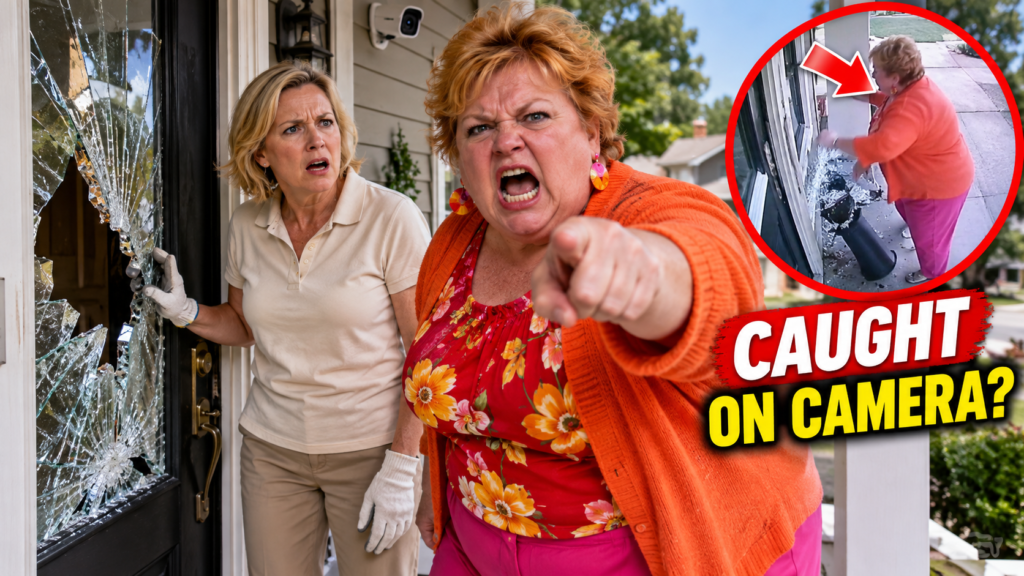
The recording showed the argument.
It showed the umbrella stand.
It showed the impact.
And it showed Karen looking directly toward the camera before the glass broke.
Nobody needed Megan to explain what the footage showed.
Karen suddenly objected.
“That doesn’t prove she didn’t provoke me!”
Linda raised a hand.
“Please let the recording finish.”
The footage continued.
After the glass shattered, Karen had looked around.
She had seen the camera.
Then she had changed her behavior.
That detail mattered.
Not because it proved what Karen had been thinking, but because it contradicted her earlier claim that she had no idea the porch was being recorded.
Linda paused the video.
“We are not here to determine anyone’s character,” she said. “We’re here to establish what happened.”
Karen looked toward Megan.
For the first time, she seemed less angry than embarrassed.
Then Mrs. Wallace raised her hand.
Everyone turned.
“I need to say something.”
She explained that Karen had previously complained about her porch decorations.
Karen had told her that several neighbors supported the complaint.
Mrs. Wallace had believed her.
Until she later discovered that no other neighbor had complained.
Another resident spoke.
Then another.
None described a major incident.
But several described the same pattern: Karen speaking on behalf of others without permission, presenting personal preferences as neighborhood rules, and escalating minor disagreements.
Megan sat quietly.
She hadn’t expected any of this.
Linda eventually announced that the association would dismiss the complaint against Megan because the cited rule did not apply to her property.
The association would also document the incident and remind all residents that private property disputes should not be handled through intimidation or unauthorized enforcement.
Then Linda turned toward Karen.
“As for the damaged door, that is a private matter between the parties. The association will not determine financial responsibility.”
Megan nodded.
She understood.
This wasn’t a courtroom.
She would have to decide what to do next.
As everyone stood, Karen approached Megan.
For a moment, Megan thought she might apologize.
Instead, Karen said quietly, “You made me look like a fool.”
Megan looked at her.
“No, Karen. The footage did that.”
Karen’s jaw tightened.
Then she walked away.
Megan expected the conflict to continue.
What she didn’t expect was the letter that arrived the following morning.
It came from Karen’s attorney.