
CHAPTER 9: THE MUNICIPAL LEVERAGE
Campbell didn’t step into the wet grass. He stayed on the intact edge of the asphalt apron, his rubber overshoes stopping two inches short of the raw fissure where the earth had swallowed the curb.
He was a man built out of committee appointments and tailored gray wool: broad-shouldered, silver hair cropped close to a square skull, his posture carrying the smooth, frictionless weight of someone whose signatures moved millions without ever touching dirt.
“Melissa,” Campbell said, his voice carrying easily over the distant rumble of the four-lane highway. “You didn’t answer your cell.”
Melissa remained on her knees in the yellow mud by the fractured gas collar, her hands still trembling around the wooden handle of the garden trowel. She didn’t stand. She didn’t speak. The rain had begun to fall—a fine, cold mist that beaded against the water-resistant shell of Campbell’s overcoat and turned the dried clay on Evelyn’s boots back into slick paste.
“The phone’s in her car,” Evelyn said, rising from the ditch.
She didn’t brush the mud from her knees. She stepped out of the depression, the steel basin wrench hanging loose in her right hand, its jaws caked in rust and mercaptan residue. Her boots made a wet, sucking sound in the crushed turf. “And her car is about eighteen inches lower than it was when you turned off the county road, Director.”
Campbell’s gaze flicked to Evelyn, lingering for half a second on the wrench before moving up to her face. His expression didn’t change; it was the unreadable, neutral mask of a municipal bureaucrat assessing a code violation.
“Mrs. Harper,” Campbell said smoothly. “I remember your late husband from the public works committee. Thomas, wasn’t it? Fine man. Reasonable man.”
“Thomas is in the churchyard on the north ridge,” Evelyn said, stopping six feet from him. The cold wind caught the hem of her canvas work shirt, whipping it against her ribs. “Where the ground doesn’t dissolve under your shoes. What are the county barricades doing across our fire lane, Campbell?”
“Emergency structural assessment,” Campbell replied, patting the leather portfolio tucked under his left arm. “We received an automated pressure drop from the trunk main at four this morning. Given the known geological instability along the highway corridor, my office has executed a preemptive health-and-safety exclusion order under Title Forty-Four. For your own protection.”
“Title Forty-Four,” Evelyn said, her voice flat, dry as winter corn. “That’s the summary eviction statute. No thirty-day hearing. No appraisal board. The county takes physical control of the perimeter, and the owners get ninety days to file an uninsured relocation claim with the general fund.”
“The ground is collapsing beneath your feet, Mrs. Harper,” Campbell said, gesturing with a gloved hand toward the open trench where the garden beds had folded in on themselves. “I can hardly leave twenty-four retired households sleeping over an unmapped void.”
“It isn’t unmapped,” Evelyn said.
Behind her, the front door of the clubhouse opened with a dull rattle.
Hank Vance walked out onto the concrete ramp, his heavy iron toolbox in one hand, the yellow pelican case containing the inspection monitor in the other. Behind him came Martha Davies and Arthur Pendelton, each holding an arm of the ammunition crate they had pulled from the furnace duct.
Campbell’s eyes narrowed, the smooth neutrality of his face cracking just enough to show the taut muscle along his jawline.
“Hank,” Campbell said. “I thought you were living down in the valley.”
“Pensions don’t stretch as far as they used to, Donald,” Hank said, setting the pelican case down on the hood of Melissa’s canted sedan. He flipped the latches open with a hard, plastic snap. “And my eyes are still good enough to read a municipal stencil sixty feet down a core hole.”
Campbell didn’t look at the screen. He kept his focus locked on Evelyn. “Whatever you think you’ve uncovered with a hobbyist camera, it doesn’t change the engineering reality. The soil has failed. The state transportation board is widening Route Twelve. This parcel is being condemned for the right-of-way.”
“Route Twelve is a mile south,” Evelyn said, taking another step forward. She tapped the steel basin wrench against the palm of her canvas glove. “The highway isn’t coming through this ridge, Campbell. But sixty thousand tons of contaminated aggregate fill from the old Yard Four dump is sitting directly beneath our basements.”
She pulled the pink inspection slip from her chest pocket, unfolding the damp paper with deliberate slowness.
“You knew the drums were under the slab when the county approved the subdivision plat in ninety-four,” Evelyn said, her voice cutting through the mist like a razor through twine. “You were the district commissioner who signed the environmental waiver. You told Melissa she had until the fifteenth to pull eighty thousand dollars together in an unlisted escrow account—not to buy us out, but to pay for a private settlement with the Department of Natural Resources so they wouldn’t test the bore water before the highway authority took title.”
Campbell looked at the pink slip, then down at the wet asphalt between them.
When he spoke again, the polite, neighborly veneer was gone. His voice dropped into that cold, pragmatic register that lived behind closed doors in the county annex.
“You think you’re holding an ace, Evelyn,” Campbell said, his voice barely rising above a whisper. “You’re not. If that report goes to the regional EPA docket, they won’t build a highway here. They won’t buy you out. They’ll declare Juniper Ridge a Superfund site. They’ll fence the lane with razor wire, slap a federal lien on every deed to cover the preliminary remediation assessment, and Martha Davies will spend the rest of her life in subsidized housing waiting for a lawsuit settlement that won’t clear before she’s buried.”
He unzipped the leather portfolio, withdrawing a document stapled inside an embossed blue county backing.
“This is the expedited right-of-way conveyance,” Campbell said, holding it out. The paper was dry, white, and immaculate in the gray drizzle. “Signed by the transportation committee at six-fifteen this morning. Full appraised value for all twenty-four parcels, paid directly from the highway expansion infrastructure bond. No environmental riders. No title exclusions. The escrow Melissa opened covers the transfer fees. The checks clear by Friday.”
He looked past Evelyn, his eyes taking in Martha’s trembling frame on the ramp, Arthur’s stiff knuckles, and Melissa, still sitting like a broken child in the mud.
“You give me the borehole logs and the pink slip,” Campbell said, “and every senior on this road walks away whole. You refuse, and the state locks the gate in twenty minutes. You get thirty minutes to grab your photo albums, and the property value drops to zero before noon.”
Evelyn looked at the white paper in his hand.
It was the clean way out. The neat, signed, legal compromise that let everybody pretend the rot was just a dry budget calculation.
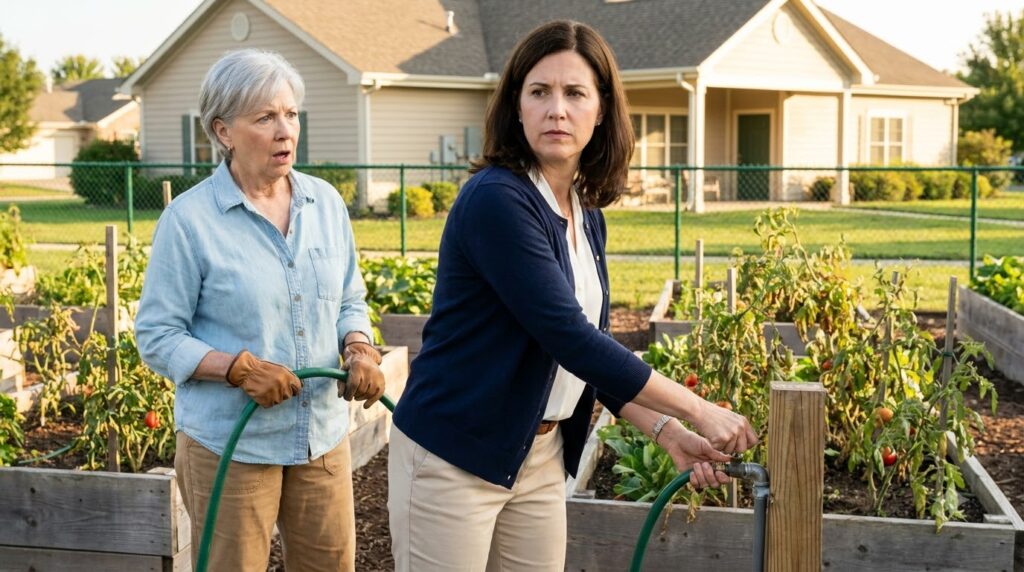
She turned and looked back at her garden. The raised beds were splintered, the dark, rich compost her husband had hauled thirty years ago sliding down into the yellow clay maw of the pit. The butterhead lettuce, the heirloom tomatoes, the years of quiet, honest work—all of it tilting toward the abyss.
Then she looked at Melissa, who had finally raised her head from the ditch. The younger woman’s eyes were bloodshot, her face streaked with tears and soot, waiting for Evelyn to decide whether they broke the law together or went down with the hill.
“A clean check from a dirty pocket,” Evelyn murmured, the weight of seventy-four years of labor settling hard against her spine.
She reached out her gloved hand toward the blue folder.








