
CHAPTER 2: BENEATH THE FOUNDATION SILL
The grease on Melissa’s skin had the heavy, petroleum-sharp tang of lithium thread-sealant—the blue-black stuff used on high-torque commercial pipe, not the Teflon tape a homeowner kept in a kitchen drawer.
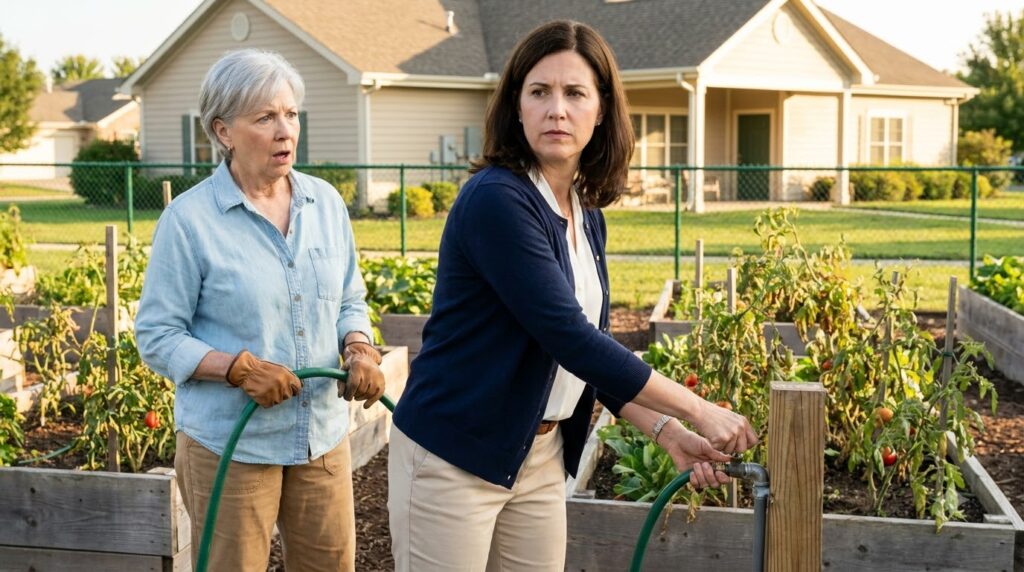
Evelyn didn’t reach for the woman. She didn’t have to. She simply took half a step sideways, letting the dead weight of the limp garden hose drop into the mulch. It hit with a flat, lifeless thud that sent a scatter of dry pine needles across the toes of Melissa’s spotless loafers.
“Step aside, Melissa.”
“I told you,” Melissa said, her voice dropping an octave into that practiced, flat tone reserved for dispute mediation. Her right hand remained plastered over the yellow vinyl tag against the siding, her fingers splayed so wide the knuckles showed white through the dampness. “The board will send out the formal notice. Touching HOA infrastructure outside an emergency is an immediate two-hundred-dollar fine. It’s in the covenant.”
“A fine needs three signatures,” Evelyn said evenly. “You’re only one. And your husband hasn’t been treasurer since the spring audit.”
Melissa’s jaw twitched. A small, involuntary tremor ran through the tendon along her throat, but she didn’t shift an inch. Her navy cardigan clung wetly to her shoulder blades, dark and cold under the falling late-afternoon sun. “You think this is personal. It isn’t. It’s resource allocation. This parcel is zoned for secondary recreation, and with the summer drought index where it is—”
“The drought index was downgraded on Tuesday,” Evelyn cut in. Her boots crunched slowly against the packed limestone gravel as she turned her back on the woman. “And secondary parcels don’t carry yellow inspection tags from the county water district.”
She didn’t wait for Melissa to manufacture another clause. Evelyn walked past the raised beds, her gloved fingers trailing along the rough, weathered cedar boards. The butterhead lettuce was already listing toward the dry soil, its outer leaves limp and curling like parchment. To an outsider, it was forty square feet of domestic hobbyism. To Evelyn, whose late husband had hauled the topsoil in five-gallon buckets from the river bottom twenty-two years ago, every square yard was packed with labor that couldn’t be quantified on an annual budget spreadsheet.
Behind her, the sharp crunch of loafers on gravel started, hesitated, then stopped. Melissa wasn’t following; she was guarding the shutoff spigot like a sentry on a contested ditch. That told Evelyn everything she needed to know about where the real line ran.
The four-inch main didn’t terminate at the exterior spigot. It ran below the frost line, ducking under the concrete apron of the utility shed that leaned against the clubhouse’s southern firewall.
Evelyn rounded the corner of the shed where the shadow fell cold and long. Here, between the cedar lap siding and a dense hedge of overgrown privet, the earth stayed perpetually damp. The smell here wasn’t summer dirt; it was the rank, sour odor of stagnant moisture and decaying leaf litter, cut through with the faint, rotten-egg prickle of hydrogen sulfide.
She knelt. Her right knee made a dull crack that she felt in her teeth, but she ignored it, sinking down into the damp mulch until her canvas trousers took on the cold moisture of the ground.
The utility shed’s crawlspace hatch was a two-foot square of unpainted marine plywood, secured with a hasp and an old master lock that had oxidized into a crust of powdery green verdigris. But the padlock wasn’t hanging through the iron loop. It dangled uselessly from a rusted link of chain, the shackle open, coated in fresh streaks of mineral oil.
Evelyn pulled off her right gardening glove with her teeth, spitting out the dry taste of dirt. She reached out and pulled the hatch outward.
The hinges groaned on dry pins. Inside, the gloom was thick, smelling of rotting wood framing and wet mineral dust. She pulled the penlight from her breast pocket—an old aluminum brass-barreled torch with a scratched glass lens—and clicked it on with her thumb.
The narrow beam sliced through the cobwebs, illuminating the foundational concrete piers.
The incoming six-inch municipal feed was thick, black ductile iron, scabbed over with decades of condensation and rust. But where it met the meter block, something was deeply, violently wrong.
A brand-new, unpainted bronze saddle clamp had been bolted directly over the municipal line ahead of the impeller housing. From the saddle, a flexible braided stainless-steel bypass hose—an inch and a half thick, heavy enough for commercial refrigeration—curved downward, snaking like an iron serpent into a shallow trench hand-dug into the sub-floor dirt.
The trench wasn’t old. The red clay piled beside it was still damp, dark as clotted blood, bearing the distinct scoop marks of a narrow trenching shovel.
Evelyn leaned further in, her breath catching as the beam caught a glint of raw copper near the footing.
The building’s heavy eight-gauge electrical grounding wire—the common safety bond required by county code to keep utility surges from electrifying the copper plumbing lines—had been severed. The thick wire hadn’t broken under tension; it had been sliced clean through with heavy diagonal cutters. The sheared end had been kicked aside into the trench, its bright, untarnished copper strands now coated in that same blue-black lithium grease Melissa had been wearing on her wrist.
Beside the severed wire lay a single discarded slip of paper, half-buried under a clod of sulfurous red mud.
Evelyn reached into the crawlspace, her bare fingers brushing against the frigid surface of the bypass line. The braided steel vibrated—a low, rhythmic pulse that hummed right into the bones of her arm. Water was moving through it right now, fast and heavy, completely bypassing the meter dials that sat silent and unmoving above.
She snagged the paper by its dry corner and pulled it out into the dying daylight.
It wasn’t an HOA memo. It was a formal pink carbon copy from the County Public Works Department, marked with a stamped red header that made her vision narrow:
NOTICE OF UNMETERED DRAW & EMERGENCY BACKFLOW AUDIT.
Account: Common Elements / Well-Head Tie-In.
Penalty Accrued: $14,280.00.
Status: Second Notice — Meter Sealing Imminent.
At the bottom, in the inspector’s scrawl, a handwritten note had been circled twice in faded blue ballpoint:
Sub-line feed showing negative pressure. Suspected cross-contamination or illicit back-siphonage into community loop. Shut off immediately or face structural quarantine.
A shadow crossed the gravel behind her.
“You really shouldn’t be poking your nose under the sill, Evelyn,” Melissa said.
Evelyn didn’t scramble to her feet. She stayed on one knee, folding the pink slip precisely along its original creases before slipping it into the chest pocket of her gardening shirt, buttoning the flap securely. When she finally rose, turning slowly to face the opening between the shed and the privet, she held the penlight pointed straight at the ground, its beam catching the bottom of Melissa’s slacks.
Melissa wasn’t holding a clipboard anymore. In her right hand, dangling against the seam of her trousers, was a ten-inch steel basin wrench, its adjustable jaw coated in wet red clay.
“You’re not saving the reserve fund,” Evelyn said, her voice dropping flat into the narrow alley between the buildings. “You’re running an illegal bypass around the district meter to hide an overage fine.”
Melissa didn’t deny it. She stepped forward, blocking the narrow gap between the shed wall and the hedge, her face half-lost in the gathering twilight.
“If that audit goes through,” Melissa said, her voice dropping into a tight, venomous whisper, “the county doesn’t just fine the board. They declare the whole water system compromised and shut the mains to every house on this lane. You think your retirement check can cover a special assessment for thirty thousand dollars to replace five hundred yards of line?”
She took another step, lifting the heavy wrench just enough that the steel jaw clinked against the copper zipper of her pocket.
“Give me the slip, Evelyn.”








