
CHAPTER 1: THE GRIT IN THE THREADS
The pressurized brass spat first.
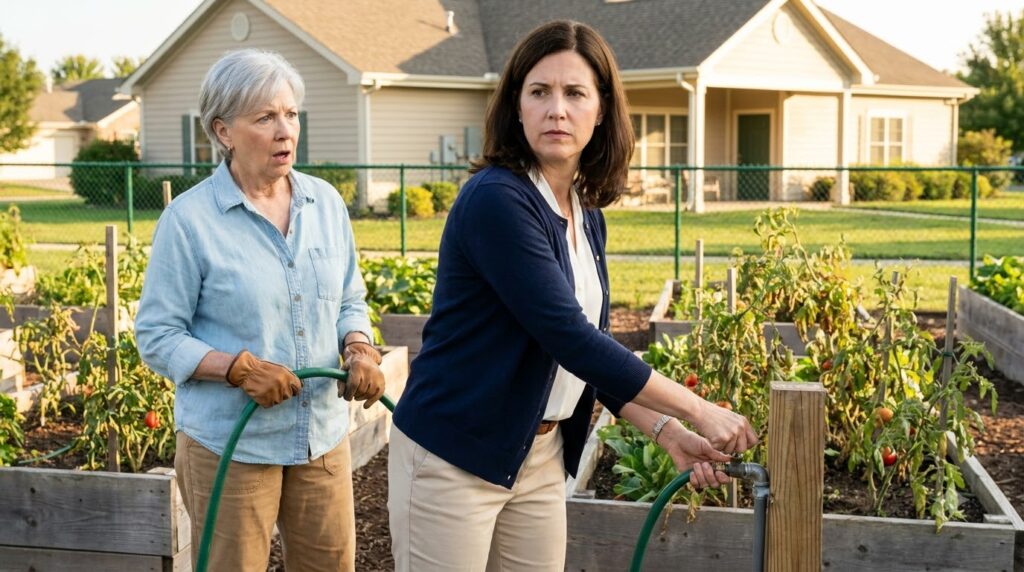
It was not a hiss; it was a percussive slap of stagnant, rust-tinted water that caught Melissa Grant square across the bridge of her nose. The impact snapped her chin back. Dark droplets broke against the pressed collar of her navy cardigan, immediately darkening the knit to the color of wet slate.
Evelyn Harper did not flinch. Her boot heels remained sunk two inches into the mulch bed beside the row of heat-starved butterhead lettuce. In her gloved right hand, the green rubber garden hose gave a single shudder, died, and flattened like an empty vein.
“The garden water is shut off,” Melissa said. She didn’t wipe her cheek immediately; she let the insult sit on her skin while her left hand stayed clamped over the gate wheel, fingers whitening against the scored iron. “Take your plants home, Evelyn.”
“Who told you you could shut this off?” Evelyn’s voice had no treble in it. It was the dry sound of a spade meeting shale. She stepped forward, drawing the dead weight of the hose with her, the coiled rubber scraping over the timber border of the raised bed.
Melissa moved with the sharp, defensive economy of someone who managed spreadsheets and boundary disputes. She slid her right loafer across the gravel apron, planting her hip directly between Evelyn’s chest and the brass riser coming out of the foundation. “I’m authorized to handle the common-element utilities. You know the bylaws. You signed them in ninety-four.”
“I signed for water,” Evelyn said. She stopped four inches short of Melissa’s shoulder. The air between them smelled of damp topsoil, heated siding, and the sharp, coppery tang of mineral-heavy well water that had spent too long inside galvanized iron. “And I planted those peppers three weeks before the board decided the reserve fund was short. Step off the box, Melissa.”
“This section is non-essential.” Melissa finally brought up a tissue from her pocket, dabbing at her hairline with jerky, calculated dabs. Her eyes stayed locked on the garden path, scanning for witnesses among the split-rail fences behind the clubhouse. “The line has an irregularity. If you keep running thirty gallons an hour on heirloom tomatoes, the whole tier gets assessed for an overage.”
“Then show me the board notice.”
“It’ll be in the mailer on Monday.”
“You don’t touch an active main on a Friday afternoon for a Monday mailer,” Evelyn said.
Her gaze dropped to the junction beneath Melissa’s hand. The spigot housing was coated in the crusty white salt of hard lime, but the hexagonal nut directly behind the gate valve was clean. The zinc plating was still bright, bearing fresh, jagged bite marks from an unpadded pipe wrench. And beneath Melissa’s manicured palm, wedged between the cold iron pipe and the siding, a yellow vinyl inspection tag stuck out, its perforated edge ragged where an official seal had been ripped away.
Evelyn pointed one dirt-caked glove straight at the yellow corner. “That label wasn’t there before.”
Melissa’s reaction was instantaneous. Her palm flattened over the vinyl, pressing it hard against the cedar planking, smothering the paper beneath her fingers. “It’s standard preventative maintenance.”
“Then why are you hiding it?”
Melissa didn’t blink. A drop of muddy runoff gathered at the lobe of her ear, hanging heavy before falling onto her shoulder. Her breath came slightly shorter through her nostrils, but her jaw set into that familiar, unyielding granite common to people who believed rules were the only things separating a neighborhood from the woods.
She said nothing. But as she pressed her hand tighter against the wood, her sleeve rode up, revealing the silver band of her wristwatch and the dark, wet grease smeared across the inside of her wrist—grease that hadn’t come from a garden hose, but from the industrial threading of a high-pressure bypass.








