Chapter 7: What the Planter Had Really Revealed
Three months later, the neighborhood looked almost exactly as it had before.
The lawns were green.
The mailboxes were crowded every morning.
The clubhouse hosted its regular gatherings.
Children rode bicycles along the streets.
Neighbors complained about parking.
Someone still left trash cans out too long.
Life had returned to normal.
But one thing had changed permanently.
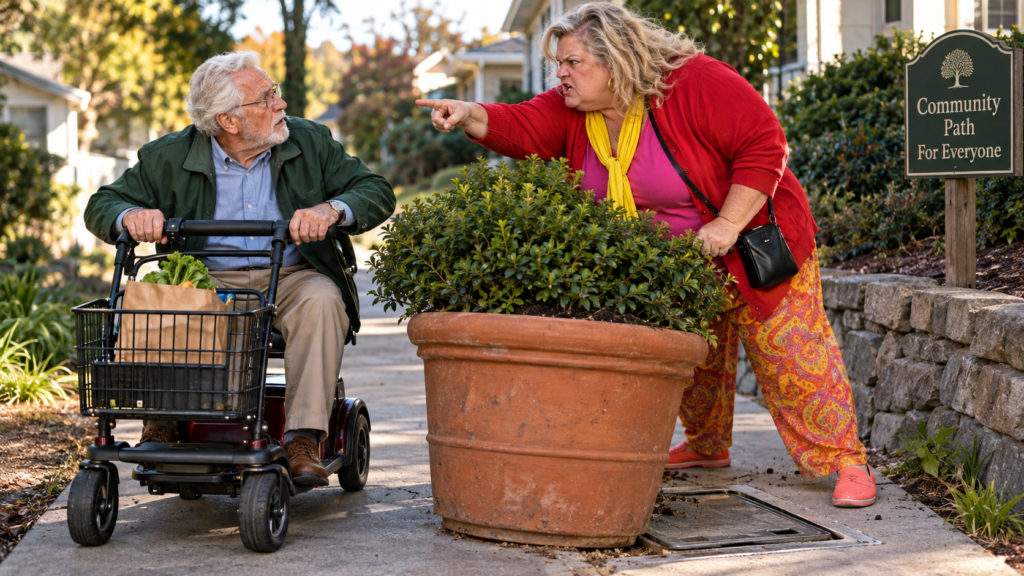
The path stayed clear.
Nobody treated it as decoration anymore.
The metal access hatch was inspected regularly.
The drainage system had been repaired.
Karen’s retaining structure had been reinforced.
And the community had avoided what could have become a much more expensive problem.
Frank still used his mobility cart every afternoon.
Sometimes he stopped at the bench beside the path.
Sometimes he continued toward the trail.
Sometimes Karen joined him.
They never became close friends.
Frank wasn’t sure they needed to.
Respect did not require friendship.
It required boundaries.
And Karen had finally learned that.
One afternoon, Frank found an envelope tucked beneath the windshield of his cart.
Inside was a photograph.
It showed the path from years earlier, before the planter had ever existed.
Written on the back were six words:
“I should have left it alone.”
Frank smiled.
Then he noticed something else.
The old photograph had been enlarged.
In the background, barely visible beside the original hatch, stood a small sign.
Frank looked at it carefully.
It wasn’t the community access sign.
It was an old construction marker.
He recognized the name of the original contractor.
That discovery led to one final piece of the story.
The contractor had installed the original drainage system incorrectly.
The modifications made by later homeowners had made the problem worse, but they had not created it.
Karen had spent more than a decade believing she was responsible for a failure she had inherited.
Her fear had grown around that misunderstanding.
It had made her controlling.
Suspicious.
Defensive.
And eventually cruel.
None of that made her treatment of Frank acceptable.
But the truth gave the neighborhood something more useful than blame.
It gave them a problem they could actually solve.
The HOA contacted the original developer’s successor.
The community eventually recovered part of the repair costs.
Karen was not forced to sell her home.
Frank kept his access.
And the path remained open.
Months later, the neighborhood held its annual summer picnic.
Frank sat beneath a shade tree with Susan.
Across the lawn, Karen was helping an elderly neighbor carry a folding chair.
Susan watched her.
“Never thought I’d see that.”
Frank smiled.
“People can surprise you.”
Susan looked at the path.
“Are you still angry with her?”
Frank considered the question.
“I was angry.”
“And now?”
Frank watched Karen carefully place the chair where it wouldn’t obstruct anyone.
“Now I think she learned something.”
Susan nodded.
Frank leaned back.
“So did I.”
“What?”
He looked toward the clear path.
“That sometimes the smallest obstruction tells you the biggest story.”
The planter had been small compared with everything it had revealed.
It had exposed a drainage problem.
An old mistake.
A buried dispute.
A frightened homeowner.
And a neighborhood that had forgotten something simple.
A shared space only works when everyone understands that it belongs to everyone.
Frank started his cart.
He rolled toward the path.
Karen saw him coming.
She stepped aside immediately.
“After you,” she said.
Frank smiled.
“Thank you.”
And this time, there was nothing between them.
No planter.
No locked hatch.
No accusation.
Just an open path.
And enough room for everyone.