Chapter 2: The Thing Beneath the Pavement
Frank did not confront Karen again that afternoon.
He knew better.
He had been married to Elaine for forty-seven years, and Elaine had taught him something important about difficult people: sometimes the smartest response was to stop talking and start paying attention.
So Frank turned his cart around and took the longer route home.
It added nearly fifteen minutes.
By the time he reached his driveway, his legs were tired and his patience was thinner than usual.
His daughter, Susan, was waiting on the porch.
She had come by to bring him groceries.
One look at his face told her something had happened.
“What did Karen do?”
Frank gave her a tired smile.
“Why does everyone assume it was Karen?”
“Because it usually is.”
He told her what happened.
He left out the insult at first.
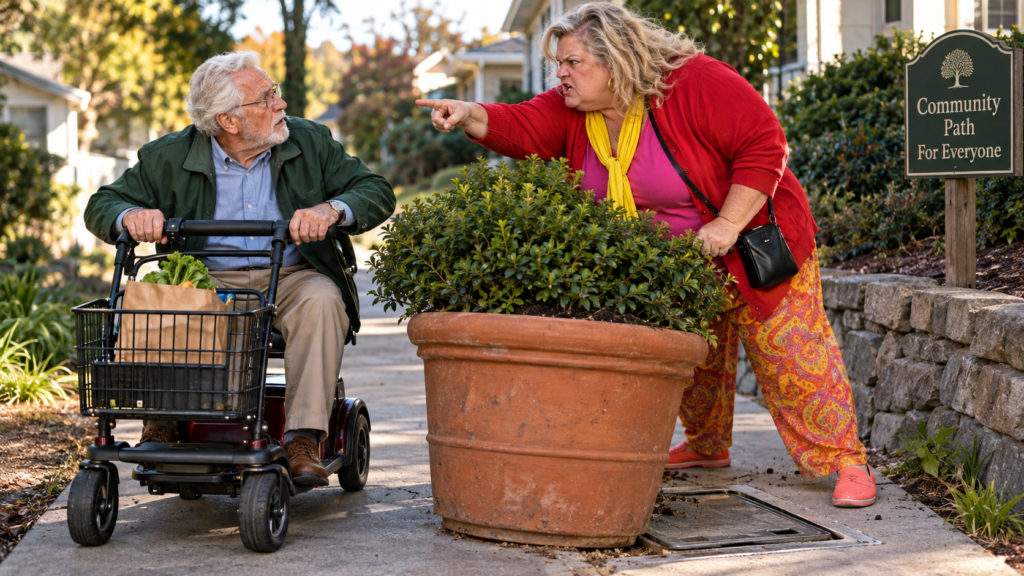
He described the planter, the blocked path, and the metal hatch.
Susan listened without interrupting.
When he finished, she frowned.
“Did you see what was under it?”
“No.”
“Did you take a picture?”
Frank shook his head.
Susan sighed.
“Dad.”
“I know.”
He looked toward the street.
“I’ll go back tomorrow.”
“You shouldn’t have to.”
“No,” Frank said. “I shouldn’t.”
That evening, Frank searched through a box of old neighborhood documents Elaine had kept.
The community had been built nearly thirty years earlier. Frank had served on the original neighborhood committee before he retired. He remembered the walking paths being connected to underground irrigation lines and stormwater drains.
But he couldn’t remember a metal access hatch in that particular location.
Then he found an old site map.
He spread it across the kitchen table.
Susan leaned over his shoulder.
The path was marked.
So were several utility points.
One was located almost exactly where Karen had placed the planter.
Frank tapped the paper.
“That wasn’t supposed to be covered permanently.”
Susan looked at him.
“Covered with what?”
“Nothing, according to this.”
The next morning, Frank returned to the path.
The planter was back in its original position.
Karen was nowhere around.
Frank stopped his cart several yards away.
He didn’t touch the planter.
Instead, he looked carefully.
There were fresh scrape marks in the pavement.
The planter had been moved.
And beneath its edge, he could see the metal outline of the hatch.
He took photographs.
Then another detail caught his attention.
A small brass padlock had been attached to the hatch.
Frank frowned.
Utility access hatches in the neighborhood were not supposed to be privately locked.
He called the HOA office.
The receptionist promised someone would look into it.
Frank expected a routine answer.
Instead, the property manager, Linda Harris, called him back twenty minutes later.
“Frank, where exactly did you say this was?”
He gave her the location.
There was a long silence.
Then Linda asked, “Are you certain Karen moved the planter?”
“Yes.”
“Did you see her lock the hatch?”
“No.”
Another pause.
“Don’t touch anything,” Linda said.
Frank looked at the planter.
“I wasn’t planning to.”
Linda lowered her voice.
“There was an old access dispute in that section years ago. I’ll have to check the records.”
That sentence stayed with Frank.
An old access dispute.
Years ago.
Frank looked down at the metal hatch.
For the first time, he wondered whether Karen’s argument with him had never really been about his mobility cart.
Maybe the cart had simply been the reason she thought she could control who noticed the hatch.