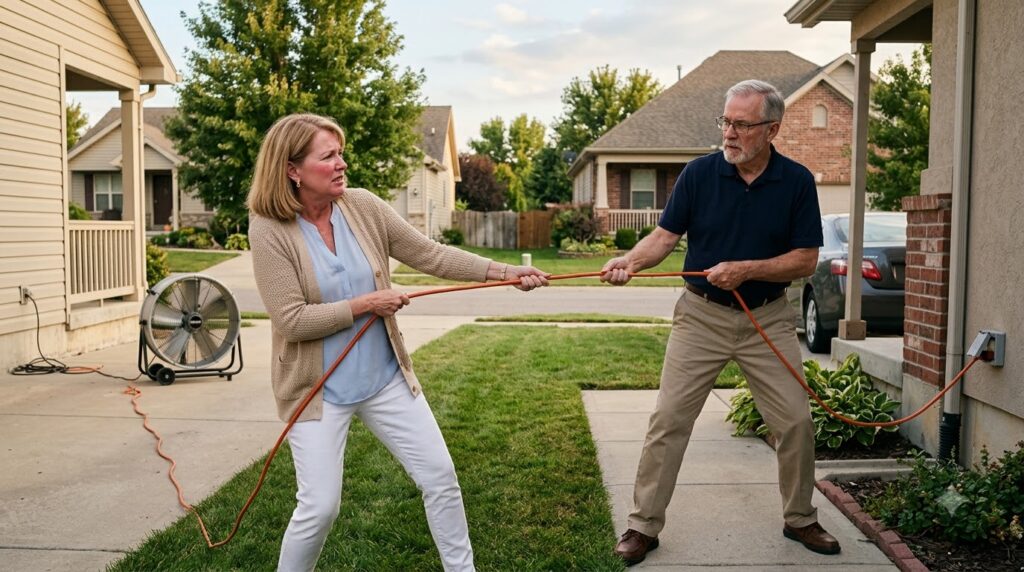
Chapter 3: What Was Behind the Fence
The next morning, Daniel’s daughter Rachel arrived.
She was forty-four and lived about thirty minutes away.
She had inherited her mother’s cautious nature and her father’s stubborn refusal to back down when something felt wrong.
They walked the property together.
Rachel examined the area where the cable had crossed the boundary.
“Did you confront her?”
“I asked her what she was doing.”
“And?”
“She told me to check my bill.”
Rachel looked at him.
“That’s not an answer.”
“No.”
They agreed not to confront Karen again.
Instead, Daniel contacted Mr. Collins, the property manager.
Mr. Collins was reluctant at first.
Neighbor disputes were common.
But when Daniel showed him the photograph, the manager’s attitude changed.
“This isn’t a lawn ornament dispute,” he said.
“No.”
“It’s electricity.”
Mr. Collins contacted the utility company and requested documentation.
Meanwhile, Karen became unusually friendly.
She waved whenever Daniel walked outside.
She smiled.
She even brought over a plate of cookies.
Daniel didn’t accept them.
Karen stood at the edge of his driveway holding the plate.
“You know, Daniel, I think you’ve misunderstood what happened.”
Daniel waited.
“I borrowed a little power.”
“A little?”
“It was temporary.”
“For what?”
Karen’s smile disappeared.
“You don’t need to know everything that happens on my property.”
Daniel nodded slowly.
“You’re right.”
For a moment, Karen looked relieved.
Then he added, “But you don’t get to use mine without permission.”
Her face tightened.
She left without another word.
That evening, Rachel noticed something through the gap between two fence boards.
There was a large industrial-style cooling unit in Karen’s backyard.
Next to it stood several tall insulated containers.
The setup looked nothing like an ordinary backyard project.
Rachel took a photograph from Daniel’s property.
She didn’t enter Karen’s yard.
The next day, they showed it to Mr. Collins.
He recognized the equipment.
Karen had apparently been operating a small home-based food preparation business.
That alone wasn’t necessarily forbidden.
The problem was that the neighborhood rules required certain commercial activities to be disclosed.
And there was something else.
The utility technician returned.
He reviewed Daniel’s meter data more closely.
The pattern showed unusual nighttime consumption.
Rachel frowned.
“Karen’s machine runs at night.”
Mike nodded.
“That’s consistent with what you’re seeing.”
Daniel looked toward the neighboring house.
Then Mike said something that changed the entire situation.
“There may be another issue.”
“What?”
“The cable you photographed isn’t the biggest concern.”
Daniel stared at him.
Mike pointed toward the boundary.
“The cable was connected to an ordinary outdoor receptacle. If she was drawing enough power to run those machines regularly, that could explain the increase.”
Daniel felt a chill.
“Could it be dangerous?”
“Any unauthorized electrical setup can become dangerous.”
For the first time, Daniel wasn’t angry.
He was afraid.
Not just for himself.
For everyone living on the street.